

3.3 Group 10/Group 4–5 Heterobimetallic Complexes
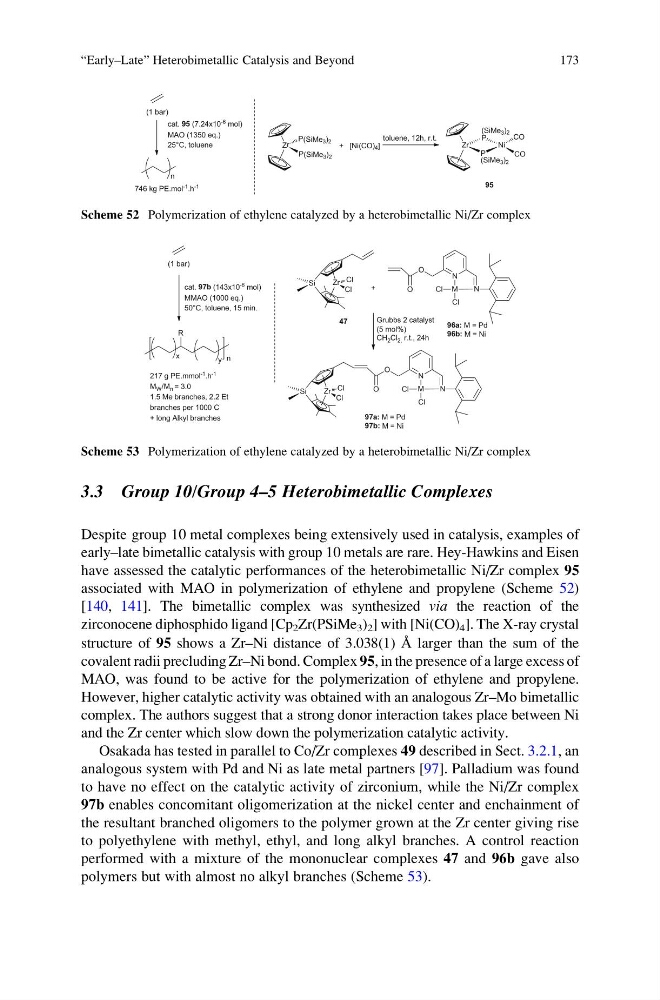
Despite group 10 metal complexes being extensively used in catalysis, examples of
early–late bimetallic catalysis with group 10 metals are rare. Hey-Hawkins and Eisen
have assessed the catalytic performances of the heterobimetallic Ni/Zr complex 95
associated with MAO in polymerization of ethylene and propylene (Scheme 52)
[140, 141]. The bimetallic complex was synthesized via the reaction of the
zirconocene diphosphido ligand [Cp 2 Zr(PSiMe 3 ) 2 ] with [Ni(CO) 4 ]. The X-ray crystal
structure of 95 shows a Zr–Ni distance of 3.038(1) Å larger than the sum of the
covalent radii precluding Zr–Ni bond. Complex 95, in the presence of a large excess of
MAO, was found to be active for the polymerization of ethylene and propylene.
However, higher catalytic activity was obtained with an analogous Zr–Mo bimetallic
complex. The authors suggest that a strong donor interaction takes place between Ni
and the Zr center which slow down the polymerization catalytic activity.
Osakada has tested in parallel to Co/Zr complexes 49 described in Sect. 3.2.1, an
analogous system with Pd and Ni as late metal partners [97]. Palladium was found
to have no effect on the catalytic activity of zirconium, while the Ni/Zr complex
97b enables concomitant oligomerization at the nickel center and enchainment of
the resultant branched oligomers to the polymer grown at the Zr center giving rise
to polyethylene with methyl, ethyl, and long alkyl branches. A control reaction
performed with a mixture of the mononuclear complexes 47 and 96b gave also
polymers but with almost no alkyl branches (Scheme 53).
x
cat. 97b (143x10 -6 mol)
MMAO (1000 eq.)
50°C, toluene, 15 min.
(1 bar)
217 g PE.mmol -1 .h -1
M W /M n = 3.0
1.5 Me branches, 2.2 Et
branches per 1000 C
+ long Alkyl branches
R
y n
Zr Cl
Cl
Si
O
O
N
N
M
Cl
Cl
Zr Cl
Cl
Si
96a: M = Pd
96b: M = Ni
O
O
N
N
M
Cl
Cl
+
Grubbs 2 catalyst
(5 mol%)
CH 2 Cl 2, r.t., 24h
47
97a: M = Pd
97b: M = Ni
Scheme 53 Polymerization of ethylene catalyzed by a heterobimetallic Ni/Zr complex
n
cat. 95 (7.24x10 -6 mol)
MAO (1350 eq.)
25°C, toluene
Zr
P(SiMe 3 ) 2
95
(1 bar)
746 kg PE.mol -1 .h -1
P(SiMe 3 ) 2 + [Ni(CO)4]
Zr
P
(SiMe 3 )2
(SiMe 3 )2
P
Ni
CO
CO
toluene, 12h, r.t.
Scheme 52 Polymerization of ethylene catalyzed by a heterobimetallic Ni/Zr complex
“Early–Late” Heterobimetallic Catalysis and Beyond
173
Despite group 10 metal complexes being extensively used in catalysis, examples of
early–late bimetallic catalysis with group 10 metals are rare. Hey-Hawkins and Eisen
have assessed the catalytic performances of the heterobimetallic Ni/Zr complex 95
associated with MAO in polymerization of ethylene and propylene (Scheme 52)
[140, 141]. The bimetallic complex was synthesized via the reaction of the
zirconocene diphosphido ligand [Cp 2 Zr(PSiMe 3 ) 2 ] with [Ni(CO) 4 ]. The X-ray crystal
structure of 95 shows a Zr–Ni distance of 3.038(1) Å larger than the sum of the
covalent radii precluding Zr–Ni bond. Complex 95, in the presence of a large excess of
MAO, was found to be active for the polymerization of ethylene and propylene.
However, higher catalytic activity was obtained with an analogous Zr–Mo bimetallic
complex. The authors suggest that a strong donor interaction takes place between Ni
and the Zr center which slow down the polymerization catalytic activity.
Osakada has tested in parallel to Co/Zr complexes 49 described in Sect. 3.2.1, an
analogous system with Pd and Ni as late metal partners [97]. Palladium was found
to have no effect on the catalytic activity of zirconium, while the Ni/Zr complex
97b enables concomitant oligomerization at the nickel center and enchainment of
the resultant branched oligomers to the polymer grown at the Zr center giving rise
to polyethylene with methyl, ethyl, and long alkyl branches. A control reaction
performed with a mixture of the mononuclear complexes 47 and 96b gave also
polymers but with almost no alkyl branches (Scheme 53).
x
cat. 97b (143x10 -6 mol)
MMAO (1000 eq.)
50°C, toluene, 15 min.
(1 bar)
217 g PE.mmol -1 .h -1
M W /M n = 3.0
1.5 Me branches, 2.2 Et
branches per 1000 C
+ long Alkyl branches
R
y n
Zr Cl
Cl
Si
O
O
N
N
M
Cl
Cl
Zr Cl
Cl
Si
96a: M = Pd
96b: M = Ni
O
O
N
N
M
Cl
Cl
+
Grubbs 2 catalyst
(5 mol%)
CH 2 Cl 2, r.t., 24h
47
97a: M = Pd
97b: M = Ni
Scheme 53 Polymerization of ethylene catalyzed by a heterobimetallic Ni/Zr complex
n
cat. 95 (7.24x10 -6 mol)
MAO (1350 eq.)
25°C, toluene
Zr
P(SiMe 3 ) 2
95
(1 bar)
746 kg PE.mol -1 .h -1
P(SiMe 3 ) 2 + [Ni(CO)4]
Zr
P
(SiMe 3 )2
(SiMe 3 )2
P
Ni
CO
CO
toluene, 12h, r.t.
Scheme 52 Polymerization of ethylene catalyzed by a heterobimetallic Ni/Zr complex
“Early–Late” Heterobimetallic Catalysis and Beyond
173