

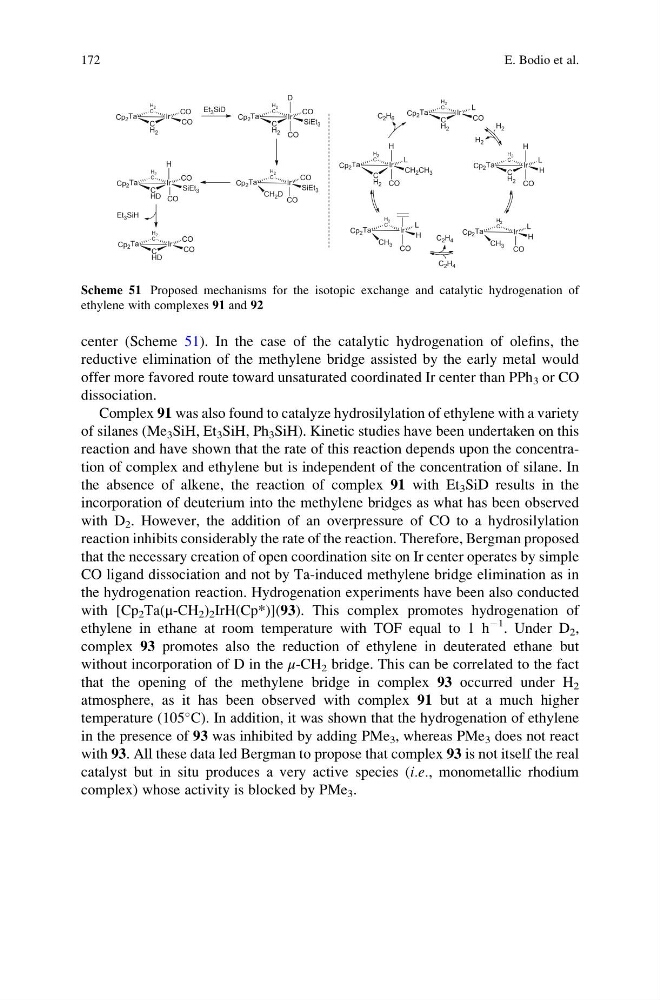
center (Scheme 51). In the case of the catalytic hydrogenation of olefins, the
reductive elimination of the methylene bridge assisted by the early metal would
offer more favored route toward unsaturated coordinated Ir center than PPh 3 or CO
dissociation.
Complex 91 was also found to catalyze hydrosilylation of ethylene with a variety
of silanes (Me 3 SiH, Et 3 SiH, Ph 3 SiH). Kinetic studies have been undertaken on this
reaction and have shown that the rate of this reaction depends upon the concentration of complex and ethylene but is independent of the concentration of silane. In
the absence of alkene, the reaction of complex 91 with Et 3 SiD results in the
incorporation of deuterium into the methylene bridges as what has been observed
with D 2 . However, the addition of an overpressure of CO to a hydrosilylation
reaction inhibits considerably the rate of the reaction. Therefore, Bergman proposed
that the necessary creation of open coordination site on Ir center operates by simple
CO ligand dissociation and not by Ta-induced methylene bridge elimination as in
the hydrogenation reaction. Hydrogenation experiments have been also conducted
with [Cp 2 Ta(μ-CH 2 ) 2 IrH(Cp*)](93). This complex promotes hydrogenation of
ethylene in ethane at room temperature with TOF equal to 1 h
À1 . Under D 2 ,
complex 93 promotes also the reduction of ethylene in deuterated ethane but
without incorporation of D in the μ-CH 2 bridge. This can be correlated to the fact
that the opening of the methylene bridge in complex 93 occurred under H 2
atmosphere, as it has been observed with complex 91 but at a much higher
temperature (105
C). In addition, it was shown that the hydrogenation of ethylene
in the presence of 93 was inhibited by adding PMe 3 , whereas PMe 3 does not react
with 93. All these data led Bergman to propose that complex 93 is not itself the real
catalyst but in situ produces a very active species (i.e., monometallic rhodium
complex) whose activity is blocked by PMe 3 .
Cp2Ta
C
H 2
Ir
H2
C
CO
CO
Cp2Ta
C
H 2
Ir
H2
C
SiEt 3
CO
D
CO
Cp2Ta
CH 2 D
Ir
H2
C
SiEt 3
CO
CO
Cp2Ta
C
HD
Ir
H2
C
SiEt 3
CO
H
CO
Et 3 SiD
Et 3 SiH
Cp2Ta
C
HD
Ir
H2
C
CO
CO
Cp2Ta
C
H 2
Ir
H2
C
CO
L
Cp2Ta
C
H 2
Ir
H2
C
H
L
H
CO
Cp2Ta
CH 3
Ir
H2
C
H
L
CO
Cp 2 Ta
CH 3
Ir
H2
C
H
L
CO
Cp2Ta
C
H 2
Ir
H2
C
CH 2 CH 3
L
H
CO
H 2
H 2
C 2 H 4
C 2 H 4
C 2 H 6
Scheme 51 Proposed mechanisms for the isotopic exchange and catalytic hydrogenation of
ethylene with complexes 91 and 92
172
E. Bodio et al.
reductive elimination of the methylene bridge assisted by the early metal would
offer more favored route toward unsaturated coordinated Ir center than PPh 3 or CO
dissociation.
Complex 91 was also found to catalyze hydrosilylation of ethylene with a variety
of silanes (Me 3 SiH, Et 3 SiH, Ph 3 SiH). Kinetic studies have been undertaken on this
reaction and have shown that the rate of this reaction depends upon the concentration of complex and ethylene but is independent of the concentration of silane. In
the absence of alkene, the reaction of complex 91 with Et 3 SiD results in the
incorporation of deuterium into the methylene bridges as what has been observed
with D 2 . However, the addition of an overpressure of CO to a hydrosilylation
reaction inhibits considerably the rate of the reaction. Therefore, Bergman proposed
that the necessary creation of open coordination site on Ir center operates by simple
CO ligand dissociation and not by Ta-induced methylene bridge elimination as in
the hydrogenation reaction. Hydrogenation experiments have been also conducted
with [Cp 2 Ta(μ-CH 2 ) 2 IrH(Cp*)](93). This complex promotes hydrogenation of
ethylene in ethane at room temperature with TOF equal to 1 h
À1 . Under D 2 ,
complex 93 promotes also the reduction of ethylene in deuterated ethane but
without incorporation of D in the μ-CH 2 bridge. This can be correlated to the fact
that the opening of the methylene bridge in complex 93 occurred under H 2
atmosphere, as it has been observed with complex 91 but at a much higher
temperature (105
C). In addition, it was shown that the hydrogenation of ethylene
in the presence of 93 was inhibited by adding PMe 3 , whereas PMe 3 does not react
with 93. All these data led Bergman to propose that complex 93 is not itself the real
catalyst but in situ produces a very active species (i.e., monometallic rhodium
complex) whose activity is blocked by PMe 3 .
Cp2Ta
C
H 2
Ir
H2
C
CO
CO
Cp2Ta
C
H 2
Ir
H2
C
SiEt 3
CO
D
CO
Cp2Ta
CH 2 D
Ir
H2
C
SiEt 3
CO
CO
Cp2Ta
C
HD
Ir
H2
C
SiEt 3
CO
H
CO
Et 3 SiD
Et 3 SiH
Cp2Ta
C
HD
Ir
H2
C
CO
CO
Cp2Ta
C
H 2
Ir
H2
C
CO
L
Cp2Ta
C
H 2
Ir
H2
C
H
L
H
CO
Cp2Ta
CH 3
Ir
H2
C
H
L
CO
Cp 2 Ta
CH 3
Ir
H2
C
H
L
CO
Cp2Ta
C
H 2
Ir
H2
C
CH 2 CH 3
L
H
CO
H 2
H 2
C 2 H 4
C 2 H 4
C 2 H 6
Scheme 51 Proposed mechanisms for the isotopic exchange and catalytic hydrogenation of
ethylene with complexes 91 and 92
172
E. Bodio et al.