

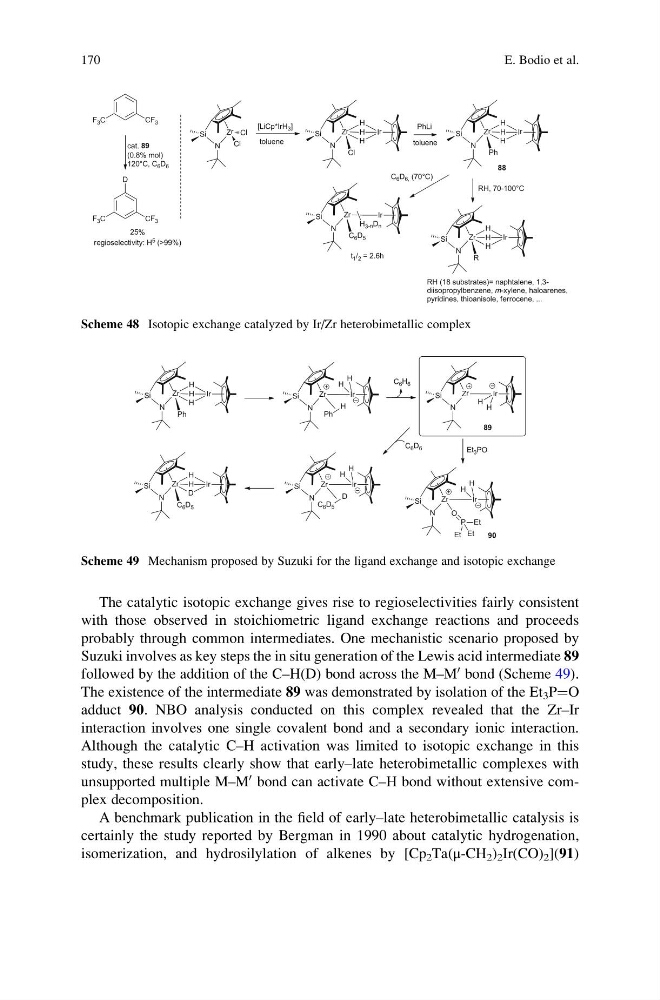
The catalytic isotopic exchange gives rise to regioselectivities fairly consistent
with those observed in stoichiometric ligand exchange reactions and proceeds
probably through common intermediates. One mechanistic scenario proposed by
Suzuki involves as key steps the in situ generation of the Lewis acid intermediate 89
followed by the addition of the C–H(D) bond across the M–M
0 bond (Scheme 49).
The existence of the intermediate 89 was demonstrated by isolation of the Et 3 P¼O
adduct 90. NBO analysis conducted on this complex revealed that the Zr–Ir
interaction involves one single covalent bond and a secondary ionic interaction.
Although the catalytic C–H activation was limited to isotopic exchange in this
study, these results clearly show that early–late heterobimetallic complexes with
unsupported multiple M–M
0 bond can activate C–H bond without extensive complex decomposition.
A benchmark publication in the field of early–late heterobimetallic catalysis is
certainly the study reported by Bergman in 1990 about catalytic hydrogenation,
isomerization, and hydrosilylation of alkenes by [Cp 2 Ta(μ-CH 2 ) 2 Ir(CO) 2 ](91)
cat. 89
(0.8% mol)
120°C, C 6 D 6
Zr
N
H
Ph
Si
H
H
Ir
C 6 D 6, (70°C)
Zr
N
C 6 D 5
Si
Ir
H 3-n Dn
Zr
N
H
Cl
Si
H
H
Ir
PhLi
Zr
N
Cl
Si
Cl
[LiCp*IrH 3 ]
toluene
toluene
F 3 C
CF 3
F 3 C
CF 3
D
88
25%
regioselectivity: H 5 (>99%)
t 1 / 2 = 2.6h
RH, 70-100°C
Zr
N
H
R
Si
H
H
Ir
RH (18 substrates)= naphtalene, 1,3diisopropylbenzene, m-xylene, haloarenes,
pyridines, thioanisole, ferrocene, ...
Scheme 48 Isotopic exchange catalyzed by Ir/Zr heterobimetallic complex
Zr
N
Si
Ir
H
H
Zr
N
H
C 6 D 5
Si
H
D
Ir
C 6 D 5
D
Zr
N
Si
Ir
H
H
Zr
N
Si
Ir
H
H
P
O
Et Et
Et
Ph
H
Zr
N
Si
Ir
H
H
Zr
N
H
Ph
Si
H
H
Ir
89
90
C 6 H 6
C 6 D 6
Et 3 PO
Scheme 49 Mechanism proposed by Suzuki for the ligand exchange and isotopic exchange
170
E. Bodio et al.
with those observed in stoichiometric ligand exchange reactions and proceeds
probably through common intermediates. One mechanistic scenario proposed by
Suzuki involves as key steps the in situ generation of the Lewis acid intermediate 89
followed by the addition of the C–H(D) bond across the M–M
0 bond (Scheme 49).
The existence of the intermediate 89 was demonstrated by isolation of the Et 3 P¼O
adduct 90. NBO analysis conducted on this complex revealed that the Zr–Ir
interaction involves one single covalent bond and a secondary ionic interaction.
Although the catalytic C–H activation was limited to isotopic exchange in this
study, these results clearly show that early–late heterobimetallic complexes with
unsupported multiple M–M
0 bond can activate C–H bond without extensive complex decomposition.
A benchmark publication in the field of early–late heterobimetallic catalysis is
certainly the study reported by Bergman in 1990 about catalytic hydrogenation,
isomerization, and hydrosilylation of alkenes by [Cp 2 Ta(μ-CH 2 ) 2 Ir(CO) 2 ](91)
cat. 89
(0.8% mol)
120°C, C 6 D 6
Zr
N
H
Ph
Si
H
H
Ir
C 6 D 6, (70°C)
Zr
N
C 6 D 5
Si
Ir
H 3-n Dn
Zr
N
H
Cl
Si
H
H
Ir
PhLi
Zr
N
Cl
Si
Cl
[LiCp*IrH 3 ]
toluene
toluene
F 3 C
CF 3
F 3 C
CF 3
D
88
25%
regioselectivity: H 5 (>99%)
t 1 / 2 = 2.6h
RH, 70-100°C
Zr
N
H
R
Si
H
H
Ir
RH (18 substrates)= naphtalene, 1,3diisopropylbenzene, m-xylene, haloarenes,
pyridines, thioanisole, ferrocene, ...
Scheme 48 Isotopic exchange catalyzed by Ir/Zr heterobimetallic complex
Zr
N
Si
Ir
H
H
Zr
N
H
C 6 D 5
Si
H
D
Ir
C 6 D 5
D
Zr
N
Si
Ir
H
H
Zr
N
Si
Ir
H
H
P
O
Et Et
Et
Ph
H
Zr
N
Si
Ir
H
H
Zr
N
H
Ph
Si
H
H
Ir
89
90
C 6 H 6
C 6 D 6
Et 3 PO
Scheme 49 Mechanism proposed by Suzuki for the ligand exchange and isotopic exchange
170
E. Bodio et al.