

ylide rhodium complexes 83. Therefore, the role of the early metal in these
complexes seems rather limited. However, a particularity of both Ir/Ta and Zr/Ta
complexes versus the parent monometallic phosphorus-ylide derivatives is that they
can incorporate D 2 into the bridging methylene positions. This reaction plays a
crucial role in Ir/Ta series for the catalytic hydrogenation takes place by opening
coordination sites on the Ir center but seems in Rh series less energetically favorable than PPh 3 or CO dissociation (vide infra).
Much later, Nikonov has become interested in catalytic hydrosilylation of
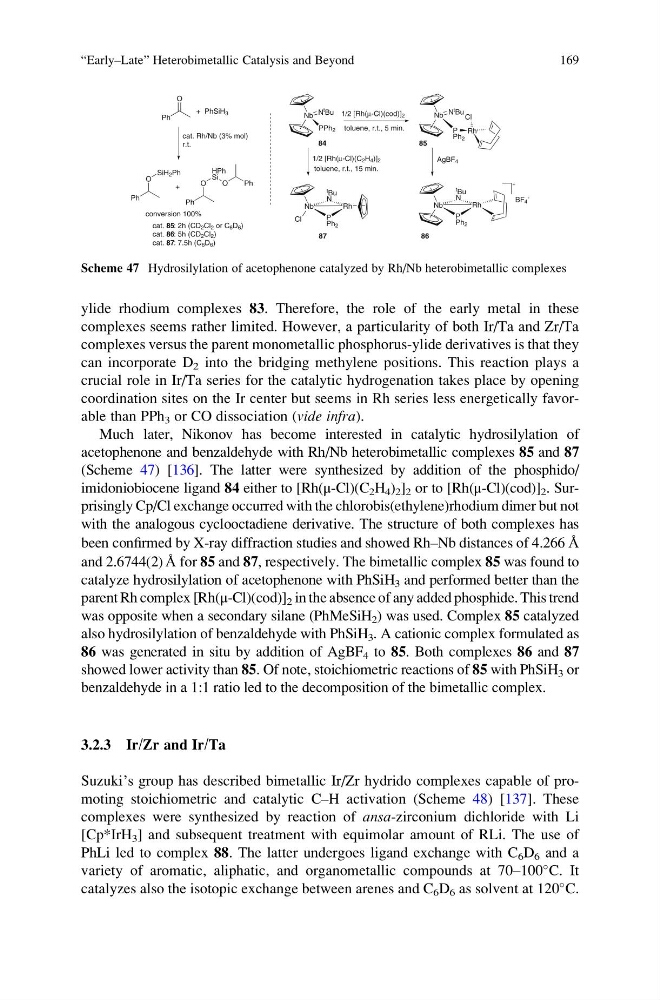
acetophenone and benzaldehyde with Rh/Nb heterobimetallic complexes 85 and 87
(Scheme 47) [136]. The latter were synthesized by addition of the phosphido/
imidoniobiocene ligand 84 either to [Rh(μ-Cl)(C 2 H 4 ) 2 ] 2 or to [Rh(μ-Cl)(cod)] 2 . Surprisingly Cp/Cl exchange occurred with the chlorobis(ethylene)rhodium dimer but not
with the analogous cyclooctadiene derivative. The structure of both complexes has
been confirmed by X-ray diffraction studies and showed Rh–Nb distances of 4.266 Å
and 2.6744(2) Å for 85 and 87, respectively. The bimetallic complex 85 was found to
catalyze hydrosilylation of acetophenone with PhSiH 3 and performed better than the
parent Rh complex [Rh(μ-Cl)(cod)] 2 in the absence of any added phosphide. This trend
was opposite when a secondary silane (PhMeSiH 2 ) was used. Complex 85 catalyzed
also hydrosilylation of benzaldehyde with PhSiH 3 . A cationic complex formulated as
86 was generated in situ by addition of AgBF 4 to 85. Both complexes 86 and 87
showed lower activity than 85. Of note, stoichiometric reactions of 85 with PhSiH 3 or
benzaldehyde in a 1:1 ratio led to the decomposition of the bimetallic complex.
3.2.3 Ir/Zr and Ir/Ta
Suzuki’s group has described bimetallic Ir/Zr hydrido complexes capable of promoting stoichiometric and catalytic C–H activation (Scheme 48) [137]. These
complexes were synthesized by reaction of ansa-zirconium dichloride with Li
[Cp*IrH 3 ] and subsequent treatment with equimolar amount of RLi. The use of
PhLi led to complex 88. The latter undergoes ligand exchange with C 6 D 6 and a
variety of aromatic, aliphatic, and organometallic compounds at 70–100
C. It
catalyzes also the isotopic exchange between arenes and C 6 D 6 as solvent at 120
C.
Nb N t Bu
PPh2
Nb N t Bu
P
Ph2
1/2 [Rh(µ-Cl)(cod)]2
toluene, r.t., 5 min.
Rh
Cl
Nb
t Bu
N
P
Ph2
Rh
BF4 -
AgBF4
1/2 [Rh(µ-Cl)(C2H4)]2
toluene, r.t., 15 min.
Nb
Cl
t Bu
N
P
Ph2
Rh
84
85
86
87
Ph
O
cat. Rh/Nb (3% mol)
r.t.
+ PhSiH3
Ph
O
SiH2Ph
+
Ph
O
HPh
Si
O
Ph
conversion 100%
cat. 85: 2h (CD2Cl2 or C6D6)
cat. 86: 5h (CD2Cl2)
cat. 87: 7.5h (C6D6)
Scheme 47 Hydrosilylation of acetophenone catalyzed by Rh/Nb heterobimetallic complexes
“Early–Late” Heterobimetallic Catalysis and Beyond
169
complexes seems rather limited. However, a particularity of both Ir/Ta and Zr/Ta
complexes versus the parent monometallic phosphorus-ylide derivatives is that they
can incorporate D 2 into the bridging methylene positions. This reaction plays a
crucial role in Ir/Ta series for the catalytic hydrogenation takes place by opening
coordination sites on the Ir center but seems in Rh series less energetically favorable than PPh 3 or CO dissociation (vide infra).
Much later, Nikonov has become interested in catalytic hydrosilylation of
acetophenone and benzaldehyde with Rh/Nb heterobimetallic complexes 85 and 87
(Scheme 47) [136]. The latter were synthesized by addition of the phosphido/
imidoniobiocene ligand 84 either to [Rh(μ-Cl)(C 2 H 4 ) 2 ] 2 or to [Rh(μ-Cl)(cod)] 2 . Surprisingly Cp/Cl exchange occurred with the chlorobis(ethylene)rhodium dimer but not
with the analogous cyclooctadiene derivative. The structure of both complexes has
been confirmed by X-ray diffraction studies and showed Rh–Nb distances of 4.266 Å
and 2.6744(2) Å for 85 and 87, respectively. The bimetallic complex 85 was found to
catalyze hydrosilylation of acetophenone with PhSiH 3 and performed better than the
parent Rh complex [Rh(μ-Cl)(cod)] 2 in the absence of any added phosphide. This trend
was opposite when a secondary silane (PhMeSiH 2 ) was used. Complex 85 catalyzed
also hydrosilylation of benzaldehyde with PhSiH 3 . A cationic complex formulated as
86 was generated in situ by addition of AgBF 4 to 85. Both complexes 86 and 87
showed lower activity than 85. Of note, stoichiometric reactions of 85 with PhSiH 3 or
benzaldehyde in a 1:1 ratio led to the decomposition of the bimetallic complex.
3.2.3 Ir/Zr and Ir/Ta
Suzuki’s group has described bimetallic Ir/Zr hydrido complexes capable of promoting stoichiometric and catalytic C–H activation (Scheme 48) [137]. These
complexes were synthesized by reaction of ansa-zirconium dichloride with Li
[Cp*IrH 3 ] and subsequent treatment with equimolar amount of RLi. The use of
PhLi led to complex 88. The latter undergoes ligand exchange with C 6 D 6 and a
variety of aromatic, aliphatic, and organometallic compounds at 70–100
C. It
catalyzes also the isotopic exchange between arenes and C 6 D 6 as solvent at 120
C.
Nb N t Bu
PPh2
Nb N t Bu
P
Ph2
1/2 [Rh(µ-Cl)(cod)]2
toluene, r.t., 5 min.
Rh
Cl
Nb
t Bu
N
P
Ph2
Rh
BF4 -
AgBF4
1/2 [Rh(µ-Cl)(C2H4)]2
toluene, r.t., 15 min.
Nb
Cl
t Bu
N
P
Ph2
Rh
84
85
86
87
Ph
O
cat. Rh/Nb (3% mol)
r.t.
+ PhSiH3
Ph
O
SiH2Ph
+
Ph
O
HPh
Si
O
Ph
conversion 100%
cat. 85: 2h (CD2Cl2 or C6D6)
cat. 86: 5h (CD2Cl2)
cat. 87: 7.5h (C6D6)
Scheme 47 Hydrosilylation of acetophenone catalyzed by Rh/Nb heterobimetallic complexes
“Early–Late” Heterobimetallic Catalysis and Beyond
169