

ligand can allow the subtle electronic effects of the late transition metal on the Zr
catalytic activity to be highlighted.
In 2005, inspired by the pioneering works of Wolczanski [126], Morgan and
Kundu reported the synthesis of the Rh/Ti heterobimetallic complex 73 in two steps
via the addition of [Ti(O
i
Pr) 4 ] to three equivalents of HOCMe 2 CH 2 PPh 2 and the
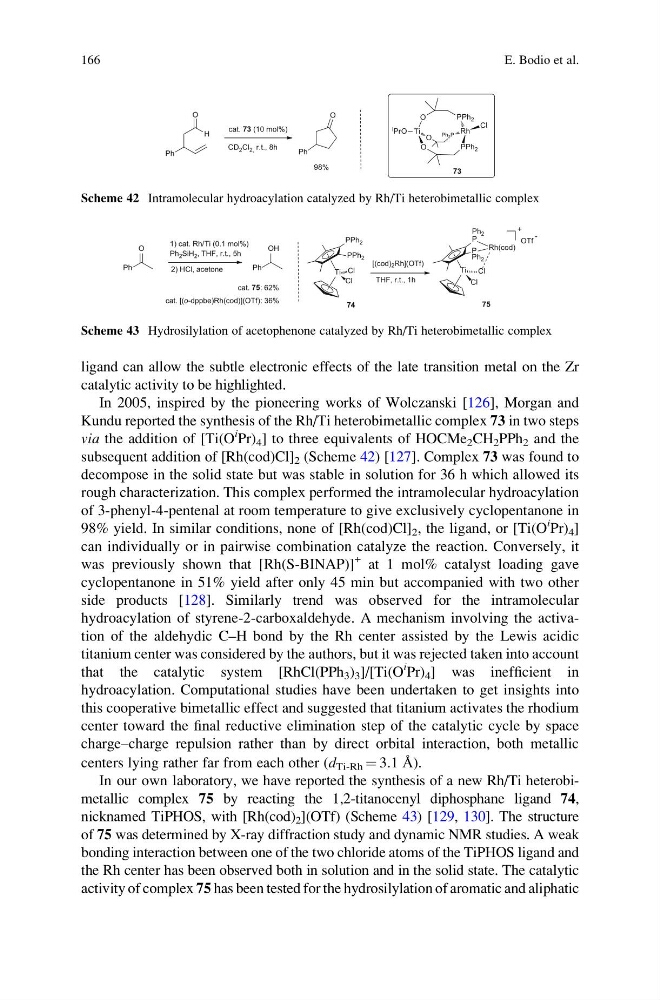
subsequent addition of [Rh(cod)Cl] 2 (Scheme 42) [127]. Complex 73 was found to
decompose in the solid state but was stable in solution for 36 h which allowed its
rough characterization. This complex performed the intramolecular hydroacylation
of 3-phenyl-4-pentenal at room temperature to give exclusively cyclopentanone in
98% yield. In similar conditions, none of [Rh(cod)Cl] 2 , the ligand, or [Ti(O
i
Pr) 4 ]
can individually or in pairwise combination catalyze the reaction. Conversely, it
was previously shown that [Rh(S-BINAP)]
+ at 1 mol% catalyst loading gave
cyclopentanone in 51% yield after only 45 min but accompanied with two other
side products [128]. Similarly trend was observed for the intramolecular
hydroacylation of styrene-2-carboxaldehyde. A mechanism involving the activation of the aldehydic C–H bond by the Rh center assisted by the Lewis acidic
titanium center was considered by the authors, but it was rejected taken into account
that the catalytic system [RhCl(PPh 3 ) 3 ]/[Ti(O
i
Pr) 4 ] was inefficient in
hydroacylation. Computational studies have been undertaken to get insights into
this cooperative bimetallic effect and suggested that titanium activates the rhodium
center toward the final reductive elimination step of the catalytic cycle by space
charge–charge repulsion rather than by direct orbital interaction, both metallic
centers lying rather far from each other (d Ti-Rh ¼ 3.1 Å).
In our own laboratory, we have reported the synthesis of a new Rh/Ti heterobimetallic complex 75 by reacting the 1,2-titanocenyl diphosphane ligand 74,
nicknamed TiPHOS, with [Rh(cod) 2 ](OTf) (Scheme 43) [129, 130]. The structure
of 75 was determined by X-ray diffraction study and dynamic NMR studies. A weak
bonding interaction between one of the two chloride atoms of the TiPHOS ligand and
the Rh center has been observed both in solution and in the solid state. The catalytic
activity of complex 75 has been tested for the hydrosilylation of aromatic and aliphatic
H
O
Ph
cat. 73 (10 mol%)
CD 2 Cl 2, r.t., 8h
O
Ph
98%
Ti
O
PPh 2
O
O
PPh 2
Ph2P
Rh
Cl
i PrO
73
Scheme 42 Intramolecular hydroacylation catalyzed by Rh/Ti heterobimetallic complex
Ti Cl
Cl
PPh 2
PPh 2
Ti
Cl
Cl
Ph 2
P
P
Ph 2
Rh(cod)
-
[(cod)2Rh](OTf)
OTf
+
THF, r.t., 1h
74
75
Ph
O
Ph
OH
1) cat. Rh/Ti (0.1 mol%)
Ph 2 SiH 2 , THF, r.t., 5h
2) HCl, acetone
cat. 75: 62%
cat. [(o-dppbe)Rh(cod)](OTf): 36%
Scheme 43 Hydrosilylation of acetophenone catalyzed by Rh/Ti heterobimetallic complex
166
E. Bodio et al.
catalytic activity to be highlighted.
In 2005, inspired by the pioneering works of Wolczanski [126], Morgan and
Kundu reported the synthesis of the Rh/Ti heterobimetallic complex 73 in two steps
via the addition of [Ti(O
i
Pr) 4 ] to three equivalents of HOCMe 2 CH 2 PPh 2 and the
subsequent addition of [Rh(cod)Cl] 2 (Scheme 42) [127]. Complex 73 was found to
decompose in the solid state but was stable in solution for 36 h which allowed its
rough characterization. This complex performed the intramolecular hydroacylation
of 3-phenyl-4-pentenal at room temperature to give exclusively cyclopentanone in
98% yield. In similar conditions, none of [Rh(cod)Cl] 2 , the ligand, or [Ti(O
i
Pr) 4 ]
can individually or in pairwise combination catalyze the reaction. Conversely, it
was previously shown that [Rh(S-BINAP)]
+ at 1 mol% catalyst loading gave
cyclopentanone in 51% yield after only 45 min but accompanied with two other
side products [128]. Similarly trend was observed for the intramolecular
hydroacylation of styrene-2-carboxaldehyde. A mechanism involving the activation of the aldehydic C–H bond by the Rh center assisted by the Lewis acidic
titanium center was considered by the authors, but it was rejected taken into account
that the catalytic system [RhCl(PPh 3 ) 3 ]/[Ti(O
i
Pr) 4 ] was inefficient in
hydroacylation. Computational studies have been undertaken to get insights into
this cooperative bimetallic effect and suggested that titanium activates the rhodium
center toward the final reductive elimination step of the catalytic cycle by space
charge–charge repulsion rather than by direct orbital interaction, both metallic
centers lying rather far from each other (d Ti-Rh ¼ 3.1 Å).
In our own laboratory, we have reported the synthesis of a new Rh/Ti heterobimetallic complex 75 by reacting the 1,2-titanocenyl diphosphane ligand 74,
nicknamed TiPHOS, with [Rh(cod) 2 ](OTf) (Scheme 43) [129, 130]. The structure
of 75 was determined by X-ray diffraction study and dynamic NMR studies. A weak
bonding interaction between one of the two chloride atoms of the TiPHOS ligand and
the Rh center has been observed both in solution and in the solid state. The catalytic
activity of complex 75 has been tested for the hydrosilylation of aromatic and aliphatic
H
O
Ph
cat. 73 (10 mol%)
CD 2 Cl 2, r.t., 8h
O
Ph
98%
Ti
O
PPh 2
O
O
PPh 2
Ph2P
Rh
Cl
i PrO
73
Scheme 42 Intramolecular hydroacylation catalyzed by Rh/Ti heterobimetallic complex
Ti Cl
Cl
PPh 2
PPh 2
Ti
Cl
Cl
Ph 2
P
P
Ph 2
Rh(cod)
-
[(cod)2Rh](OTf)
OTf
+
THF, r.t., 1h
74
75
Ph
O
Ph
OH
1) cat. Rh/Ti (0.1 mol%)
Ph 2 SiH 2 , THF, r.t., 5h
2) HCl, acetone
cat. 75: 62%
cat. [(o-dppbe)Rh(cod)](OTf): 36%
Scheme 43 Hydrosilylation of acetophenone catalyzed by Rh/Ti heterobimetallic complex
166
E. Bodio et al.