

ketones with Ph 2 SiH 2 as stoichiometric reducing agent. Control reactions have been
performed with the monometallic [(o-dppbe)Rh(cod)](OTf) complex (odppbe¼ortho-diphenylphosphinobenzene). With acetophenone, the more active catalyst was found to be the bimetallic complex 75. This supremacy was further confirmed with two other substrates (propiophenone and tetralone). The reason of the
“bimetallic effect” was not established, but we hypothesized that the oxophilic
titanium ion assists the Rh center in the activation of the carbonyl substrate.
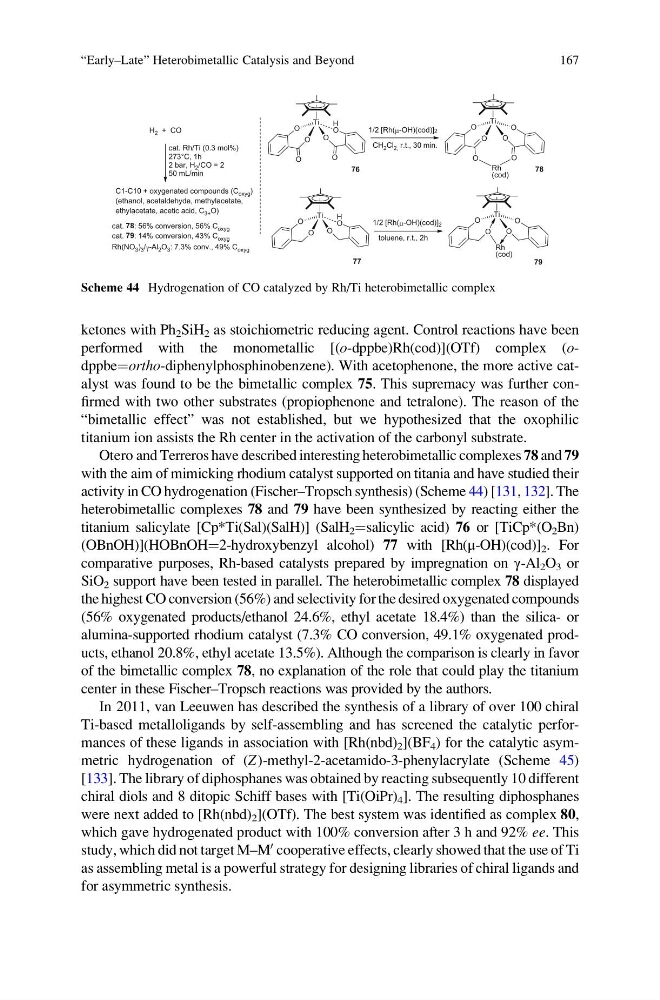
Otero and Terreros have described interesting heterobimetallic complexes 78 and 79
with the aim of mimicking rhodium catalyst supported on titania and have studied their
activity in CO hydrogenation (Fischer–Tropsch synthesis) (Scheme 44) [131, 132]. The
heterobimetallic complexes 78 and 79 have been synthesized by reacting either the
titanium salicylate [Cp*Ti(Sal)(SalH)] (SalH 2 ¼salicylic acid) 76 or [TiCp*(O 2 Bn)
(OBnOH)](HOBnOH¼2-hydroxybenzyl alcohol) 77 with [Rh(μ-OH)(cod)] 2 . For
comparative purposes, Rh-based catalysts prepared by impregnation on γ-Al 2 O 3 or
SiO 2 support have been tested in parallel. The heterobimetallic complex 78 displayed
the highest CO conversion (56%) and selectivity for the desired oxygenated compounds
(56% oxygenated products/ethanol 24.6%, ethyl acetate 18.4%) than the silica- or
alumina-supported rhodium catalyst (7.3% CO conversion, 49.1% oxygenated products, ethanol 20.8%, ethyl acetate 13.5%). Although the comparison is clearly in favor
of the bimetallic complex 78, no explanation of the role that could play the titanium
center in these Fischer–Tropsch reactions was provided by the authors.
In 2011, van Leeuwen has described the synthesis of a library of over 100 chiral
Ti-based metalloligands by self-assembling and has screened the catalytic performances of these ligands in association with [Rh(nbd) 2 ](BF 4 ) for the catalytic asymmetric hydrogenation of (Z)-methyl-2-acetamido-3-phenylacrylate (Scheme 45)
[133]. The library of diphosphanes was obtained by reacting subsequently 10 different
chiral diols and 8 ditopic Schiff bases with [Ti(OiPr) 4 ]. The resulting diphosphanes
were next added to [Rh(nbd) 2 ](OTf). The best system was identified as complex 80,
which gave hydrogenated product with 100% conversion after 3 h and 92% ee. This
study, which did not target M–M
0 cooperative effects, clearly showed that the use of Ti
as assembling metal is a powerful strategy for designing libraries of chiral ligands and
for asymmetric synthesis.
Ti
O
O
O
H
O
O
O
Ti
O
O
O
O
O
O
Rh
(cod)
1/2 [Rh(μ-OH)(cod)]2
CH 2 Cl 2, r.t., 30 min.
Ti
O
O
H
O
O
Ti
O
O
O
O
Rh
(cod)
1/2 [Rh(μ-OH)(cod)] 2
toluene, r.t., 2h
H 2 + CO
76
78
77
79
cat. Rh/Ti (0.3 mol%)
273°C, 1h
2 bar, H 2 /CO = 2
50 mL/min
C1-C10 + oxygenated compounds (C oxyg )
(ethanol, acetaldehyde, methylacetate,
ethylacetate, acetic acid, C 3+ O)
cat. 78: 56% conversion, 56% C oxyg
cat. 79: 14% conversion, 43% C oxyg
Rh(NO 3 ) 3 /γ-Al 2 O 3 : 7.3% conv., 49% C oxyg
Scheme 44 Hydrogenation of CO catalyzed by Rh/Ti heterobimetallic complex
“Early–Late” Heterobimetallic Catalysis and Beyond
167
performed with the monometallic [(o-dppbe)Rh(cod)](OTf) complex (odppbe¼ortho-diphenylphosphinobenzene). With acetophenone, the more active catalyst was found to be the bimetallic complex 75. This supremacy was further confirmed with two other substrates (propiophenone and tetralone). The reason of the
“bimetallic effect” was not established, but we hypothesized that the oxophilic
titanium ion assists the Rh center in the activation of the carbonyl substrate.
Otero and Terreros have described interesting heterobimetallic complexes 78 and 79
with the aim of mimicking rhodium catalyst supported on titania and have studied their
activity in CO hydrogenation (Fischer–Tropsch synthesis) (Scheme 44) [131, 132]. The
heterobimetallic complexes 78 and 79 have been synthesized by reacting either the
titanium salicylate [Cp*Ti(Sal)(SalH)] (SalH 2 ¼salicylic acid) 76 or [TiCp*(O 2 Bn)
(OBnOH)](HOBnOH¼2-hydroxybenzyl alcohol) 77 with [Rh(μ-OH)(cod)] 2 . For
comparative purposes, Rh-based catalysts prepared by impregnation on γ-Al 2 O 3 or
SiO 2 support have been tested in parallel. The heterobimetallic complex 78 displayed
the highest CO conversion (56%) and selectivity for the desired oxygenated compounds
(56% oxygenated products/ethanol 24.6%, ethyl acetate 18.4%) than the silica- or
alumina-supported rhodium catalyst (7.3% CO conversion, 49.1% oxygenated products, ethanol 20.8%, ethyl acetate 13.5%). Although the comparison is clearly in favor
of the bimetallic complex 78, no explanation of the role that could play the titanium
center in these Fischer–Tropsch reactions was provided by the authors.
In 2011, van Leeuwen has described the synthesis of a library of over 100 chiral
Ti-based metalloligands by self-assembling and has screened the catalytic performances of these ligands in association with [Rh(nbd) 2 ](BF 4 ) for the catalytic asymmetric hydrogenation of (Z)-methyl-2-acetamido-3-phenylacrylate (Scheme 45)
[133]. The library of diphosphanes was obtained by reacting subsequently 10 different
chiral diols and 8 ditopic Schiff bases with [Ti(OiPr) 4 ]. The resulting diphosphanes
were next added to [Rh(nbd) 2 ](OTf). The best system was identified as complex 80,
which gave hydrogenated product with 100% conversion after 3 h and 92% ee. This
study, which did not target M–M
0 cooperative effects, clearly showed that the use of Ti
as assembling metal is a powerful strategy for designing libraries of chiral ligands and
for asymmetric synthesis.
Ti
O
O
O
H
O
O
O
Ti
O
O
O
O
O
O
Rh
(cod)
1/2 [Rh(μ-OH)(cod)]2
CH 2 Cl 2, r.t., 30 min.
Ti
O
O
H
O
O
Ti
O
O
O
O
Rh
(cod)
1/2 [Rh(μ-OH)(cod)] 2
toluene, r.t., 2h
H 2 + CO
76
78
77
79
cat. Rh/Ti (0.3 mol%)
273°C, 1h
2 bar, H 2 /CO = 2
50 mL/min
C1-C10 + oxygenated compounds (C oxyg )
(ethanol, acetaldehyde, methylacetate,
ethylacetate, acetic acid, C 3+ O)
cat. 78: 56% conversion, 56% C oxyg
cat. 79: 14% conversion, 43% C oxyg
Rh(NO 3 ) 3 /γ-Al 2 O 3 : 7.3% conv., 49% C oxyg
Scheme 44 Hydrogenation of CO catalyzed by Rh/Ti heterobimetallic complex
“Early–Late” Heterobimetallic Catalysis and Beyond
167