

stoichiometric amount. Of note, the rhodium precursor [Rh 2 (μ-St
Bu) 2 (CO) 4 ] was
found totally inactive in these conditions, while [Cp* 2 Zr(SH) 2 ] gave a small
amount of acrolein but rapidly decomposed. These results strongly suggest that
both metals are required for the reaction to occur.
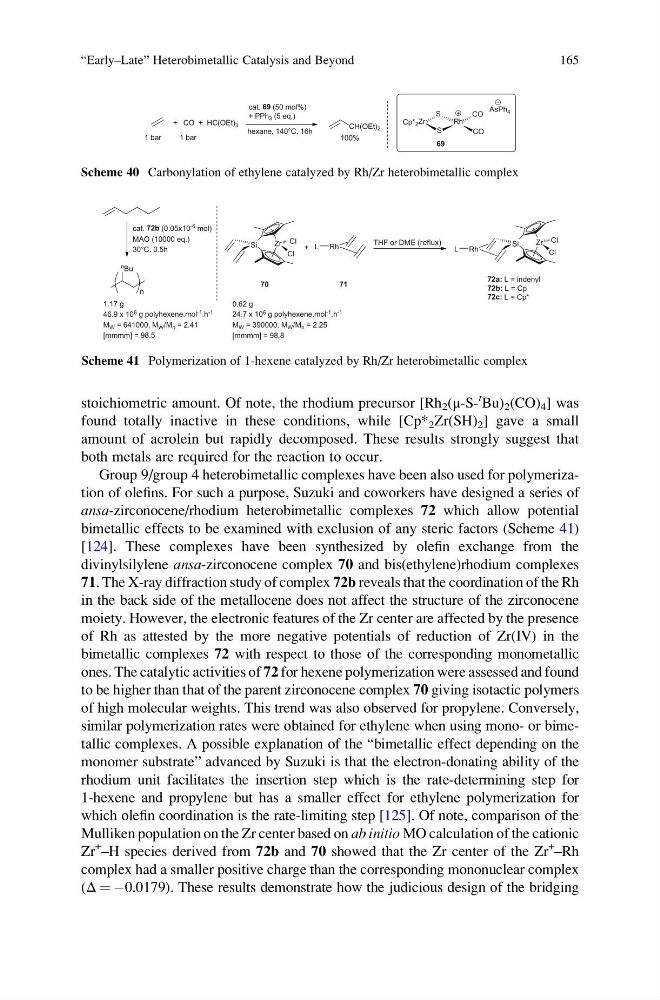
Group 9/group 4 heterobimetallic complexes have been also used for polymerization of olefins. For such a purpose, Suzuki and coworkers have designed a series of
ansa-zirconocene/rhodium heterobimetallic complexes 72 which allow potential
bimetallic effects to be examined with exclusion of any steric factors (Scheme 41)
[124]. These complexes have been synthesized by olefin exchange from the
divinylsilylene ansa-zirconocene complex 70 and bis(ethylene)rhodium complexes
71. The X-ray diffraction study of complex 72b reveals that the coordination of the Rh
in the back side of the metallocene does not affect the structure of the zirconocene
moiety. However, the electronic features of the Zr center are affected by the presence
of Rh as attested by the more negative potentials of reduction of Zr(IV) in the
bimetallic complexes 72 with respect to those of the corresponding monometallic
ones. The catalytic activities of 72 for hexene polymerization were assessed and found
to be higher than that of the parent zirconocene complex 70 giving isotactic polymers
of high molecular weights. This trend was also observed for propylene. Conversely,
similar polymerization rates were obtained for ethylene when using mono- or bimetallic complexes. A possible explanation of the “bimetallic effect depending on the
monomer substrate” advanced by Suzuki is that the electron-donating ability of the
rhodium unit facilitates the insertion step which is the rate-determining step for
1-hexene and propylene but has a smaller effect for ethylene polymerization for
which olefin coordination is the rate-limiting step [125]. Of note, comparison of the
Mulliken population on the Zr center based on ab initio MO calculation of the cationic
Zr
+
–H species derived from 72b and 70 showed that the Zr center of the Zr
+
–Rh
complex had a smaller positive charge than the corresponding mononuclear complex
(Δ ¼ À0.0179). These results demonstrate how the judicious design of the bridging
+ CO + HC(OEt) 3
cat. 69 (50 mol%)
+ PPh 3 (5 eq.)
CH(OEt)2
100%
hexane, 140°C, 16h
1 bar
1 bar
Cp* 2 Zr
S
S
Rh
CO
CO
AsPh 4
69
Scheme 40 Carbonylation of ethylene catalyzed by Rh/Zr heterobimetallic complex
n
cat. 72b (0.05x10 -6 mol)
MAO (10000 eq.)
30°C, 0.5h
Zr
Cl
72a: L = indenyl
72b: L = Cp
72c: L = Cp*
1.17 g
46.9 x 10 6 g polyhexene.mol -1 .h -1
M W = 641000, M W /M n = 2.41
[mmmm] = 98.5
n Bu
Cl
Si
Rh
L
Zr
Cl
70
Cl
Si
+
Rh
L
THF or DME (reflux)
0.62 g
24.7 x 10 6 g polyhexene.mol -1 .h -1
M W = 390000, M W /M n = 2.25
[mmmm] = 98.8
71
Scheme 41 Polymerization of 1-hexene catalyzed by Rh/Zr heterobimetallic complex
“Early–Late” Heterobimetallic Catalysis and Beyond
165
Bu) 2 (CO) 4 ] was
found totally inactive in these conditions, while [Cp* 2 Zr(SH) 2 ] gave a small
amount of acrolein but rapidly decomposed. These results strongly suggest that
both metals are required for the reaction to occur.
Group 9/group 4 heterobimetallic complexes have been also used for polymerization of olefins. For such a purpose, Suzuki and coworkers have designed a series of
ansa-zirconocene/rhodium heterobimetallic complexes 72 which allow potential
bimetallic effects to be examined with exclusion of any steric factors (Scheme 41)
[124]. These complexes have been synthesized by olefin exchange from the
divinylsilylene ansa-zirconocene complex 70 and bis(ethylene)rhodium complexes
71. The X-ray diffraction study of complex 72b reveals that the coordination of the Rh
in the back side of the metallocene does not affect the structure of the zirconocene
moiety. However, the electronic features of the Zr center are affected by the presence
of Rh as attested by the more negative potentials of reduction of Zr(IV) in the
bimetallic complexes 72 with respect to those of the corresponding monometallic
ones. The catalytic activities of 72 for hexene polymerization were assessed and found
to be higher than that of the parent zirconocene complex 70 giving isotactic polymers
of high molecular weights. This trend was also observed for propylene. Conversely,
similar polymerization rates were obtained for ethylene when using mono- or bimetallic complexes. A possible explanation of the “bimetallic effect depending on the
monomer substrate” advanced by Suzuki is that the electron-donating ability of the
rhodium unit facilitates the insertion step which is the rate-determining step for
1-hexene and propylene but has a smaller effect for ethylene polymerization for
which olefin coordination is the rate-limiting step [125]. Of note, comparison of the
Mulliken population on the Zr center based on ab initio MO calculation of the cationic
Zr
+
–H species derived from 72b and 70 showed that the Zr center of the Zr
+
–Rh
complex had a smaller positive charge than the corresponding mononuclear complex
(Δ ¼ À0.0179). These results demonstrate how the judicious design of the bridging
+ CO + HC(OEt) 3
cat. 69 (50 mol%)
+ PPh 3 (5 eq.)
CH(OEt)2
100%
hexane, 140°C, 16h
1 bar
1 bar
Cp* 2 Zr
S
S
Rh
CO
CO
AsPh 4
69
Scheme 40 Carbonylation of ethylene catalyzed by Rh/Zr heterobimetallic complex
n
cat. 72b (0.05x10 -6 mol)
MAO (10000 eq.)
30°C, 0.5h
Zr
Cl
72a: L = indenyl
72b: L = Cp
72c: L = Cp*
1.17 g
46.9 x 10 6 g polyhexene.mol -1 .h -1
M W = 641000, M W /M n = 2.41
[mmmm] = 98.5
n Bu
Cl
Si
Rh
L
Zr
Cl
70
Cl
Si
+
Rh
L
THF or DME (reflux)
0.62 g
24.7 x 10 6 g polyhexene.mol -1 .h -1
M W = 390000, M W /M n = 2.25
[mmmm] = 98.8
71
Scheme 41 Polymerization of 1-hexene catalyzed by Rh/Zr heterobimetallic complex
“Early–Late” Heterobimetallic Catalysis and Beyond
165