

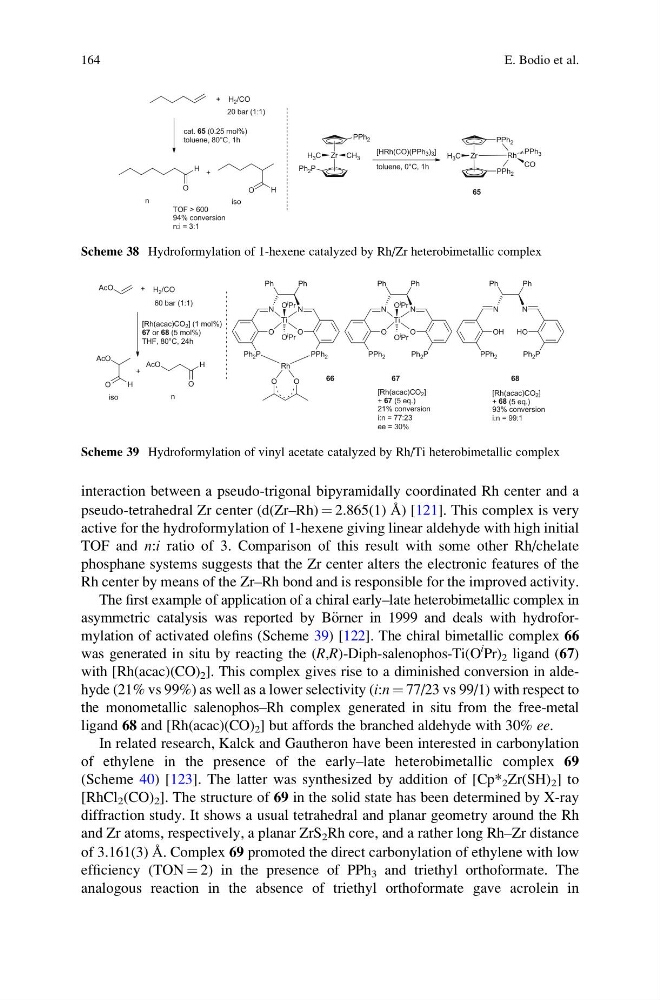
interaction between a pseudo-trigonal bipyramidally coordinated Rh center and a
pseudo-tetrahedral Zr center (d(Zr–Rh) ¼ 2.865(1) Å) [121]. This complex is very
active for the hydroformylation of 1-hexene giving linear aldehyde with high initial
TOF and n:i ratio of 3. Comparison of this result with some other Rh/chelate
phosphane systems suggests that the Zr center alters the electronic features of the
Rh center by means of the Zr–Rh bond and is responsible for the improved activity.
The first example of application of a chiral early–late heterobimetallic complex in
asymmetric catalysis was reported by B€ orner in 1999 and deals with hydroformylation of activated olefins (Scheme 39) [122]. The chiral bimetallic complex 66
was generated in situ by reacting the (R,R)-Diph-salenophos-Ti(O
i
Pr) 2 ligand (67)
with [Rh(acac)(CO) 2 ]. This complex gives rise to a diminished conversion in aldehyde (21% vs 99%) as well as a lower selectivity (i:n ¼ 77/23 vs 99/1) with respect to
the monometallic salenophos–Rh complex generated in situ from the free-metal
ligand 68 and [Rh(acac)(CO) 2 ] but affords the branched aldehyde with 30% ee.
In related research, Kalck and Gautheron have been interested in carbonylation
of ethylene in the presence of the early–late heterobimetallic complex 69
(Scheme 40) [123]. The latter was synthesized by addition of [Cp* 2 Zr(SH) 2 ] to
[RhCl 2 (CO) 2 ]. The structure of 69 in the solid state has been determined by X-ray
diffraction study. It shows a usual tetrahedral and planar geometry around the Rh
and Zr atoms, respectively, a planar ZrS 2 Rh core, and a rather long Rh–Zr distance
of 3.161(3) Å. Complex 69 promoted the direct carbonylation of ethylene with low
efficiency (TON ¼ 2) in the presence of PPh 3 and triethyl orthoformate. The
analogous reaction in the absence of triethyl orthoformate gave acrolein in
+ H 2 /CO
20 bar (1:1)
cat. 65 (0.25 mol%)
toluene, 80°C, 1h
H
O
+
O
H
n
iso
Zr
PPh 2
Ph 2 P
H 3 C
CH 3
[HRh(CO)(PPh3)3]
toluene, 0°C, 1h
Zr
PPh 2
H 3 C
PPh 2
Rh
CO
PPh 3
65
TOF > 600
94% conversion
n:i = 3:1
Scheme 38 Hydroformylation of 1-hexene catalyzed by Rh/Zr heterobimetallic complex
N
N
Ph 2 P
PPh 2
Ph
Ph
O
O
Ti
O i Pr
O i Pr
Rh
O
O
AcO
+ H 2 /CO
60 bar (1:1)
[Rh(acac)CO 2 ] (1 mol%)
67 or 68 (5 mol%)
THF, 80°C, 24h
AcO
H
O
+
AcO
O
H
n
iso
[Rh(acac)CO2]
+ 68 (5 eq.)
93% conversion
i:n = 99:1
66
N
N
PPh 2
Ph 2 P
Ph
Ph
O
O
Ti
O i Pr
O i Pr
67
N
N
PPh 2
Ph 2 P
Ph
Ph
OH
HO
68
[Rh(acac)CO 2 ]
+ 67 (5 eq.)
21% conversion
i:n = 77:23
ee = 30%
Scheme 39 Hydroformylation of vinyl acetate catalyzed by Rh/Ti heterobimetallic complex
164
E. Bodio et al.
pseudo-tetrahedral Zr center (d(Zr–Rh) ¼ 2.865(1) Å) [121]. This complex is very
active for the hydroformylation of 1-hexene giving linear aldehyde with high initial
TOF and n:i ratio of 3. Comparison of this result with some other Rh/chelate
phosphane systems suggests that the Zr center alters the electronic features of the
Rh center by means of the Zr–Rh bond and is responsible for the improved activity.
The first example of application of a chiral early–late heterobimetallic complex in
asymmetric catalysis was reported by B€ orner in 1999 and deals with hydroformylation of activated olefins (Scheme 39) [122]. The chiral bimetallic complex 66
was generated in situ by reacting the (R,R)-Diph-salenophos-Ti(O
i
Pr) 2 ligand (67)
with [Rh(acac)(CO) 2 ]. This complex gives rise to a diminished conversion in aldehyde (21% vs 99%) as well as a lower selectivity (i:n ¼ 77/23 vs 99/1) with respect to
the monometallic salenophos–Rh complex generated in situ from the free-metal
ligand 68 and [Rh(acac)(CO) 2 ] but affords the branched aldehyde with 30% ee.
In related research, Kalck and Gautheron have been interested in carbonylation
of ethylene in the presence of the early–late heterobimetallic complex 69
(Scheme 40) [123]. The latter was synthesized by addition of [Cp* 2 Zr(SH) 2 ] to
[RhCl 2 (CO) 2 ]. The structure of 69 in the solid state has been determined by X-ray
diffraction study. It shows a usual tetrahedral and planar geometry around the Rh
and Zr atoms, respectively, a planar ZrS 2 Rh core, and a rather long Rh–Zr distance
of 3.161(3) Å. Complex 69 promoted the direct carbonylation of ethylene with low
efficiency (TON ¼ 2) in the presence of PPh 3 and triethyl orthoformate. The
analogous reaction in the absence of triethyl orthoformate gave acrolein in
+ H 2 /CO
20 bar (1:1)
cat. 65 (0.25 mol%)
toluene, 80°C, 1h
H
O
+
O
H
n
iso
Zr
PPh 2
Ph 2 P
H 3 C
CH 3
[HRh(CO)(PPh3)3]
toluene, 0°C, 1h
Zr
PPh 2
H 3 C
PPh 2
Rh
CO
PPh 3
65
TOF > 600
94% conversion
n:i = 3:1
Scheme 38 Hydroformylation of 1-hexene catalyzed by Rh/Zr heterobimetallic complex
N
N
Ph 2 P
PPh 2
Ph
Ph
O
O
Ti
O i Pr
O i Pr
Rh
O
O
AcO
+ H 2 /CO
60 bar (1:1)
[Rh(acac)CO 2 ] (1 mol%)
67 or 68 (5 mol%)
THF, 80°C, 24h
AcO
H
O
+
AcO
O
H
n
iso
[Rh(acac)CO2]
+ 68 (5 eq.)
93% conversion
i:n = 99:1
66
N
N
PPh 2
Ph 2 P
Ph
Ph
O
O
Ti
O i Pr
O i Pr
67
N
N
PPh 2
Ph 2 P
Ph
Ph
OH
HO
68
[Rh(acac)CO 2 ]
+ 67 (5 eq.)
21% conversion
i:n = 77:23
ee = 30%
Scheme 39 Hydroformylation of vinyl acetate catalyzed by Rh/Ti heterobimetallic complex
164
E. Bodio et al.