

60. The rate of catalysis was slower for the bimetallic complex than for [RhH(CO)
(PPh 3 ) 3 ], but the selectivity for the terminal aldehyde was much greater (n:i ¼ 16:1
vs 2:1 Rh). Few years later, Choukroun and Royo have shown that the introduction
of SiMe 3 groups to the cyclopentadienyl rings of the zirconocene diphosphane
increased the hydroformylation rate (99% conversion within 55 h) but is less
favorable in terms of selectivity (n:i ¼ 10) [117]. This result highlights the deep
influence of the early metal fragment on the catalytic performances of the late
transition metal.
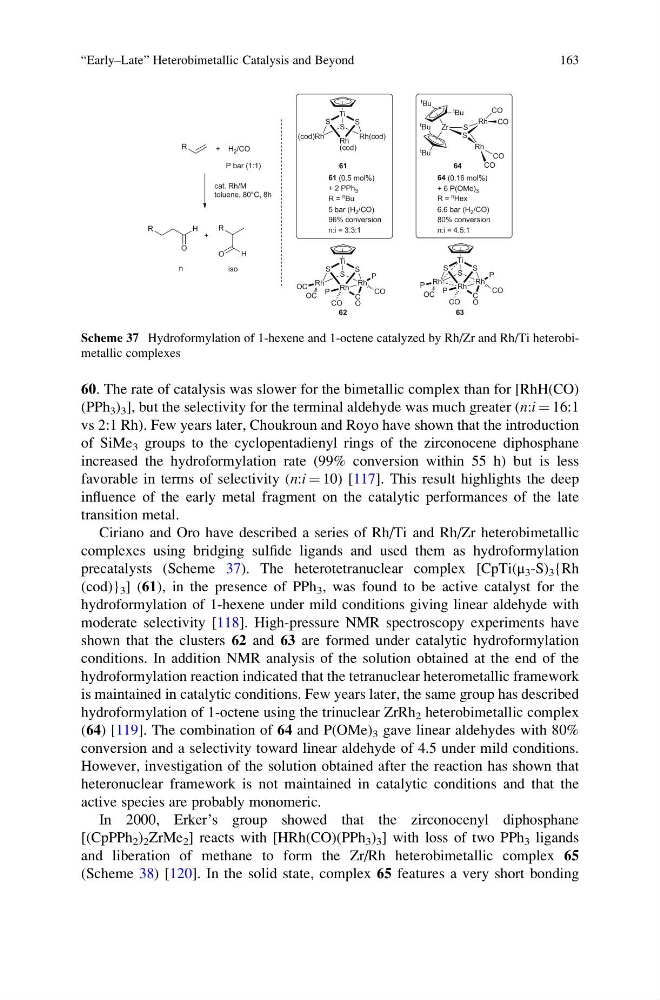
Ciriano and Oro have described a series of Rh/Ti and Rh/Zr heterobimetallic
complexes using bridging sulfide ligands and used them as hydroformylation
precatalysts (Scheme 37). The heterotetranuclear complex [CpTi(μ 3 -S) 3 {Rh
(cod)} 3 ] (61), in the presence of PPh 3 , was found to be active catalyst for the
hydroformylation of 1-hexene under mild conditions giving linear aldehyde with
moderate selectivity [118]. High-pressure NMR spectroscopy experiments have
shown that the clusters 62 and 63 are formed under catalytic hydroformylation
conditions. In addition NMR analysis of the solution obtained at the end of the
hydroformylation reaction indicated that the tetranuclear heterometallic framework
is maintained in catalytic conditions. Few years later, the same group has described
hydroformylation of 1-octene using the trinuclear ZrRh 2 heterobimetallic complex
(64) [119]. The combination of 64 and P(OMe) 3 gave linear aldehydes with 80%
conversion and a selectivity toward linear aldehyde of 4.5 under mild conditions.
However, investigation of the solution obtained after the reaction has shown that
heteronuclear framework is not maintained in catalytic conditions and that the
active species are probably monomeric.
In 2000, Erker’s group showed that the zirconocenyl diphosphane
[(CpPPh 2 ) 2 ZrMe 2 ] reacts with [HRh(CO)(PPh 3 ) 3 ] with loss of two PPh 3 ligands
and liberation of methane to form the Zr/Rh heterobimetallic complex 65
(Scheme 38) [120]. In the solid state, complex 65 features a very short bonding
S
Rh
Zr
(cod)Rh
Ti
S
S
S
Rh
(cod)
Rh(cod)
Rh
Ti
S
S
S
Rh
Rh
P
CO
C
O
P
CO
OC
OC
Rh
Ti
S
S
S
Rh
Rh
P
CO
C
O
P
CO
P
OC
+ H 2 /CO
P bar (1:1)
cat. Rh/M
toluene, 80°C, 8h
H
O
+
O
H
n
iso
61
62
63
61 (0.5 mol%)
+ 2 PPh 3
R = n Bu
5 bar (H 2 /CO)
96% conversion
n:i = 3.3:1
t Bu
t Bu
t Bu
t Bu
S
Rh CO
CO
CO
CO
64
R
R
R
64 (0.16 mol%)
+ 6 P(OMe) 3
R = n Hex
6.6 bar (H 2 /CO)
80% conversion
n:i = 4.5:1
Scheme 37 Hydroformylation of 1-hexene and 1-octene catalyzed by Rh/Zr and Rh/Ti heterobimetallic complexes
“Early–Late” Heterobimetallic Catalysis and Beyond
163
(PPh 3 ) 3 ], but the selectivity for the terminal aldehyde was much greater (n:i ¼ 16:1
vs 2:1 Rh). Few years later, Choukroun and Royo have shown that the introduction
of SiMe 3 groups to the cyclopentadienyl rings of the zirconocene diphosphane
increased the hydroformylation rate (99% conversion within 55 h) but is less
favorable in terms of selectivity (n:i ¼ 10) [117]. This result highlights the deep
influence of the early metal fragment on the catalytic performances of the late
transition metal.
Ciriano and Oro have described a series of Rh/Ti and Rh/Zr heterobimetallic
complexes using bridging sulfide ligands and used them as hydroformylation
precatalysts (Scheme 37). The heterotetranuclear complex [CpTi(μ 3 -S) 3 {Rh
(cod)} 3 ] (61), in the presence of PPh 3 , was found to be active catalyst for the
hydroformylation of 1-hexene under mild conditions giving linear aldehyde with
moderate selectivity [118]. High-pressure NMR spectroscopy experiments have
shown that the clusters 62 and 63 are formed under catalytic hydroformylation
conditions. In addition NMR analysis of the solution obtained at the end of the
hydroformylation reaction indicated that the tetranuclear heterometallic framework
is maintained in catalytic conditions. Few years later, the same group has described
hydroformylation of 1-octene using the trinuclear ZrRh 2 heterobimetallic complex
(64) [119]. The combination of 64 and P(OMe) 3 gave linear aldehydes with 80%
conversion and a selectivity toward linear aldehyde of 4.5 under mild conditions.
However, investigation of the solution obtained after the reaction has shown that
heteronuclear framework is not maintained in catalytic conditions and that the
active species are probably monomeric.
In 2000, Erker’s group showed that the zirconocenyl diphosphane
[(CpPPh 2 ) 2 ZrMe 2 ] reacts with [HRh(CO)(PPh 3 ) 3 ] with loss of two PPh 3 ligands
and liberation of methane to form the Zr/Rh heterobimetallic complex 65
(Scheme 38) [120]. In the solid state, complex 65 features a very short bonding
S
Rh
Zr
(cod)Rh
Ti
S
S
S
Rh
(cod)
Rh(cod)
Rh
Ti
S
S
S
Rh
Rh
P
CO
C
O
P
CO
OC
OC
Rh
Ti
S
S
S
Rh
Rh
P
CO
C
O
P
CO
P
OC
+ H 2 /CO
P bar (1:1)
cat. Rh/M
toluene, 80°C, 8h
H
O
+
O
H
n
iso
61
62
63
61 (0.5 mol%)
+ 2 PPh 3
R = n Bu
5 bar (H 2 /CO)
96% conversion
n:i = 3.3:1
t Bu
t Bu
t Bu
t Bu
S
Rh CO
CO
CO
CO
64
R
R
R
64 (0.16 mol%)
+ 6 P(OMe) 3
R = n Hex
6.6 bar (H 2 /CO)
80% conversion
n:i = 4.5:1
Scheme 37 Hydroformylation of 1-hexene and 1-octene catalyzed by Rh/Zr and Rh/Ti heterobimetallic complexes
“Early–Late” Heterobimetallic Catalysis and Beyond
163