

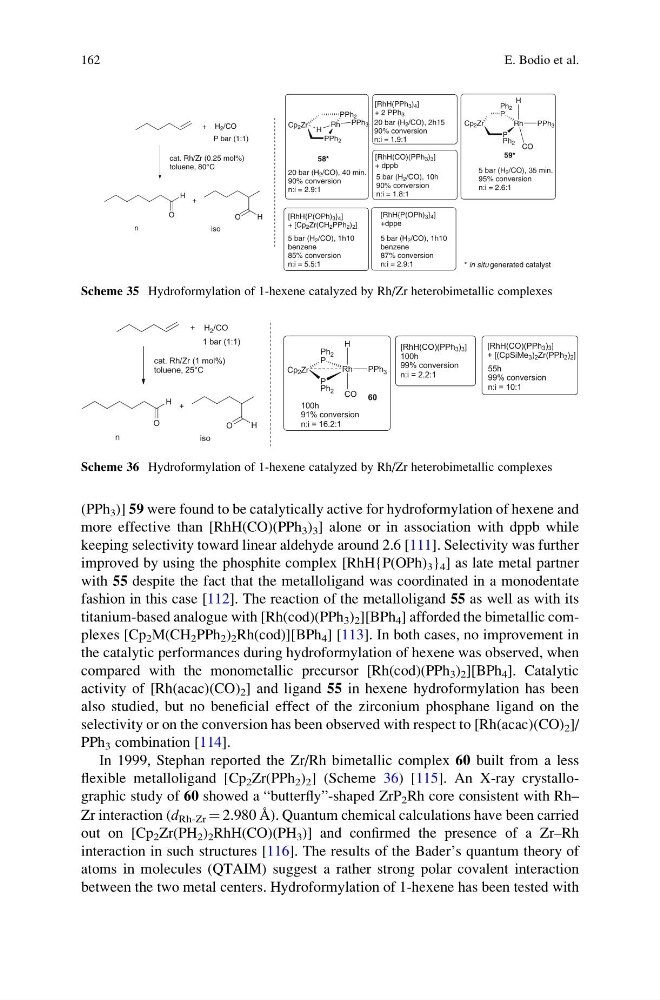
(PPh 3 )] 59 were found to be catalytically active for hydroformylation of hexene and
more effective than [RhH(CO)(PPh 3 ) 3 ] alone or in association with dppb while
keeping selectivity toward linear aldehyde around 2.6 [111]. Selectivity was further
improved by using the phosphite complex [RhH{P(OPh) 3 } 4 ] as late metal partner
with 55 despite the fact that the metalloligand was coordinated in a monodentate
fashion in this case [112]. The reaction of the metalloligand 55 as well as with its
titanium-based analogue with [Rh(cod)(PPh 3 ) 2 ][BPh 4 ] afforded the bimetallic complexes [Cp 2 M(CH 2 PPh 2 ) 2 Rh(cod)][BPh 4 ] [113]. In both cases, no improvement in
the catalytic performances during hydroformylation of hexene was observed, when
compared with the monometallic precursor [Rh(cod)(PPh 3 ) 2 ][BPh 4 ]. Catalytic
activity of [Rh(acac)(CO) 2 ] and ligand 55 in hexene hydroformylation has been
also studied, but no beneficial effect of the zirconium phosphane ligand on the
selectivity or on the conversion has been observed with respect to [Rh(acac)(CO) 2 ]/
PPh 3 combination [114].
In 1999, Stephan reported the Zr/Rh bimetallic complex 60 built from a less
flexible metalloligand [Cp 2 Zr(PPh 2 ) 2 ] (Scheme 36) [115]. An X-ray crystallographic study of 60 showed a “butterfly”-shaped ZrP 2 Rh core consistent with Rh–
Zr interaction (d Rh-Zr ¼ 2.980 Å). Quantum chemical calculations have been carried
out on [Cp 2 Zr(PH 2 ) 2 RhH(CO)(PH 3 )] and confirmed the presence of a Zr–Rh
interaction in such structures [116]. The results of the Bader’s quantum theory of
atoms in molecules (QTAIM) suggest a rather strong polar covalent interaction
between the two metal centers. Hydroformylation of 1-hexene has been tested with
+ H2/CO
P bar (1:1)
cat. Rh/Zr (0.25 mol%)
toluene, 80°C
H
O
+
O
H
n
iso
Cp2Zr
Ph2
P
P
Ph2
Rh
H
CO
PPh3
Cp2Zr
PPh2
PPh2
Rh
H
PPh3
20 bar (H2/CO), 40 min.
90% conversion
n:i = 2.9:1
5 bar (H2/CO), 35 min.
95% conversion
n:i = 2.6:1
58*
[RhH(PPh3)4]
+ 2 PPh3
20 bar (H2/CO), 2h15
90% conversion
n:i = 1.9:1
[RhH(CO)(PPh3)3]
+ dppb
5 bar (H2/CO), 10h
90% conversion
n:i = 1.8:1
59*
[RhH{P(OPh)3}4]
+ [Cp2Zr(CH2PPh2)2]
5 bar (H2/CO), 1h10
benzene
85% conversion
n:i = 5.5:1
[RhH{P(OPh)3}4]
+dppe
5 bar (H2/CO), 1h10
benzene
87% conversion
n:i = 2.9:1
* in situ generated catalyst
Scheme 35 Hydroformylation of 1-hexene catalyzed by Rh/Zr heterobimetallic complexes
Cp2Zr
P
Ph 2
Ph 2
P
Rh
H
CO
PPh 3
+ H 2 /CO
1 bar (1:1)
cat. Rh/Zr (1 mol%)
toluene, 25°C
H
O
+
O
H
n
iso
[RhH(CO)(PPh3)3]
+ [(CpSiMe 3 ) 2 Zr(PPh 2 ) 2 ]
100h
91% conversion
n:i = 16.2:1
100h
99% conversion
n:i = 2.2:1
55h
99% conversion
n:i = 10:1
60
[RhH(CO)(PPh3)3]
Scheme 36 Hydroformylation of 1-hexene catalyzed by Rh/Zr heterobimetallic complexes
162
E. Bodio et al.
more effective than [RhH(CO)(PPh 3 ) 3 ] alone or in association with dppb while
keeping selectivity toward linear aldehyde around 2.6 [111]. Selectivity was further
improved by using the phosphite complex [RhH{P(OPh) 3 } 4 ] as late metal partner
with 55 despite the fact that the metalloligand was coordinated in a monodentate
fashion in this case [112]. The reaction of the metalloligand 55 as well as with its
titanium-based analogue with [Rh(cod)(PPh 3 ) 2 ][BPh 4 ] afforded the bimetallic complexes [Cp 2 M(CH 2 PPh 2 ) 2 Rh(cod)][BPh 4 ] [113]. In both cases, no improvement in
the catalytic performances during hydroformylation of hexene was observed, when
compared with the monometallic precursor [Rh(cod)(PPh 3 ) 2 ][BPh 4 ]. Catalytic
activity of [Rh(acac)(CO) 2 ] and ligand 55 in hexene hydroformylation has been
also studied, but no beneficial effect of the zirconium phosphane ligand on the
selectivity or on the conversion has been observed with respect to [Rh(acac)(CO) 2 ]/
PPh 3 combination [114].
In 1999, Stephan reported the Zr/Rh bimetallic complex 60 built from a less
flexible metalloligand [Cp 2 Zr(PPh 2 ) 2 ] (Scheme 36) [115]. An X-ray crystallographic study of 60 showed a “butterfly”-shaped ZrP 2 Rh core consistent with Rh–
Zr interaction (d Rh-Zr ¼ 2.980 Å). Quantum chemical calculations have been carried
out on [Cp 2 Zr(PH 2 ) 2 RhH(CO)(PH 3 )] and confirmed the presence of a Zr–Rh
interaction in such structures [116]. The results of the Bader’s quantum theory of
atoms in molecules (QTAIM) suggest a rather strong polar covalent interaction
between the two metal centers. Hydroformylation of 1-hexene has been tested with
+ H2/CO
P bar (1:1)
cat. Rh/Zr (0.25 mol%)
toluene, 80°C
H
O
+
O
H
n
iso
Cp2Zr
Ph2
P
P
Ph2
Rh
H
CO
PPh3
Cp2Zr
PPh2
PPh2
Rh
H
PPh3
20 bar (H2/CO), 40 min.
90% conversion
n:i = 2.9:1
5 bar (H2/CO), 35 min.
95% conversion
n:i = 2.6:1
58*
[RhH(PPh3)4]
+ 2 PPh3
20 bar (H2/CO), 2h15
90% conversion
n:i = 1.9:1
[RhH(CO)(PPh3)3]
+ dppb
5 bar (H2/CO), 10h
90% conversion
n:i = 1.8:1
59*
[RhH{P(OPh)3}4]
+ [Cp2Zr(CH2PPh2)2]
5 bar (H2/CO), 1h10
benzene
85% conversion
n:i = 5.5:1
[RhH{P(OPh)3}4]
+dppe
5 bar (H2/CO), 1h10
benzene
87% conversion
n:i = 2.9:1
* in situ generated catalyst
Scheme 35 Hydroformylation of 1-hexene catalyzed by Rh/Zr heterobimetallic complexes
Cp2Zr
P
Ph 2
Ph 2
P
Rh
H
CO
PPh 3
+ H 2 /CO
1 bar (1:1)
cat. Rh/Zr (1 mol%)
toluene, 25°C
H
O
+
O
H
n
iso
[RhH(CO)(PPh3)3]
+ [(CpSiMe 3 ) 2 Zr(PPh 2 ) 2 ]
100h
91% conversion
n:i = 16.2:1
100h
99% conversion
n:i = 2.2:1
55h
99% conversion
n:i = 10:1
60
[RhH(CO)(PPh3)3]
Scheme 36 Hydroformylation of 1-hexene catalyzed by Rh/Zr heterobimetallic complexes
162
E. Bodio et al.