

3.2.2 Rh/Ti, Rh/Zr, and Rh/Hf
The hydroformylation of alkenes involves the activation of the small molecules H 2
and CO and is therefore a relevant reaction for evaluating the performances of
early–late heterobimetallic complexes and highlighting synergetic effects. It is
therefore understandable that this reaction has been one of the first and most studied
reactions in the field. Kalck, Gervais, and Choukroun have greatly contributed to
this topic and have reported the first study on hydroformylation of 1-hexene using
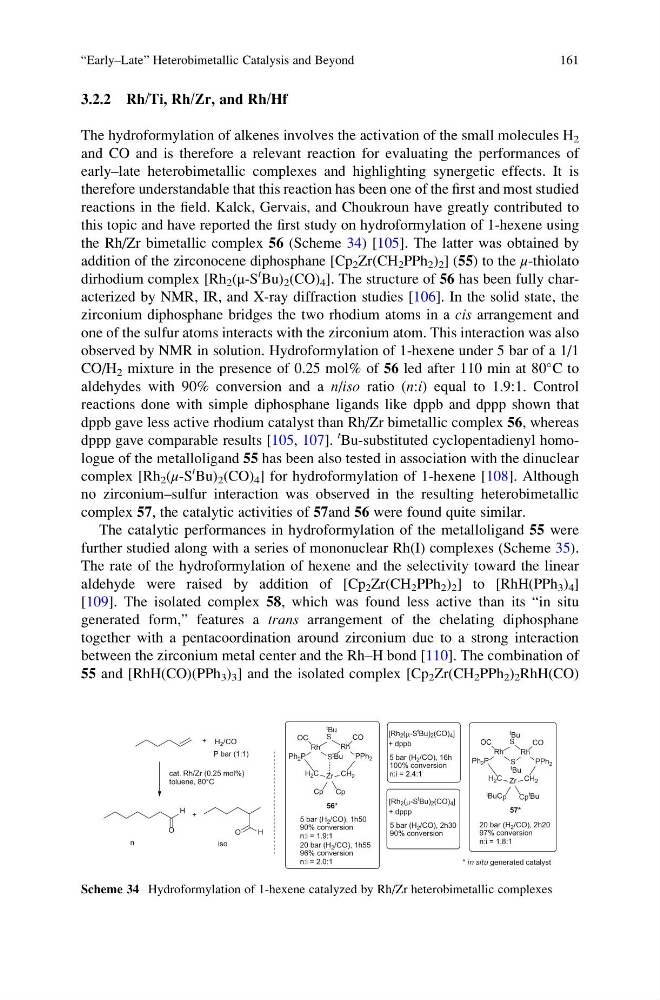
the Rh/Zr bimetallic complex 56 (Scheme 34) [105]. The latter was obtained by
addition of the zirconocene diphosphane [Cp 2 Zr(CH 2 PPh 2 ) 2 ] (55) to the μ-thiolato
dirhodium complex [Rh 2 (μ-S
t
Bu) 2 (CO) 4 ]. The structure of 56 has been fully characterized by NMR, IR, and X-ray diffraction studies [106]. In the solid state, the
zirconium diphosphane bridges the two rhodium atoms in a cis arrangement and
one of the sulfur atoms interacts with the zirconium atom. This interaction was also
observed by NMR in solution. Hydroformylation of 1-hexene under 5 bar of a 1/1
CO/H 2 mixture in the presence of 0.25 mol% of 56 led after 110 min at 80
C to
aldehydes with 90% conversion and a n/iso ratio (n:i) equal to 1.9:1. Control
reactions done with simple diphosphane ligands like dppb and dppp shown that
dppb gave less active rhodium catalyst than Rh/Zr bimetallic complex 56, whereas
dppp gave comparable results [105, 107].
t
Bu-substituted cyclopentadienyl homologue of the metalloligand 55 has been also tested in association with the dinuclear
complex [Rh 2 (μ-S
t
Bu) 2 (CO) 4 ] for hydroformylation of 1-hexene [108]. Although
no zirconium–sulfur interaction was observed in the resulting heterobimetallic
complex 57, the catalytic activities of 57and 56 were found quite similar.
The catalytic performances in hydroformylation of the metalloligand 55 were
further studied along with a series of mononuclear Rh(I) complexes (Scheme 35).
The rate of the hydroformylation of hexene and the selectivity toward the linear
aldehyde were raised by addition of [Cp 2 Zr(CH 2 PPh 2 ) 2 ] to [RhH(PPh 3 ) 4 ]
[109]. The isolated complex 58, which was found less active than its “in situ
generated form,” features a trans arrangement of the chelating diphosphane
together with a pentacoordination around zirconium due to a strong interaction
between the zirconium metal center and the Rh–H bond [110]. The combination of
55 and [RhH(CO)(PPh 3 ) 3 ] and the isolated complex [Cp 2 Zr(CH 2 PPh 2 ) 2 RhH(CO)
Ph 2 P
Rh
S t Bu
Rh
PPh 2
H 2 C Zr CH 2
t Bu
S
OC
CO
Cp
Cp
56*
+ H 2 /CO
P bar (1:1)
cat. Rh/Zr (0.25 mol%)
toluene, 80°C
H
O
+
O
H
n
iso
5 bar (H 2 /CO), 1h50
90% conversion
n:i = 1.9:1
20 bar (H 2 /CO), 1h55
96% conversion
n:i = 2.0:1
Ph 2 P
Rh
S
t Bu
Rh
PPh 2
H 2 C Zr CH 2
t Bu
S
OC
CO
t BuCp
Cp t Bu
57*
20 bar (H 2 /CO), 2h20
97% conversion
n:i = 1.8:1
* in situ generated catalyst
[Rh2(μ-S t Bu)2(CO)4]
+ dppb
5 bar (H 2 /CO), 16h
100% conversion
n:i = 2.4:1
[Rh2(μ-S t Bu)2(CO)4]
+ dppp
5 bar (H 2 /CO), 2h30
90% conversion
Scheme 34 Hydroformylation of 1-hexene catalyzed by Rh/Zr heterobimetallic complexes
“Early–Late” Heterobimetallic Catalysis and Beyond
161
The hydroformylation of alkenes involves the activation of the small molecules H 2
and CO and is therefore a relevant reaction for evaluating the performances of
early–late heterobimetallic complexes and highlighting synergetic effects. It is
therefore understandable that this reaction has been one of the first and most studied
reactions in the field. Kalck, Gervais, and Choukroun have greatly contributed to
this topic and have reported the first study on hydroformylation of 1-hexene using
the Rh/Zr bimetallic complex 56 (Scheme 34) [105]. The latter was obtained by
addition of the zirconocene diphosphane [Cp 2 Zr(CH 2 PPh 2 ) 2 ] (55) to the μ-thiolato
dirhodium complex [Rh 2 (μ-S
t
Bu) 2 (CO) 4 ]. The structure of 56 has been fully characterized by NMR, IR, and X-ray diffraction studies [106]. In the solid state, the
zirconium diphosphane bridges the two rhodium atoms in a cis arrangement and
one of the sulfur atoms interacts with the zirconium atom. This interaction was also
observed by NMR in solution. Hydroformylation of 1-hexene under 5 bar of a 1/1
CO/H 2 mixture in the presence of 0.25 mol% of 56 led after 110 min at 80
C to
aldehydes with 90% conversion and a n/iso ratio (n:i) equal to 1.9:1. Control
reactions done with simple diphosphane ligands like dppb and dppp shown that
dppb gave less active rhodium catalyst than Rh/Zr bimetallic complex 56, whereas
dppp gave comparable results [105, 107].
t
Bu-substituted cyclopentadienyl homologue of the metalloligand 55 has been also tested in association with the dinuclear
complex [Rh 2 (μ-S
t
Bu) 2 (CO) 4 ] for hydroformylation of 1-hexene [108]. Although
no zirconium–sulfur interaction was observed in the resulting heterobimetallic
complex 57, the catalytic activities of 57and 56 were found quite similar.
The catalytic performances in hydroformylation of the metalloligand 55 were
further studied along with a series of mononuclear Rh(I) complexes (Scheme 35).
The rate of the hydroformylation of hexene and the selectivity toward the linear
aldehyde were raised by addition of [Cp 2 Zr(CH 2 PPh 2 ) 2 ] to [RhH(PPh 3 ) 4 ]
[109]. The isolated complex 58, which was found less active than its “in situ
generated form,” features a trans arrangement of the chelating diphosphane
together with a pentacoordination around zirconium due to a strong interaction
between the zirconium metal center and the Rh–H bond [110]. The combination of
55 and [RhH(CO)(PPh 3 ) 3 ] and the isolated complex [Cp 2 Zr(CH 2 PPh 2 ) 2 RhH(CO)
Ph 2 P
Rh
S t Bu
Rh
PPh 2
H 2 C Zr CH 2
t Bu
S
OC
CO
Cp
Cp
56*
+ H 2 /CO
P bar (1:1)
cat. Rh/Zr (0.25 mol%)
toluene, 80°C
H
O
+
O
H
n
iso
5 bar (H 2 /CO), 1h50
90% conversion
n:i = 1.9:1
20 bar (H 2 /CO), 1h55
96% conversion
n:i = 2.0:1
Ph 2 P
Rh
S
t Bu
Rh
PPh 2
H 2 C Zr CH 2
t Bu
S
OC
CO
t BuCp
Cp t Bu
57*
20 bar (H 2 /CO), 2h20
97% conversion
n:i = 1.8:1
* in situ generated catalyst
[Rh2(μ-S t Bu)2(CO)4]
+ dppb
5 bar (H 2 /CO), 16h
100% conversion
n:i = 2.4:1
[Rh2(μ-S t Bu)2(CO)4]
+ dppp
5 bar (H 2 /CO), 2h30
90% conversion
Scheme 34 Hydroformylation of 1-hexene catalyzed by Rh/Zr heterobimetallic complexes
“Early–Late” Heterobimetallic Catalysis and Beyond
161