

of homocoupling by-products [102]. Analogous Co/Hf complexes to 51 have been
synthesized and tested in Kumada cross-coupling reaction [103]. Their activity is
diminished compared to Zr analogues. This more sluggish reactivity may be
explained considering the weakest ability of Hf vs Zr to withdraw electron density
on Co (Co–Hf bond in analogous complex to 52 is elongated by 0.04 Å from the
Co–Zr distance).
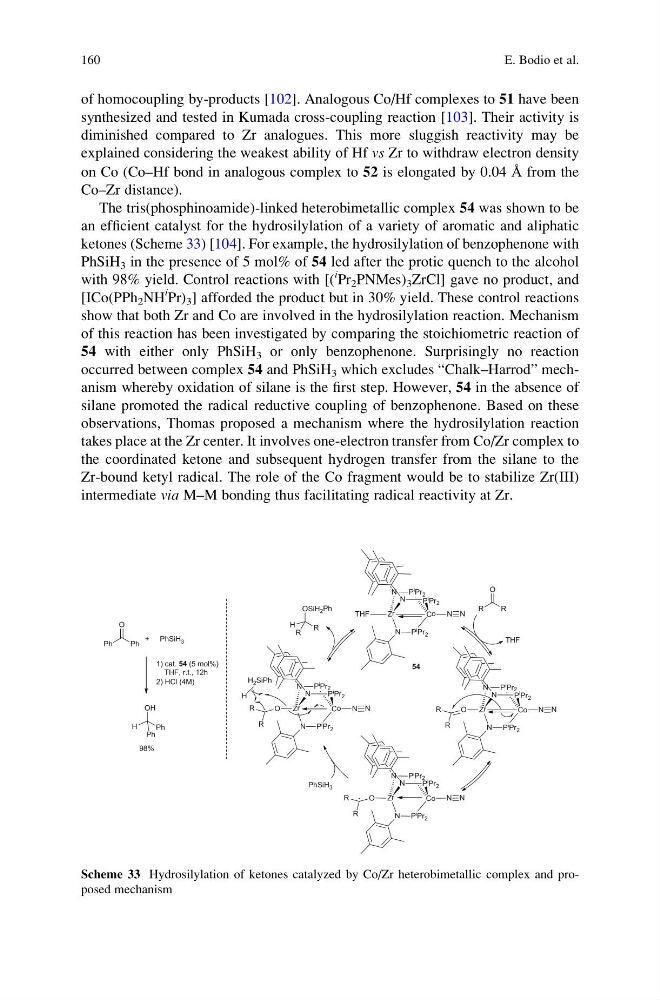
The tris(phosphinoamide)-linked heterobimetallic complex 54 was shown to be
an efficient catalyst for the hydrosilylation of a variety of aromatic and aliphatic
ketones (Scheme 33) [104]. For example, the hydrosilylation of benzophenone with
PhSiH 3 in the presence of 5 mol% of 54 led after the protic quench to the alcohol
with 98% yield. Control reactions with [(
i
Pr 2 PNMes) 3 ZrCl] gave no product, and
[ICo(PPh 2 NH
i
Pr) 3 ] afforded the product but in 30% yield. These control reactions
show that both Zr and Co are involved in the hydrosilylation reaction. Mechanism
of this reaction has been investigated by comparing the stoichiometric reaction of
54 with either only PhSiH 3 or only benzophenone. Surprisingly no reaction
occurred between complex 54 and PhSiH 3 which excludes “Chalk–Harrod” mechanism whereby oxidation of silane is the first step. However, 54 in the absence of
silane promoted the radical reductive coupling of benzophenone. Based on these
observations, Thomas proposed a mechanism where the hydrosilylation reaction
takes place at the Zr center. It involves one-electron transfer from Co/Zr complex to
the coordinated ketone and subsequent hydrogen transfer from the silane to the
Zr-bound ketyl radical. The role of the Co fragment would be to stabilize Zr(III)
intermediate via M–M bonding thus facilitating radical reactivity at Zr.
1) cat. 54 (5 mol%)
THF, r.t., 12h
2) HCl (4M)
+
P i Pr 2
Zr
N P i Pr 2
P i Pr 2
N
N
Co N N
54
THF
P i Pr2
Zr
N P i Pr 2
P i Pr 2
N
N
Co N N
O
R
R
H
H 2 SiPh
P i Pr2
Zr
N P i Pr 2
P i Pr 2
N
N
Co N N
O
R
R
P i Pr2
Zr
N P i Pr 2
P i Pr 2
N
N
Co N N
O
R
R
R
R
O
THF
PhSiH 3
OSiH 2 Ph
H
R
R
Ph
Ph
O
PhSiH 3
Ph
OH
Ph
H
98%
Scheme 33 Hydrosilylation of ketones catalyzed by Co/Zr heterobimetallic complex and proposed mechanism
160
E. Bodio et al.
synthesized and tested in Kumada cross-coupling reaction [103]. Their activity is
diminished compared to Zr analogues. This more sluggish reactivity may be
explained considering the weakest ability of Hf vs Zr to withdraw electron density
on Co (Co–Hf bond in analogous complex to 52 is elongated by 0.04 Å from the
Co–Zr distance).
The tris(phosphinoamide)-linked heterobimetallic complex 54 was shown to be
an efficient catalyst for the hydrosilylation of a variety of aromatic and aliphatic
ketones (Scheme 33) [104]. For example, the hydrosilylation of benzophenone with
PhSiH 3 in the presence of 5 mol% of 54 led after the protic quench to the alcohol
with 98% yield. Control reactions with [(
i
Pr 2 PNMes) 3 ZrCl] gave no product, and
[ICo(PPh 2 NH
i
Pr) 3 ] afforded the product but in 30% yield. These control reactions
show that both Zr and Co are involved in the hydrosilylation reaction. Mechanism
of this reaction has been investigated by comparing the stoichiometric reaction of
54 with either only PhSiH 3 or only benzophenone. Surprisingly no reaction
occurred between complex 54 and PhSiH 3 which excludes “Chalk–Harrod” mechanism whereby oxidation of silane is the first step. However, 54 in the absence of
silane promoted the radical reductive coupling of benzophenone. Based on these
observations, Thomas proposed a mechanism where the hydrosilylation reaction
takes place at the Zr center. It involves one-electron transfer from Co/Zr complex to
the coordinated ketone and subsequent hydrogen transfer from the silane to the
Zr-bound ketyl radical. The role of the Co fragment would be to stabilize Zr(III)
intermediate via M–M bonding thus facilitating radical reactivity at Zr.
1) cat. 54 (5 mol%)
THF, r.t., 12h
2) HCl (4M)
+
P i Pr 2
Zr
N P i Pr 2
P i Pr 2
N
N
Co N N
54
THF
P i Pr2
Zr
N P i Pr 2
P i Pr 2
N
N
Co N N
O
R
R
H
H 2 SiPh
P i Pr2
Zr
N P i Pr 2
P i Pr 2
N
N
Co N N
O
R
R
P i Pr2
Zr
N P i Pr 2
P i Pr 2
N
N
Co N N
O
R
R
R
R
O
THF
PhSiH 3
OSiH 2 Ph
H
R
R
Ph
Ph
O
PhSiH 3
Ph
OH
Ph
H
98%
Scheme 33 Hydrosilylation of ketones catalyzed by Co/Zr heterobimetallic complex and proposed mechanism
160
E. Bodio et al.