

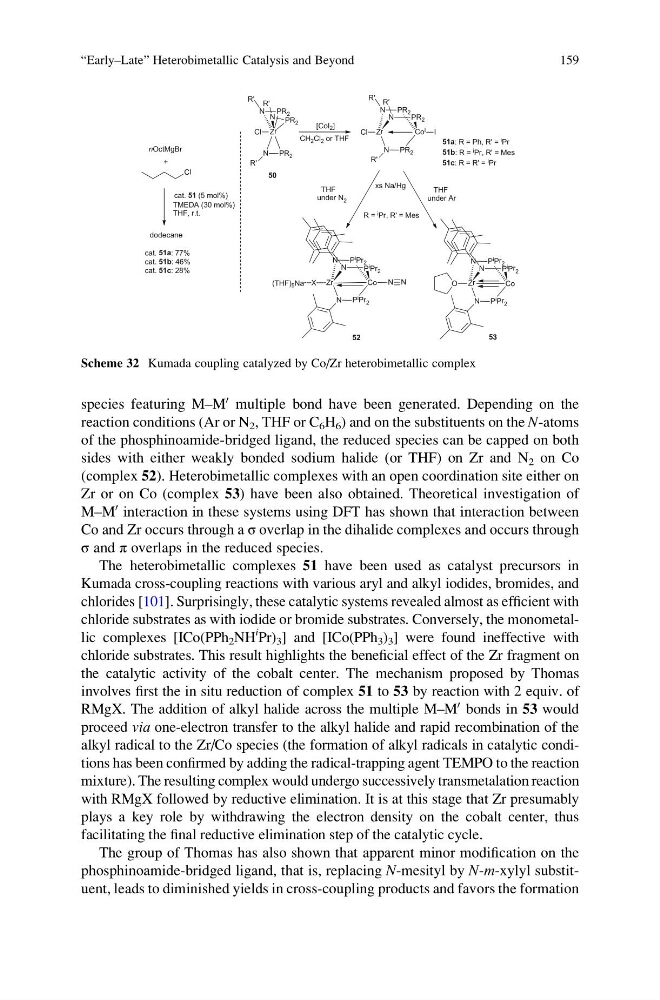
species featuring M–M
0 multiple bond have been generated. Depending on the
reaction conditions (Ar or N 2 , THF or C 6 H 6 ) and on the substituents on the N-atoms
of the phosphinoamide-bridged ligand, the reduced species can be capped on both
sides with either weakly bonded sodium halide (or THF) on Zr and N 2 on Co
(complex 52). Heterobimetallic complexes with an open coordination site either on
Zr or on Co (complex 53) have been also obtained. Theoretical investigation of
M–M
0 interaction in these systems using DFT has shown that interaction between
Co and Zr occurs through a σ overlap in the dihalide complexes and occurs through
σ and π overlaps in the reduced species.
The heterobimetallic complexes 51 have been used as catalyst precursors in
Kumada cross-coupling reactions with various aryl and alkyl iodides, bromides, and
chlorides [101]. Surprisingly, these catalytic systems revealed almost as efficient with
chloride substrates as with iodide or bromide substrates. Conversely, the monometallic complexes [ICo(PPh 2 NH
i
Pr) 3 ] and [ICo(PPh 3 ) 3 ] were found ineffective with
chloride substrates. This result highlights the beneficial effect of the Zr fragment on
the catalytic activity of the cobalt center. The mechanism proposed by Thomas
involves first the in situ reduction of complex 51 to 53 by reaction with 2 equiv. of
RMgX. The addition of alkyl halide across the multiple M–M
0 bonds in 53 would
proceed via one-electron transfer to the alkyl halide and rapid recombination of the
alkyl radical to the Zr/Co species (the formation of alkyl radicals in catalytic conditions has been confirmed by adding the radical-trapping agent TEMPO to the reaction
mixture). The resulting complex would undergo successively transmetalation reaction
with RMgX followed by reductive elimination. It is at this stage that Zr presumably
plays a key role by withdrawing the electron density on the cobalt center, thus
facilitating the final reductive elimination step of the catalytic cycle.
The group of Thomas has also shown that apparent minor modification on the
phosphinoamide-bridged ligand, that is, replacing N-mesityl by N-m-xylyl substituent, leads to diminished yields in cross-coupling products and favors the formation
PR 2
nOctMgBr
Cl
cat. 51 (5 mol%)
TMEDA (30 mol%)
THF, r.t.
dodecane
cat. 51a: 77%
cat. 51b: 46%
cat. 51c: 28%
Zr
Cl
N PR 2
PR 2
N
R'
R'
N
R'
[CoI2]
CH 2 Cl 2 or THF
PR 2
Zr
Cl
N PR 2
PR 2
N
R'
R'
N
R'
Co I I
51a: R = Ph, R' = i Pr
51b: R = i Pr, R' = Mes
51c: R = R' = i Pr
50
+
xs Na/Hg
THF
under Ar
P i Pr 2
Zr
N P i Pr 2
P i Pr 2
N
N
Co
O
R = i Pr, R' = Mes
THF
under N 2
53
P i Pr 2
(THF) 5 Na---X----Zr
N P i Pr 2
P i Pr 2
N
N
Co N N
52
Scheme 32 Kumada coupling catalyzed by Co/Zr heterobimetallic complex
“Early–Late” Heterobimetallic Catalysis and Beyond
159
0 multiple bond have been generated. Depending on the
reaction conditions (Ar or N 2 , THF or C 6 H 6 ) and on the substituents on the N-atoms
of the phosphinoamide-bridged ligand, the reduced species can be capped on both
sides with either weakly bonded sodium halide (or THF) on Zr and N 2 on Co
(complex 52). Heterobimetallic complexes with an open coordination site either on
Zr or on Co (complex 53) have been also obtained. Theoretical investigation of
M–M
0 interaction in these systems using DFT has shown that interaction between
Co and Zr occurs through a σ overlap in the dihalide complexes and occurs through
σ and π overlaps in the reduced species.
The heterobimetallic complexes 51 have been used as catalyst precursors in
Kumada cross-coupling reactions with various aryl and alkyl iodides, bromides, and
chlorides [101]. Surprisingly, these catalytic systems revealed almost as efficient with
chloride substrates as with iodide or bromide substrates. Conversely, the monometallic complexes [ICo(PPh 2 NH
i
Pr) 3 ] and [ICo(PPh 3 ) 3 ] were found ineffective with
chloride substrates. This result highlights the beneficial effect of the Zr fragment on
the catalytic activity of the cobalt center. The mechanism proposed by Thomas
involves first the in situ reduction of complex 51 to 53 by reaction with 2 equiv. of
RMgX. The addition of alkyl halide across the multiple M–M
0 bonds in 53 would
proceed via one-electron transfer to the alkyl halide and rapid recombination of the
alkyl radical to the Zr/Co species (the formation of alkyl radicals in catalytic conditions has been confirmed by adding the radical-trapping agent TEMPO to the reaction
mixture). The resulting complex would undergo successively transmetalation reaction
with RMgX followed by reductive elimination. It is at this stage that Zr presumably
plays a key role by withdrawing the electron density on the cobalt center, thus
facilitating the final reductive elimination step of the catalytic cycle.
The group of Thomas has also shown that apparent minor modification on the
phosphinoamide-bridged ligand, that is, replacing N-mesityl by N-m-xylyl substituent, leads to diminished yields in cross-coupling products and favors the formation
PR 2
nOctMgBr
Cl
cat. 51 (5 mol%)
TMEDA (30 mol%)
THF, r.t.
dodecane
cat. 51a: 77%
cat. 51b: 46%
cat. 51c: 28%
Zr
Cl
N PR 2
PR 2
N
R'
R'
N
R'
[CoI2]
CH 2 Cl 2 or THF
PR 2
Zr
Cl
N PR 2
PR 2
N
R'
R'
N
R'
Co I I
51a: R = Ph, R' = i Pr
51b: R = i Pr, R' = Mes
51c: R = R' = i Pr
50
+
xs Na/Hg
THF
under Ar
P i Pr 2
Zr
N P i Pr 2
P i Pr 2
N
N
Co
O
R = i Pr, R' = Mes
THF
under N 2
53
P i Pr 2
(THF) 5 Na---X----Zr
N P i Pr 2
P i Pr 2
N
N
Co N N
52
Scheme 32 Kumada coupling catalyzed by Co/Zr heterobimetallic complex
“Early–Late” Heterobimetallic Catalysis and Beyond
159