

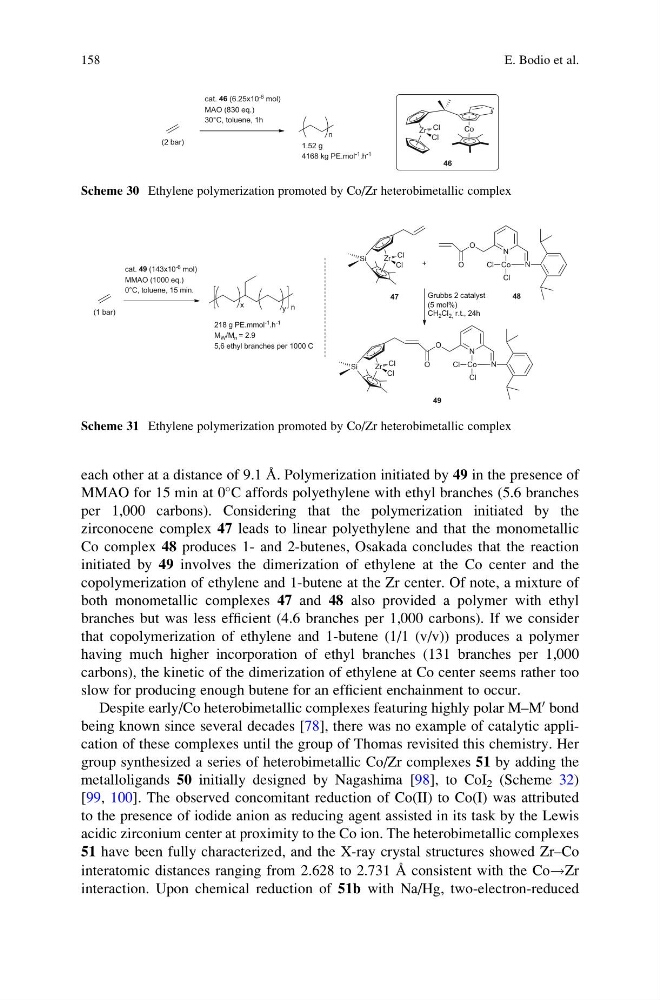
each other at a distance of 9.1 Å. Polymerization initiated by 49 in the presence of
MMAO for 15 min at 0
C affords polyethylene with ethyl branches (5.6 branches
per 1,000 carbons). Considering that the polymerization initiated by the
zirconocene complex 47 leads to linear polyethylene and that the monometallic
Co complex 48 produces 1- and 2-butenes, Osakada concludes that the reaction
initiated by 49 involves the dimerization of ethylene at the Co center and the
copolymerization of ethylene and 1-butene at the Zr center. Of note, a mixture of
both monometallic complexes 47 and 48 also provided a polymer with ethyl
branches but was less efficient (4.6 branches per 1,000 carbons). If we consider
that copolymerization of ethylene and 1-butene (1/1 (v/v)) produces a polymer
having much higher incorporation of ethyl branches (131 branches per 1,000
carbons), the kinetic of the dimerization of ethylene at Co center seems rather too
slow for producing enough butene for an efficient enchainment to occur.
Despite early/Co heterobimetallic complexes featuring highly polar M–M
0 bond
being known since several decades [78], there was no example of catalytic application of these complexes until the group of Thomas revisited this chemistry. Her
group synthesized a series of heterobimetallic Co/Zr complexes 51 by adding the
metalloligands 50 initially designed by Nagashima [98], to CoI 2 (Scheme 32)
[99, 100]. The observed concomitant reduction of Co(II) to Co(I) was attributed
to the presence of iodide anion as reducing agent assisted in its task by the Lewis
acidic zirconium center at proximity to the Co ion. The heterobimetallic complexes
51 have been fully characterized, and the X-ray crystal structures showed Zr–Co
interatomic distances ranging from 2.628 to 2.731 Å consistent with the Co!Zr
interaction. Upon chemical reduction of 51b with Na/Hg, two-electron-reduced
Zr Cl
Cl
Co
n
cat. 46 (6.25x10 -6 mol)
MAO (830 eq.)
30°C, toluene, 1h
(2 bar)
1.52 g
4168 kg PE.mol -1 .h -1
46
Scheme 30 Ethylene polymerization promoted by Co/Zr heterobimetallic complex
x
cat. 49 (143x10 -6 mol)
MMAO (1000 eq.)
0°C, toluene, 15 min.
(1 bar)
218 g PE.mmol -1 .h -1
M W /M n = 2.9
5,6 ethyl branches per 1000 C
y n
Zr Cl
Cl
49
Si
O
O
N
N
Co
Cl
Cl
Zr Cl
Cl
Si
48
O
O
N
N
Co
Cl
Cl
+
Grubbs 2 catalyst
(5 mol%)
CH 2 Cl 2, r.t., 24h
47
Scheme 31 Ethylene polymerization promoted by Co/Zr heterobimetallic complex
158
E. Bodio et al.
MMAO for 15 min at 0
C affords polyethylene with ethyl branches (5.6 branches
per 1,000 carbons). Considering that the polymerization initiated by the
zirconocene complex 47 leads to linear polyethylene and that the monometallic
Co complex 48 produces 1- and 2-butenes, Osakada concludes that the reaction
initiated by 49 involves the dimerization of ethylene at the Co center and the
copolymerization of ethylene and 1-butene at the Zr center. Of note, a mixture of
both monometallic complexes 47 and 48 also provided a polymer with ethyl
branches but was less efficient (4.6 branches per 1,000 carbons). If we consider
that copolymerization of ethylene and 1-butene (1/1 (v/v)) produces a polymer
having much higher incorporation of ethyl branches (131 branches per 1,000
carbons), the kinetic of the dimerization of ethylene at Co center seems rather too
slow for producing enough butene for an efficient enchainment to occur.
Despite early/Co heterobimetallic complexes featuring highly polar M–M
0 bond
being known since several decades [78], there was no example of catalytic application of these complexes until the group of Thomas revisited this chemistry. Her
group synthesized a series of heterobimetallic Co/Zr complexes 51 by adding the
metalloligands 50 initially designed by Nagashima [98], to CoI 2 (Scheme 32)
[99, 100]. The observed concomitant reduction of Co(II) to Co(I) was attributed
to the presence of iodide anion as reducing agent assisted in its task by the Lewis
acidic zirconium center at proximity to the Co ion. The heterobimetallic complexes
51 have been fully characterized, and the X-ray crystal structures showed Zr–Co
interatomic distances ranging from 2.628 to 2.731 Å consistent with the Co!Zr
interaction. Upon chemical reduction of 51b with Na/Hg, two-electron-reduced
Zr Cl
Cl
Co
n
cat. 46 (6.25x10 -6 mol)
MAO (830 eq.)
30°C, toluene, 1h
(2 bar)
1.52 g
4168 kg PE.mol -1 .h -1
46
Scheme 30 Ethylene polymerization promoted by Co/Zr heterobimetallic complex
x
cat. 49 (143x10 -6 mol)
MMAO (1000 eq.)
0°C, toluene, 15 min.
(1 bar)
218 g PE.mmol -1 .h -1
M W /M n = 2.9
5,6 ethyl branches per 1000 C
y n
Zr Cl
Cl
49
Si
O
O
N
N
Co
Cl
Cl
Zr Cl
Cl
Si
48
O
O
N
N
Co
Cl
Cl
+
Grubbs 2 catalyst
(5 mol%)
CH 2 Cl 2, r.t., 24h
47
Scheme 31 Ethylene polymerization promoted by Co/Zr heterobimetallic complex
158
E. Bodio et al.