

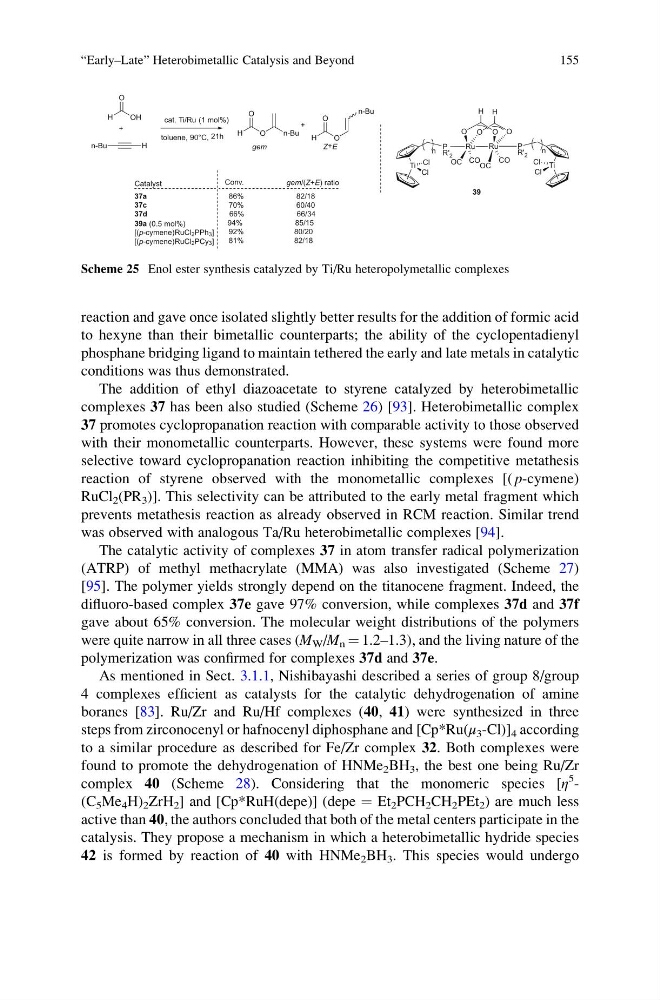
reaction and gave once isolated slightly better results for the addition of formic acid
to hexyne than their bimetallic counterparts; the ability of the cyclopentadienyl
phosphane bridging ligand to maintain tethered the early and late metals in catalytic
conditions was thus demonstrated.
The addition of ethyl diazoacetate to styrene catalyzed by heterobimetallic
complexes 37 has been also studied (Scheme 26) [93]. Heterobimetallic complex
37 promotes cyclopropanation reaction with comparable activity to those observed
with their monometallic counterparts. However, these systems were found more
selective toward cyclopropanation reaction inhibiting the competitive metathesis
reaction of styrene observed with the monometallic complexes [( p-cymene)
RuCl 2 (PR 3 )]. This selectivity can be attributed to the early metal fragment which
prevents metathesis reaction as already observed in RCM reaction. Similar trend
was observed with analogous Ta/Ru heterobimetallic complexes [94].
The catalytic activity of complexes 37 in atom transfer radical polymerization
(ATRP) of methyl methacrylate (MMA) was also investigated (Scheme 27)
[95]. The polymer yields strongly depend on the titanocene fragment. Indeed, the
difluoro-based complex 37e gave 97% conversion, while complexes 37d and 37f
gave about 65% conversion. The molecular weight distributions of the polymers
were quite narrow in all three cases (M W /M n ¼ 1.2–1.3), and the living nature of the
polymerization was confirmed for complexes 37d and 37e.
As mentioned in Sect. 3.1.1, Nishibayashi described a series of group 8/group
4 complexes efficient as catalysts for the catalytic dehydrogenation of amine
boranes [83]. Ru/Zr and Ru/Hf complexes (40, 41) were synthesized in three
steps from zirconocenyl or hafnocenyl diphosphane and [Cp*Ru(μ 3 -Cl)] 4 according
to a similar procedure as described for Fe/Zr complex 32. Both complexes were
found to promote the dehydrogenation of HNMe 2 BH 3 , the best one being Ru/Zr
complex 40 (Scheme 28). Considering that the monomeric species [η
5 -
(C 5 Me 4 H) 2 ZrH 2 ] and [Cp*RuH(depe)] (depe ¼ Et 2 PCH 2 CH 2 PEt 2 ) are much less
active than 40, the authors concluded that both of the metal centers participate in the
catalysis. They propose a mechanism in which a heterobimetallic hydride species
42 is formed by reaction of 40 with HNMe 2 BH 3 . This species would undergo
H
OH
O
n-Bu
H
H
O
n-Bu
O
cat. Ti/Ru (1 mol%)
H
O
O
+
n-Bu
toluene, 90°C, 21h
gem
Z+E
Ti Cl
Cl
P
R' 2
n
Ru
CO
OC
O O
Ti
Cl
Cl
P
R' 2
n
Ru
OC
CO
O O
H H
39
+
Catalyst
Conv.
gem/(Z+E) ratio
37a
86%
82/18
37c
70%
60/40
37d
66%
66/34
39a (0.5 mol%)
94%
85/15
[(p-cymene)RuCl2PPh3]
92%
80/20
[(p-cymene)RuCl2PCy3]
81%
82/18
Scheme 25 Enol ester synthesis catalyzed by Ti/Ru heteropolymetallic complexes
“Early–Late” Heterobimetallic Catalysis and Beyond
155
to hexyne than their bimetallic counterparts; the ability of the cyclopentadienyl
phosphane bridging ligand to maintain tethered the early and late metals in catalytic
conditions was thus demonstrated.
The addition of ethyl diazoacetate to styrene catalyzed by heterobimetallic
complexes 37 has been also studied (Scheme 26) [93]. Heterobimetallic complex
37 promotes cyclopropanation reaction with comparable activity to those observed
with their monometallic counterparts. However, these systems were found more
selective toward cyclopropanation reaction inhibiting the competitive metathesis
reaction of styrene observed with the monometallic complexes [( p-cymene)
RuCl 2 (PR 3 )]. This selectivity can be attributed to the early metal fragment which
prevents metathesis reaction as already observed in RCM reaction. Similar trend
was observed with analogous Ta/Ru heterobimetallic complexes [94].
The catalytic activity of complexes 37 in atom transfer radical polymerization
(ATRP) of methyl methacrylate (MMA) was also investigated (Scheme 27)
[95]. The polymer yields strongly depend on the titanocene fragment. Indeed, the
difluoro-based complex 37e gave 97% conversion, while complexes 37d and 37f
gave about 65% conversion. The molecular weight distributions of the polymers
were quite narrow in all three cases (M W /M n ¼ 1.2–1.3), and the living nature of the
polymerization was confirmed for complexes 37d and 37e.
As mentioned in Sect. 3.1.1, Nishibayashi described a series of group 8/group
4 complexes efficient as catalysts for the catalytic dehydrogenation of amine
boranes [83]. Ru/Zr and Ru/Hf complexes (40, 41) were synthesized in three
steps from zirconocenyl or hafnocenyl diphosphane and [Cp*Ru(μ 3 -Cl)] 4 according
to a similar procedure as described for Fe/Zr complex 32. Both complexes were
found to promote the dehydrogenation of HNMe 2 BH 3 , the best one being Ru/Zr
complex 40 (Scheme 28). Considering that the monomeric species [η
5 -
(C 5 Me 4 H) 2 ZrH 2 ] and [Cp*RuH(depe)] (depe ¼ Et 2 PCH 2 CH 2 PEt 2 ) are much less
active than 40, the authors concluded that both of the metal centers participate in the
catalysis. They propose a mechanism in which a heterobimetallic hydride species
42 is formed by reaction of 40 with HNMe 2 BH 3 . This species would undergo
H
OH
O
n-Bu
H
H
O
n-Bu
O
cat. Ti/Ru (1 mol%)
H
O
O
+
n-Bu
toluene, 90°C, 21h
gem
Z+E
Ti Cl
Cl
P
R' 2
n
Ru
CO
OC
O O
Ti
Cl
Cl
P
R' 2
n
Ru
OC
CO
O O
H H
39
+
Catalyst
Conv.
gem/(Z+E) ratio
37a
86%
82/18
37c
70%
60/40
37d
66%
66/34
39a (0.5 mol%)
94%
85/15
[(p-cymene)RuCl2PPh3]
92%
80/20
[(p-cymene)RuCl2PCy3]
81%
82/18
Scheme 25 Enol ester synthesis catalyzed by Ti/Ru heteropolymetallic complexes
“Early–Late” Heterobimetallic Catalysis and Beyond
155