

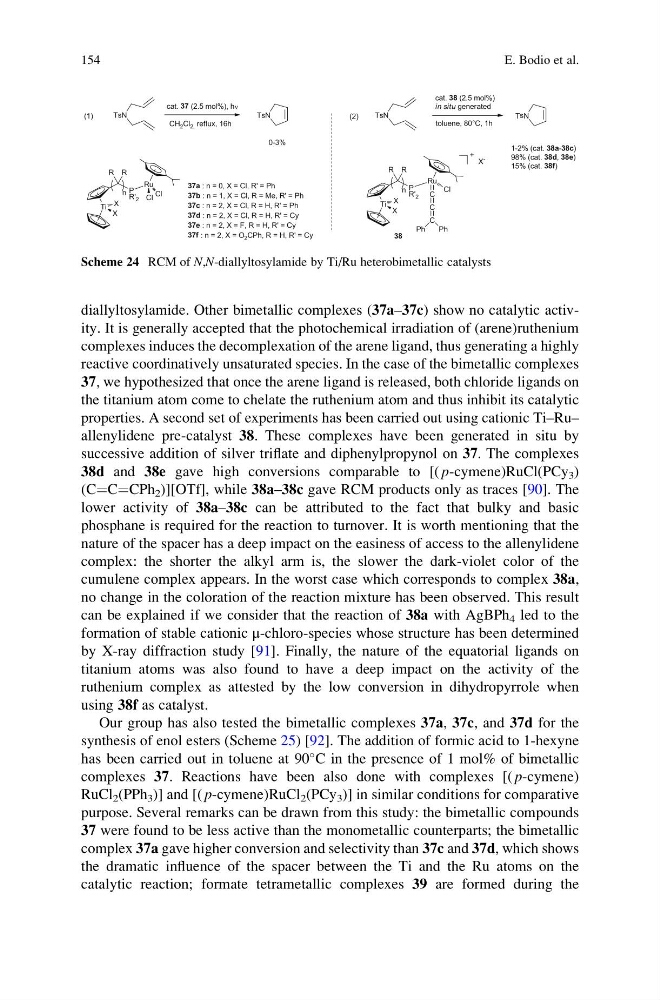
diallyltosylamide. Other bimetallic complexes (37a–37c) show no catalytic activity. It is generally accepted that the photochemical irradiation of (arene)ruthenium
complexes induces the decomplexation of the arene ligand, thus generating a highly
reactive coordinatively unsaturated species. In the case of the bimetallic complexes
37, we hypothesized that once the arene ligand is released, both chloride ligands on
the titanium atom come to chelate the ruthenium atom and thus inhibit its catalytic
properties. A second set of experiments has been carried out using cationic Ti–Ru–
allenylidene pre-catalyst 38. These complexes have been generated in situ by
successive addition of silver triflate and diphenylpropynol on 37. The complexes
38d and 38e gave high conversions comparable to [( p-cymene)RuCl(PCy 3 )
(C¼C¼CPh 2 )][OTf], while 38a–38c gave RCM products only as traces [90]. The
lower activity of 38a–38c can be attributed to the fact that bulky and basic
phosphane is required for the reaction to turnover. It is worth mentioning that the
nature of the spacer has a deep impact on the easiness of access to the allenylidene
complex: the shorter the alkyl arm is, the slower the dark-violet color of the
cumulene complex appears. In the worst case which corresponds to complex 38a,
no change in the coloration of the reaction mixture has been observed. This result
can be explained if we consider that the reaction of 38a with AgBPh 4 led to the
formation of stable cationic μ-chloro-species whose structure has been determined
by X-ray diffraction study [91]. Finally, the nature of the equatorial ligands on
titanium atoms was also found to have a deep impact on the activity of the
ruthenium complex as attested by the low conversion in dihydropyrrole when
using 38f as catalyst.
Our group has also tested the bimetallic complexes 37a, 37c, and 37d for the
synthesis of enol esters (Scheme 25) [92]. The addition of formic acid to 1-hexyne
has been carried out in toluene at 90
C in the presence of 1 mol% of bimetallic
complexes 37. Reactions have been also done with complexes [( p-cymene)
RuCl 2 (PPh 3 )] and [( p-cymene)RuCl 2 (PCy 3 )] in similar conditions for comparative
purpose. Several remarks can be drawn from this study: the bimetallic compounds
37 were found to be less active than the monometallic counterparts; the bimetallic
complex 37a gave higher conversion and selectivity than 37c and 37d, which shows
the dramatic influence of the spacer between the Ti and the Ru atoms on the
catalytic reaction; formate tetrametallic complexes 39 are formed during the
Ti X
X
P
R' 2
R
R
n
Ru
Cl
Cl
37a : n = 0, X = Cl, R' = Ph
37b : n = 1, X = Cl, R = Me, R' = Ph
37c : n = 2, X = Cl, R = H, R' = Ph
37d : n = 2, X = Cl, R = H, R' = Cy
37e : n = 2, X = F, R = H, R' = Cy
37f : n = 2, X = O 2 CPh, R = H, R' = Cy
TsN
TsN
CH 2 Cl 2, reflux, 16h
cat. 37 (2.5 mol%), hν
0-3%
TsN
TsN
toluene, 80°C, 1h
cat. 38 (2.5 mol%)
in situ generated
1-2% (cat. 38a-38c)
98% (cat. 38d, 38e)
15% (cat. 38f)
Ru
Cl
+
X -
C
C
C
Ph
Ph
38
(1)
(2)
Ti X
X
P
R' 2
R
R
n
Scheme 24 RCM of N,N-diallyltosylamide by Ti/Ru heterobimetallic catalysts
154
E. Bodio et al.
complexes induces the decomplexation of the arene ligand, thus generating a highly
reactive coordinatively unsaturated species. In the case of the bimetallic complexes
37, we hypothesized that once the arene ligand is released, both chloride ligands on
the titanium atom come to chelate the ruthenium atom and thus inhibit its catalytic
properties. A second set of experiments has been carried out using cationic Ti–Ru–
allenylidene pre-catalyst 38. These complexes have been generated in situ by
successive addition of silver triflate and diphenylpropynol on 37. The complexes
38d and 38e gave high conversions comparable to [( p-cymene)RuCl(PCy 3 )
(C¼C¼CPh 2 )][OTf], while 38a–38c gave RCM products only as traces [90]. The
lower activity of 38a–38c can be attributed to the fact that bulky and basic
phosphane is required for the reaction to turnover. It is worth mentioning that the
nature of the spacer has a deep impact on the easiness of access to the allenylidene
complex: the shorter the alkyl arm is, the slower the dark-violet color of the
cumulene complex appears. In the worst case which corresponds to complex 38a,
no change in the coloration of the reaction mixture has been observed. This result
can be explained if we consider that the reaction of 38a with AgBPh 4 led to the
formation of stable cationic μ-chloro-species whose structure has been determined
by X-ray diffraction study [91]. Finally, the nature of the equatorial ligands on
titanium atoms was also found to have a deep impact on the activity of the
ruthenium complex as attested by the low conversion in dihydropyrrole when
using 38f as catalyst.
Our group has also tested the bimetallic complexes 37a, 37c, and 37d for the
synthesis of enol esters (Scheme 25) [92]. The addition of formic acid to 1-hexyne
has been carried out in toluene at 90
C in the presence of 1 mol% of bimetallic
complexes 37. Reactions have been also done with complexes [( p-cymene)
RuCl 2 (PPh 3 )] and [( p-cymene)RuCl 2 (PCy 3 )] in similar conditions for comparative
purpose. Several remarks can be drawn from this study: the bimetallic compounds
37 were found to be less active than the monometallic counterparts; the bimetallic
complex 37a gave higher conversion and selectivity than 37c and 37d, which shows
the dramatic influence of the spacer between the Ti and the Ru atoms on the
catalytic reaction; formate tetrametallic complexes 39 are formed during the
Ti X
X
P
R' 2
R
R
n
Ru
Cl
Cl
37a : n = 0, X = Cl, R' = Ph
37b : n = 1, X = Cl, R = Me, R' = Ph
37c : n = 2, X = Cl, R = H, R' = Ph
37d : n = 2, X = Cl, R = H, R' = Cy
37e : n = 2, X = F, R = H, R' = Cy
37f : n = 2, X = O 2 CPh, R = H, R' = Cy
TsN
TsN
CH 2 Cl 2, reflux, 16h
cat. 37 (2.5 mol%), hν
0-3%
TsN
TsN
toluene, 80°C, 1h
cat. 38 (2.5 mol%)
in situ generated
1-2% (cat. 38a-38c)
98% (cat. 38d, 38e)
15% (cat. 38f)
Ru
Cl
+
X -
C
C
C
Ph
Ph
38
(1)
(2)
Ti X
X
P
R' 2
R
R
n
Scheme 24 RCM of N,N-diallyltosylamide by Ti/Ru heterobimetallic catalysts
154
E. Bodio et al.