

of [AgOTf] affords the dicationic species 34, which can be reversibly reduced upon
the addition of [Cp* 2 Fe]. The ROP of rac-lactide (LA) was investigated with both
complexes and showed that complex with the non-oxidized ligand affords a more
rapid polymerization (k app [33]/k app [34] % 30). The reversible nature of the redox
switch was further proved by stopping the ROP of LA by adding [AgOTf] and
restoring the activity by addition of [Cp* 2 Fe].
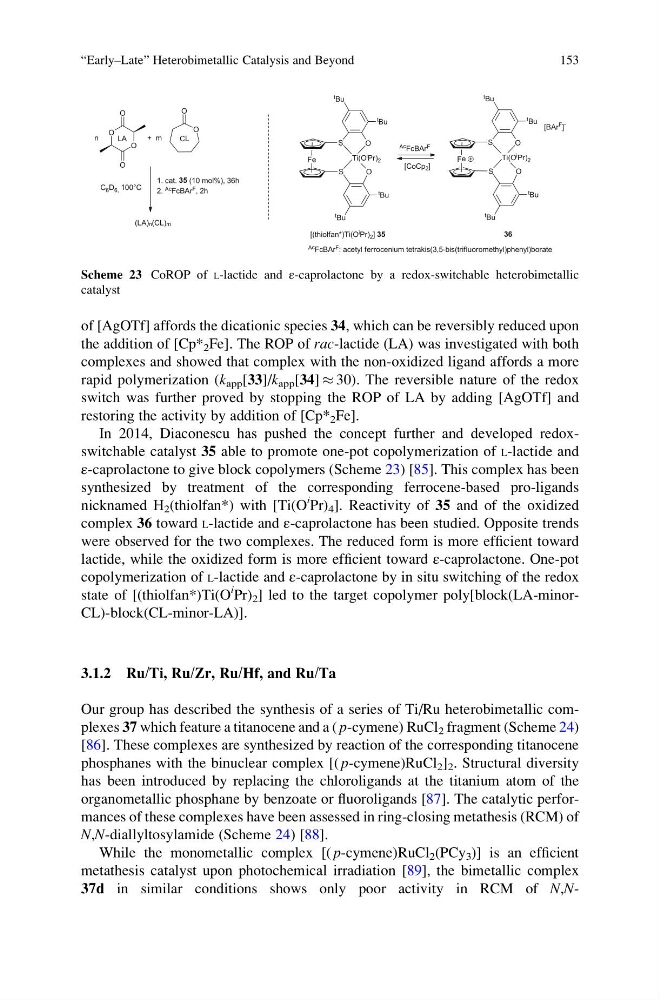
In 2014, Diaconescu has pushed the concept further and developed redoxswitchable catalyst 35 able to promote one-pot copolymerization of L-lactide and
ε-caprolactone to give block copolymers (Scheme 23) [85]. This complex has been
synthesized by treatment of the corresponding ferrocene-based pro-ligands
nicknamed H 2 (thiolfan*) with [Ti(O
i
Pr) 4 ]. Reactivity of 35 and of the oxidized
complex 36 toward L-lactide and ε-caprolactone has been studied. Opposite trends
were observed for the two complexes. The reduced form is more efficient toward
lactide, while the oxidized form is more efficient toward ε-caprolactone. One-pot
copolymerization of L-lactide and ε-caprolactone by in situ switching of the redox
state of [(thiolfan*)Ti(O
i
Pr) 2 ] led to the target copolymer poly[block(LA-minorCL)-block(CL-minor-LA)].
3.1.2 Ru/Ti, Ru/Zr, Ru/Hf, and Ru/Ta
Our group has described the synthesis of a series of Ti/Ru heterobimetallic complexes 37 which feature a titanocene and a ( p-cymene) RuCl 2 fragment (Scheme 24)
[86]. These complexes are synthesized by reaction of the corresponding titanocene
phosphanes with the binuclear complex [( p-cymene)RuCl 2 ] 2 . Structural diversity
has been introduced by replacing the chloroligands at the titanium atom of the
organometallic phosphane by benzoate or fluoroligands [87]. The catalytic performances of these complexes have been assessed in ring-closing metathesis (RCM) of
N,N-diallyltosylamide (Scheme 24) [88].
While the monometallic complex [( p-cymene)RuCl 2 (PCy 3 )] is an efficient
metathesis catalyst upon photochemical irradiation [89], the bimetallic complex
37d in similar conditions shows only poor activity in RCM of N,NFe
S
O
t Bu
t Bu
S
O
t Bu
t Bu
Ti(O i Pr) 2
[(thiolfan*)Ti(O i Pr) 2 ] 35
Fe
S
O
t Bu
t Bu
S
O
t Bu
t Bu
Ti(O i Pr) 2
[BAr F ]
-
36
O
O
O
O
n
+ m
O
O
LA
CL
1. cat. 35 (10 mol%), 36h
2. Ac FcBAr F , 2h
C 6 D 6, 100°C
(LA)n(CL)m
Ac FcBAr F
[CoCp2]
Ac FcBAr F : acetyl ferrocenium tetrakis(3,5-bis(trifluoromethyl)phenyl)borate
Scheme 23 CoROP of L-lactide and ε-caprolactone by a redox-switchable heterobimetallic
catalyst
“Early–Late” Heterobimetallic Catalysis and Beyond
153
the addition of [Cp* 2 Fe]. The ROP of rac-lactide (LA) was investigated with both
complexes and showed that complex with the non-oxidized ligand affords a more
rapid polymerization (k app [33]/k app [34] % 30). The reversible nature of the redox
switch was further proved by stopping the ROP of LA by adding [AgOTf] and
restoring the activity by addition of [Cp* 2 Fe].
In 2014, Diaconescu has pushed the concept further and developed redoxswitchable catalyst 35 able to promote one-pot copolymerization of L-lactide and
ε-caprolactone to give block copolymers (Scheme 23) [85]. This complex has been
synthesized by treatment of the corresponding ferrocene-based pro-ligands
nicknamed H 2 (thiolfan*) with [Ti(O
i
Pr) 4 ]. Reactivity of 35 and of the oxidized
complex 36 toward L-lactide and ε-caprolactone has been studied. Opposite trends
were observed for the two complexes. The reduced form is more efficient toward
lactide, while the oxidized form is more efficient toward ε-caprolactone. One-pot
copolymerization of L-lactide and ε-caprolactone by in situ switching of the redox
state of [(thiolfan*)Ti(O
i
Pr) 2 ] led to the target copolymer poly[block(LA-minorCL)-block(CL-minor-LA)].
3.1.2 Ru/Ti, Ru/Zr, Ru/Hf, and Ru/Ta
Our group has described the synthesis of a series of Ti/Ru heterobimetallic complexes 37 which feature a titanocene and a ( p-cymene) RuCl 2 fragment (Scheme 24)
[86]. These complexes are synthesized by reaction of the corresponding titanocene
phosphanes with the binuclear complex [( p-cymene)RuCl 2 ] 2 . Structural diversity
has been introduced by replacing the chloroligands at the titanium atom of the
organometallic phosphane by benzoate or fluoroligands [87]. The catalytic performances of these complexes have been assessed in ring-closing metathesis (RCM) of
N,N-diallyltosylamide (Scheme 24) [88].
While the monometallic complex [( p-cymene)RuCl 2 (PCy 3 )] is an efficient
metathesis catalyst upon photochemical irradiation [89], the bimetallic complex
37d in similar conditions shows only poor activity in RCM of N,NFe
S
O
t Bu
t Bu
S
O
t Bu
t Bu
Ti(O i Pr) 2
[(thiolfan*)Ti(O i Pr) 2 ] 35
Fe
S
O
t Bu
t Bu
S
O
t Bu
t Bu
Ti(O i Pr) 2
[BAr F ]
-
36
O
O
O
O
n
+ m
O
O
LA
CL
1. cat. 35 (10 mol%), 36h
2. Ac FcBAr F , 2h
C 6 D 6, 100°C
(LA)n(CL)m
Ac FcBAr F
[CoCp2]
Ac FcBAr F : acetyl ferrocenium tetrakis(3,5-bis(trifluoromethyl)phenyl)borate
Scheme 23 CoROP of L-lactide and ε-caprolactone by a redox-switchable heterobimetallic
catalyst
“Early–Late” Heterobimetallic Catalysis and Beyond
153