

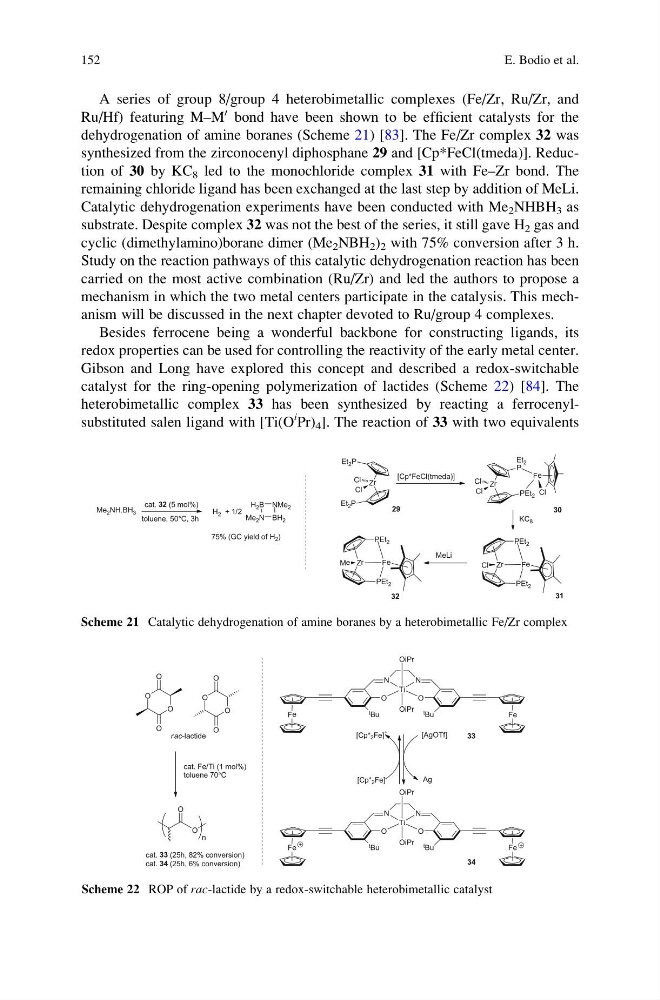
A series of group 8/group 4 heterobimetallic complexes (Fe/Zr, Ru/Zr, and
Ru/Hf) featuring M–M
0 bond have been shown to be efficient catalysts for the
dehydrogenation of amine boranes (Scheme 21) [83]. The Fe/Zr complex 32 was
synthesized from the zirconocenyl diphosphane 29 and [Cp*FeCl(tmeda)]. Reduction of 30 by KC 8 led to the monochloride complex 31 with Fe–Zr bond. The
remaining chloride ligand has been exchanged at the last step by addition of MeLi.
Catalytic dehydrogenation experiments have been conducted with Me 2 NHBH 3 as
substrate. Despite complex 32 was not the best of the series, it still gave H 2 gas and
cyclic (dimethylamino)borane dimer (Me 2 NBH 2 ) 2 with 75% conversion after 3 h.
Study on the reaction pathways of this catalytic dehydrogenation reaction has been
carried on the most active combination (Ru/Zr) and led the authors to propose a
mechanism in which the two metal centers participate in the catalysis. This mechanism will be discussed in the next chapter devoted to Ru/group 4 complexes.
Besides ferrocene being a wonderful backbone for constructing ligands, its
redox properties can be used for controlling the reactivity of the early metal center.
Gibson and Long have explored this concept and described a redox-switchable
catalyst for the ring-opening polymerization of lactides (Scheme 22) [84]. The
heterobimetallic complex 33 has been synthesized by reacting a ferrocenylsubstituted salen ligand with [Ti(O
i
Pr) 4 ]. The reaction of 33 with two equivalents
Zr
Cl
Cl
Et 2 P
Et 2 P
[Cp*FeCl(tmeda)]
Zr
Cl
Cl
Et 2
P
PEt 2
Fe
Cl
KC 8
Zr
Cl
PEt 2
PEt 2
Fe
Zr
Me
PEt 2
PEt 2
Fe
MeLi
Me 2 NH.BH 3
cat. 32 (5 mol%)
29
30
31
32
toluene, 50°C, 3h
H 2 B
Me 2 N BH 2
NMe 2
H 2 + 1/2
75% (GC yield of H 2 )
Scheme 21 Catalytic dehydrogenation of amine boranes by a heterobimetallic Fe/Zr complex
Fe
t Bu
N
Fe
t Bu
N
O
O
Ti
OiPr
OiPr
[AgOTf]
Ag
[Cp*2Fe]
[Cp*2Fe]
+
Fe
t Bu
N
Fe
t Bu
N
O
O
Ti
OiPr
OiPr
33
34
O
O
O
O
rac-lactide
cat. Fe/Ti (1 mol%)
toluene 70°C
O
O
n
O
O
O
O
cat. 33 (25h, 82% conversion)
cat. 34 (25h, 6% conversion)
Scheme 22 ROP of rac-lactide by a redox-switchable heterobimetallic catalyst
152
E. Bodio et al.
Ru/Hf) featuring M–M
0 bond have been shown to be efficient catalysts for the
dehydrogenation of amine boranes (Scheme 21) [83]. The Fe/Zr complex 32 was
synthesized from the zirconocenyl diphosphane 29 and [Cp*FeCl(tmeda)]. Reduction of 30 by KC 8 led to the monochloride complex 31 with Fe–Zr bond. The
remaining chloride ligand has been exchanged at the last step by addition of MeLi.
Catalytic dehydrogenation experiments have been conducted with Me 2 NHBH 3 as
substrate. Despite complex 32 was not the best of the series, it still gave H 2 gas and
cyclic (dimethylamino)borane dimer (Me 2 NBH 2 ) 2 with 75% conversion after 3 h.
Study on the reaction pathways of this catalytic dehydrogenation reaction has been
carried on the most active combination (Ru/Zr) and led the authors to propose a
mechanism in which the two metal centers participate in the catalysis. This mechanism will be discussed in the next chapter devoted to Ru/group 4 complexes.
Besides ferrocene being a wonderful backbone for constructing ligands, its
redox properties can be used for controlling the reactivity of the early metal center.
Gibson and Long have explored this concept and described a redox-switchable
catalyst for the ring-opening polymerization of lactides (Scheme 22) [84]. The
heterobimetallic complex 33 has been synthesized by reacting a ferrocenylsubstituted salen ligand with [Ti(O
i
Pr) 4 ]. The reaction of 33 with two equivalents
Zr
Cl
Cl
Et 2 P
Et 2 P
[Cp*FeCl(tmeda)]
Zr
Cl
Cl
Et 2
P
PEt 2
Fe
Cl
KC 8
Zr
Cl
PEt 2
PEt 2
Fe
Zr
Me
PEt 2
PEt 2
Fe
MeLi
Me 2 NH.BH 3
cat. 32 (5 mol%)
29
30
31
32
toluene, 50°C, 3h
H 2 B
Me 2 N BH 2
NMe 2
H 2 + 1/2
75% (GC yield of H 2 )
Scheme 21 Catalytic dehydrogenation of amine boranes by a heterobimetallic Fe/Zr complex
Fe
t Bu
N
Fe
t Bu
N
O
O
Ti
OiPr
OiPr
[AgOTf]
Ag
[Cp*2Fe]
[Cp*2Fe]
+
Fe
t Bu
N
Fe
t Bu
N
O
O
Ti
OiPr
OiPr
33
34
O
O
O
O
rac-lactide
cat. Fe/Ti (1 mol%)
toluene 70°C
O
O
n
O
O
O
O
cat. 33 (25h, 82% conversion)
cat. 34 (25h, 6% conversion)
Scheme 22 ROP of rac-lactide by a redox-switchable heterobimetallic catalyst
152
E. Bodio et al.