

Ferrocene has been extensively used as ligand backbone in coordination chemistry. The use of such ligands with early metals constitutes a straightforward route
toward early–late heterobimetallic complexes. Moreover, the presence of the
electron-rich ferrocenyl moiety can stabilize the neighbor early metal and is
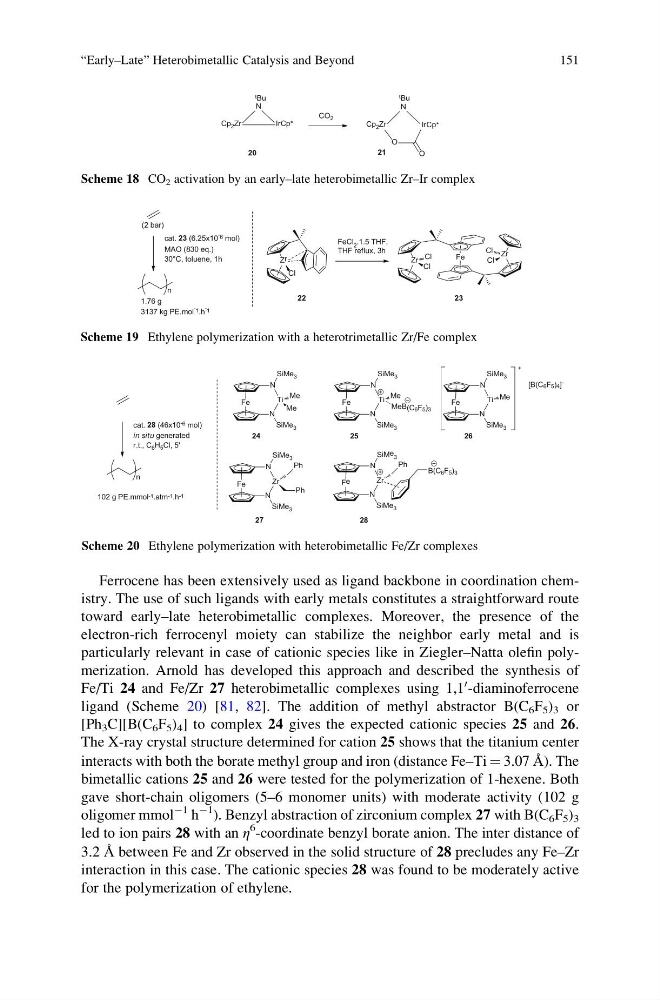
particularly relevant in case of cationic species like in Ziegler–Natta olefin polymerization. Arnold has developed this approach and described the synthesis of
Fe/Ti 24 and Fe/Zr 27 heterobimetallic complexes using 1,1
0 -diaminoferrocene
ligand (Scheme 20) [81, 82]. The addition of methyl abstractor B(C 6 F 5 ) 3 or
[Ph 3 C][B(C 6 F 5 ) 4 ] to complex 24 gives the expected cationic species 25 and 26.
The X-ray crystal structure determined for cation 25 shows that the titanium center
interacts with both the borate methyl group and iron (distance Fe–Ti ¼ 3.07 Å). The
bimetallic cations 25 and 26 were tested for the polymerization of 1-hexene. Both
gave short-chain oligomers (5–6 monomer units) with moderate activity (102 g
oligomer mmol
À1 h
À1 ). Benzyl abstraction of zirconium complex 27 with B(C 6 F 5 ) 3
led to ion pairs 28 with an η
6 -coordinate benzyl borate anion. The inter distance of
3.2 Å between Fe and Zr observed in the solid structure of 28 precludes any Fe–Zr
interaction in this case. The cationic species 28 was found to be moderately active
for the polymerization of ethylene.
Cp 2 Zr
IrCp*
N
CO 2
Cp 2 Zr
IrCp*
N
O
O
20
21
t Bu
t Bu
Scheme 18 CO 2 activation by an early–late heterobimetallic Zr–Ir complex
Zr Cl
Cl
Zr
Cl
Cl
Fe
n
cat. 23 (6.25x10
- 6 mol)
MAO (830 eq.)
30°C, toluene, 1h
Zr
Cl
FeCl 2 .1.5 THF,
THF reflux, 3h
22
23
(2 bar)
1.76 g
3137 kg PE.mol
- 1 .h
- 1
Scheme 19 Ethylene polymerization with a heterotrimetallic Zr/Fe complex
Fe
N
N
SiMe 3
SiMe 3
Zr
Ph
Ph
Fe
N
N
SiMe 3
SiMe 3
Zr
Ph
B(C6F5)3
Fe
N
N
SiMe 3
SiMe 3
Ti
Me
Me
Fe
N
N
SiMe 3
SiMe 3
Ti
Me
MeB(C 6F5)3
Fe
N
N
SiMe 3
SiMe 3
Ti Me
[B(C6F5)4] -
24
25
26
27
28
n
cat. 28 (46x10 -6 mol)
in situ generated
r.t., C 6 H 5 Cl, 5'
102 g PE.mmol -1 .atm -1 .h -1
Scheme 20 Ethylene polymerization with heterobimetallic Fe/Zr complexes
“Early–Late” Heterobimetallic Catalysis and Beyond
151
toward early–late heterobimetallic complexes. Moreover, the presence of the
electron-rich ferrocenyl moiety can stabilize the neighbor early metal and is
particularly relevant in case of cationic species like in Ziegler–Natta olefin polymerization. Arnold has developed this approach and described the synthesis of
Fe/Ti 24 and Fe/Zr 27 heterobimetallic complexes using 1,1
0 -diaminoferrocene
ligand (Scheme 20) [81, 82]. The addition of methyl abstractor B(C 6 F 5 ) 3 or
[Ph 3 C][B(C 6 F 5 ) 4 ] to complex 24 gives the expected cationic species 25 and 26.
The X-ray crystal structure determined for cation 25 shows that the titanium center
interacts with both the borate methyl group and iron (distance Fe–Ti ¼ 3.07 Å). The
bimetallic cations 25 and 26 were tested for the polymerization of 1-hexene. Both
gave short-chain oligomers (5–6 monomer units) with moderate activity (102 g
oligomer mmol
À1 h
À1 ). Benzyl abstraction of zirconium complex 27 with B(C 6 F 5 ) 3
led to ion pairs 28 with an η
6 -coordinate benzyl borate anion. The inter distance of
3.2 Å between Fe and Zr observed in the solid structure of 28 precludes any Fe–Zr
interaction in this case. The cationic species 28 was found to be moderately active
for the polymerization of ethylene.
Cp 2 Zr
IrCp*
N
CO 2
Cp 2 Zr
IrCp*
N
O
O
20
21
t Bu
t Bu
Scheme 18 CO 2 activation by an early–late heterobimetallic Zr–Ir complex
Zr Cl
Cl
Zr
Cl
Cl
Fe
n
cat. 23 (6.25x10
- 6 mol)
MAO (830 eq.)
30°C, toluene, 1h
Zr
Cl
FeCl 2 .1.5 THF,
THF reflux, 3h
22
23
(2 bar)
1.76 g
3137 kg PE.mol
- 1 .h
- 1
Scheme 19 Ethylene polymerization with a heterotrimetallic Zr/Fe complex
Fe
N
N
SiMe 3
SiMe 3
Zr
Ph
Ph
Fe
N
N
SiMe 3
SiMe 3
Zr
Ph
B(C6F5)3
Fe
N
N
SiMe 3
SiMe 3
Ti
Me
Me
Fe
N
N
SiMe 3
SiMe 3
Ti
Me
MeB(C 6F5)3
Fe
N
N
SiMe 3
SiMe 3
Ti Me
[B(C6F5)4] -
24
25
26
27
28
n
cat. 28 (46x10 -6 mol)
in situ generated
r.t., C 6 H 5 Cl, 5'
102 g PE.mmol -1 .atm -1 .h -1
Scheme 20 Ethylene polymerization with heterobimetallic Fe/Zr complexes
“Early–Late” Heterobimetallic Catalysis and Beyond
151