

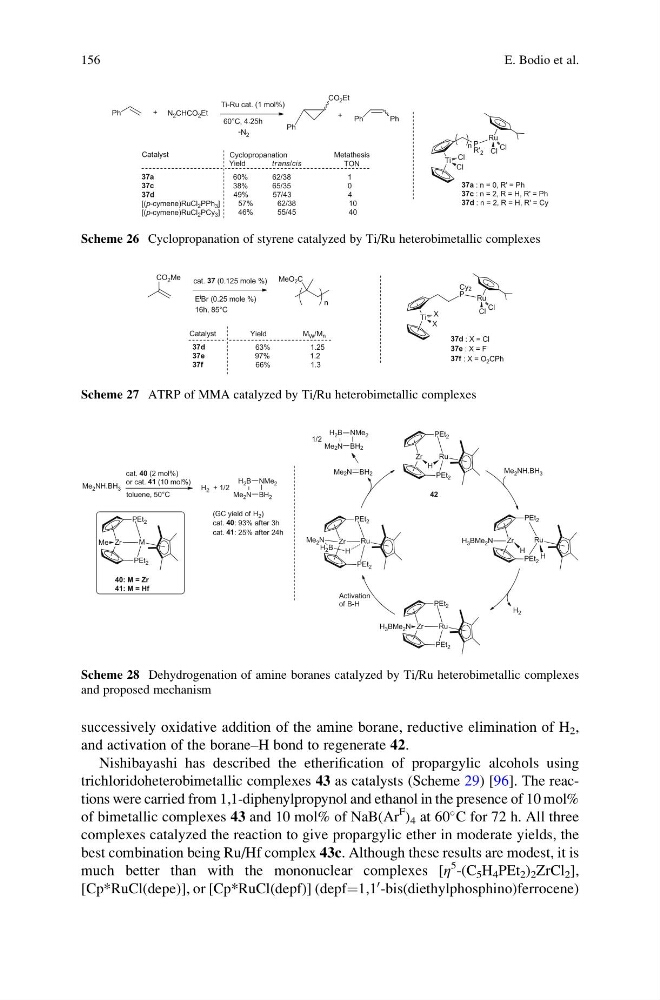
successively oxidative addition of the amine borane, reductive elimination of H 2 ,
and activation of the borane–H bond to regenerate 42.
Nishibayashi has described the etherification of propargylic alcohols using
trichloridoheterobimetallic complexes 43 as catalysts (Scheme 29) [96]. The reactions were carried from 1,1-diphenylpropynol and ethanol in the presence of 10 mol%
of bimetallic complexes 43 and 10 mol% of NaB(Ar
F
) 4 at 60
C for 72 h. All three
complexes catalyzed the reaction to give propargylic ether in moderate yields, the
best combination being Ru/Hf complex 43c. Although these results are modest, it is
much better than with the mononuclear complexes [η
5 -(C 5 H 4 PEt 2 ) 2 ZrCl 2 ],
[Cp*RuCl(depe)], or [Cp*RuCl(depf)] (depf¼1,1
0 -bis(diethylphosphino)ferrocene)
Ph
+ N 2 CHCO 2 Et
Ti-Ru cat. (1 mol%)
-N 2
CO 2 Et
Ph
Ph
Ph
+
Catalyst
Cyclopropanation
Metathesis
Yield
trans/cis
TON
60°C, 4.25h
37a
60%
62/38
1
37c
38%
65/35
0
37d
49%
57/43
4
[(p-cymene)RuCl 2 PPh 3 ]
57%
62/38
10
[(p-cymene)RuCl 2 PCy 3 ]
46%
55/45
40
Ti Cl
Cl
P
R' 2
n
Ru
Cl
Cl
37a : n = 0, R' = Ph
37c : n = 2, R = H, R' = Ph
37d : n = 2, R = H, R' = Cy
Scheme 26 Cyclopropanation of styrene catalyzed by Ti/Ru heterobimetallic complexes
CO 2 Me
MeO 2 C
cat. 37 (0.125 mole %)
n
E i Br (0.25 mole %)
16h, 85°C
Catalyst
Yield
M W /Mn
37d
63%
1.25
37e
97%
1.2
37f
66%
1.3
Cy2
P
Ru
Cl
Cl
37d : X = Cl
37e : X = F
37f : X = O 2 CPh
Ti X
X
Scheme 27 ATRP of MMA catalyzed by Ti/Ru heterobimetallic complexes
Zr
Me
PEt 2
PEt 2
M
40: M = Zr
41: M = Hf
Me 2 NH.BH 3
cat. 40 (2 mol%)
or cat. 41 (10 mol%)
toluene, 50°C
H 2 B
Me 2 N BH 2
NMe 2
H 2 + 1/2
(GC yield of H 2 )
cat. 40: 93% after 3h
cat. 41: 25% after 24h
Zr
H
PEt 2
PEt 2
Ru
42
Zr
H 3 BMe 2 N
PEt 2
PEt 2
Ru
H
H
Zr
H 3 BMe 2 N
PEt 2
PEt 2
Ru
Zr
Me 2 N
PEt 2
PEt 2
Ru
H 2 B
H
H 2
Activation
of B-H
Me 2 NH.BH 3
H 2 B
Me2N BH2
NMe 2
Me2N BH2
1/2
Scheme 28 Dehydrogenation of amine boranes catalyzed by Ti/Ru heterobimetallic complexes
and proposed mechanism
156
E. Bodio et al.
and activation of the borane–H bond to regenerate 42.
Nishibayashi has described the etherification of propargylic alcohols using
trichloridoheterobimetallic complexes 43 as catalysts (Scheme 29) [96]. The reactions were carried from 1,1-diphenylpropynol and ethanol in the presence of 10 mol%
of bimetallic complexes 43 and 10 mol% of NaB(Ar
F
) 4 at 60
C for 72 h. All three
complexes catalyzed the reaction to give propargylic ether in moderate yields, the
best combination being Ru/Hf complex 43c. Although these results are modest, it is
much better than with the mononuclear complexes [η
5 -(C 5 H 4 PEt 2 ) 2 ZrCl 2 ],
[Cp*RuCl(depe)], or [Cp*RuCl(depf)] (depf¼1,1
0 -bis(diethylphosphino)ferrocene)
Ph
+ N 2 CHCO 2 Et
Ti-Ru cat. (1 mol%)
-N 2
CO 2 Et
Ph
Ph
Ph
+
Catalyst
Cyclopropanation
Metathesis
Yield
trans/cis
TON
60°C, 4.25h
37a
60%
62/38
1
37c
38%
65/35
0
37d
49%
57/43
4
[(p-cymene)RuCl 2 PPh 3 ]
57%
62/38
10
[(p-cymene)RuCl 2 PCy 3 ]
46%
55/45
40
Ti Cl
Cl
P
R' 2
n
Ru
Cl
Cl
37a : n = 0, R' = Ph
37c : n = 2, R = H, R' = Ph
37d : n = 2, R = H, R' = Cy
Scheme 26 Cyclopropanation of styrene catalyzed by Ti/Ru heterobimetallic complexes
CO 2 Me
MeO 2 C
cat. 37 (0.125 mole %)
n
E i Br (0.25 mole %)
16h, 85°C
Catalyst
Yield
M W /Mn
37d
63%
1.25
37e
97%
1.2
37f
66%
1.3
Cy2
P
Ru
Cl
Cl
37d : X = Cl
37e : X = F
37f : X = O 2 CPh
Ti X
X
Scheme 27 ATRP of MMA catalyzed by Ti/Ru heterobimetallic complexes
Zr
Me
PEt 2
PEt 2
M
40: M = Zr
41: M = Hf
Me 2 NH.BH 3
cat. 40 (2 mol%)
or cat. 41 (10 mol%)
toluene, 50°C
H 2 B
Me 2 N BH 2
NMe 2
H 2 + 1/2
(GC yield of H 2 )
cat. 40: 93% after 3h
cat. 41: 25% after 24h
Zr
H
PEt 2
PEt 2
Ru
42
Zr
H 3 BMe 2 N
PEt 2
PEt 2
Ru
H
H
Zr
H 3 BMe 2 N
PEt 2
PEt 2
Ru
Zr
Me 2 N
PEt 2
PEt 2
Ru
H 2 B
H
H 2
Activation
of B-H
Me 2 NH.BH 3
H 2 B
Me2N BH2
NMe 2
Me2N BH2
1/2
Scheme 28 Dehydrogenation of amine boranes catalyzed by Ti/Ru heterobimetallic complexes
and proposed mechanism
156
E. Bodio et al.