

the catalyst but also the regiochemistry of the polymerization for which
1,2-insertion competes with 2,1-insertion to a significant degree.
Introducing a second metal also opens the way to bimetallic redox synergy,
which has been observed in paddlewheel binuclear rhodium(II) catalysts. These
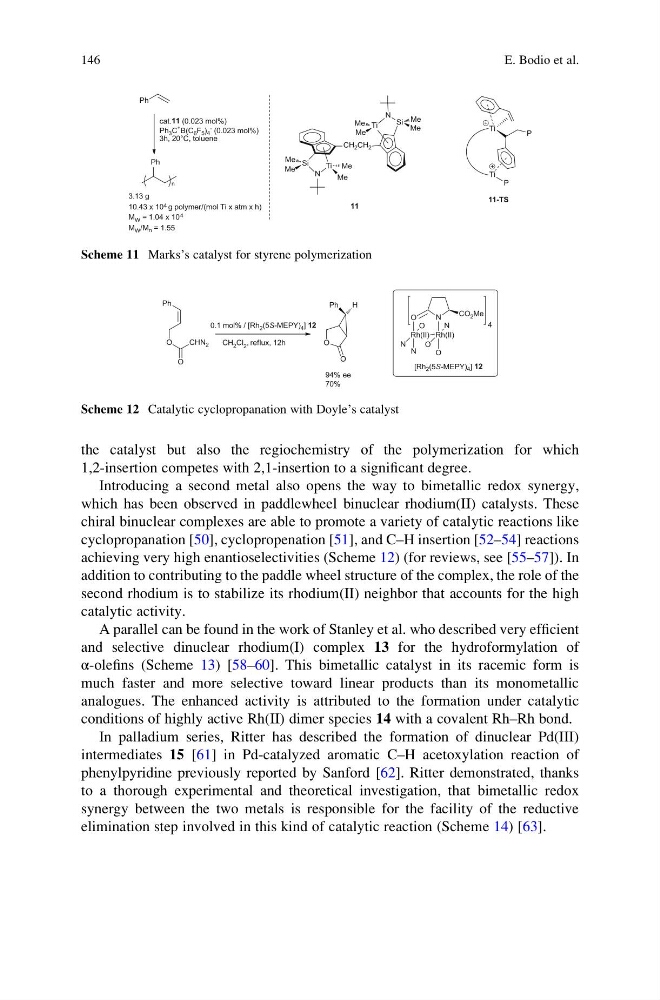
chiral binuclear complexes are able to promote a variety of catalytic reactions like
cyclopropanation [50], cyclopropenation [51], and C–H insertion [52–54] reactions
achieving very high enantioselectivities (Scheme 12) (for reviews, see [55–57]). In
addition to contributing to the paddle wheel structure of the complex, the role of the
second rhodium is to stabilize its rhodium(II) neighbor that accounts for the high
catalytic activity.
A parallel can be found in the work of Stanley et al. who described very efficient
and selective dinuclear rhodium(I) complex 13 for the hydroformylation of
α-olefins (Scheme 13) [58–60]. This bimetallic catalyst in its racemic form is
much faster and more selective toward linear products than its monometallic
analogues. The enhanced activity is attributed to the formation under catalytic
conditions of highly active Rh(II) dimer species 14 with a covalent Rh–Rh bond.
In palladium series, Ritter has described the formation of dinuclear Pd(III)
intermediates 15 [61] in Pd-catalyzed aromatic C–H acetoxylation reaction of
phenylpyridine previously reported by Sanford [62]. Ritter demonstrated, thanks
to a thorough experimental and theoretical investigation, that bimetallic redox
synergy between the two metals is responsible for the facility of the reductive
elimination step involved in this kind of catalytic reaction (Scheme 14) [63].
Si
N
Ti
Me
Me
Me
Me
CH 2 CH 2
Ti
N
Si
Me
Me
Me
Me
11
Ti
Ti
P
P
11-TS
Ph
cat.11 (0.023 mol%)
Ph 3 C + B(C 6 F 5 ) 4
- (0.023 mol%)
3h, 20°C, toluene
Ph
n
3.13 g
10.43 x 10 4 g polymer/(mol Ti x atm x h)
M W = 1.04 x 10 4
M W /M n = 1.55
Scheme 11 Marks’s catalyst for styrene polymerization
O
O
CHN 2
Ph
O
O
Ph
H
94% ee
70%
0.1 mol% / [Rh 2 (5S-MEPY) 4 ] 12
CH 2 Cl 2 , reflux, 12h
Rh(II)
O
N
N
O
Rh(II)
N
O
O
N
CO 2 Me
4
[Rh 2 (5S-MEPY) 4 ] 12
Scheme 12 Catalytic cyclopropanation with Doyle’s catalyst
146
E. Bodio et al.
1,2-insertion competes with 2,1-insertion to a significant degree.
Introducing a second metal also opens the way to bimetallic redox synergy,
which has been observed in paddlewheel binuclear rhodium(II) catalysts. These
chiral binuclear complexes are able to promote a variety of catalytic reactions like
cyclopropanation [50], cyclopropenation [51], and C–H insertion [52–54] reactions
achieving very high enantioselectivities (Scheme 12) (for reviews, see [55–57]). In
addition to contributing to the paddle wheel structure of the complex, the role of the
second rhodium is to stabilize its rhodium(II) neighbor that accounts for the high
catalytic activity.
A parallel can be found in the work of Stanley et al. who described very efficient
and selective dinuclear rhodium(I) complex 13 for the hydroformylation of
α-olefins (Scheme 13) [58–60]. This bimetallic catalyst in its racemic form is
much faster and more selective toward linear products than its monometallic
analogues. The enhanced activity is attributed to the formation under catalytic
conditions of highly active Rh(II) dimer species 14 with a covalent Rh–Rh bond.
In palladium series, Ritter has described the formation of dinuclear Pd(III)
intermediates 15 [61] in Pd-catalyzed aromatic C–H acetoxylation reaction of
phenylpyridine previously reported by Sanford [62]. Ritter demonstrated, thanks
to a thorough experimental and theoretical investigation, that bimetallic redox
synergy between the two metals is responsible for the facility of the reductive
elimination step involved in this kind of catalytic reaction (Scheme 14) [63].
Si
N
Ti
Me
Me
Me
Me
CH 2 CH 2
Ti
N
Si
Me
Me
Me
Me
11
Ti
Ti
P
P
11-TS
Ph
cat.11 (0.023 mol%)
Ph 3 C + B(C 6 F 5 ) 4
- (0.023 mol%)
3h, 20°C, toluene
Ph
n
3.13 g
10.43 x 10 4 g polymer/(mol Ti x atm x h)
M W = 1.04 x 10 4
M W /M n = 1.55
Scheme 11 Marks’s catalyst for styrene polymerization
O
O
CHN 2
Ph
O
O
Ph
H
94% ee
70%
0.1 mol% / [Rh 2 (5S-MEPY) 4 ] 12
CH 2 Cl 2 , reflux, 12h
Rh(II)
O
N
N
O
Rh(II)
N
O
O
N
CO 2 Me
4
[Rh 2 (5S-MEPY) 4 ] 12
Scheme 12 Catalytic cyclopropanation with Doyle’s catalyst
146
E. Bodio et al.