

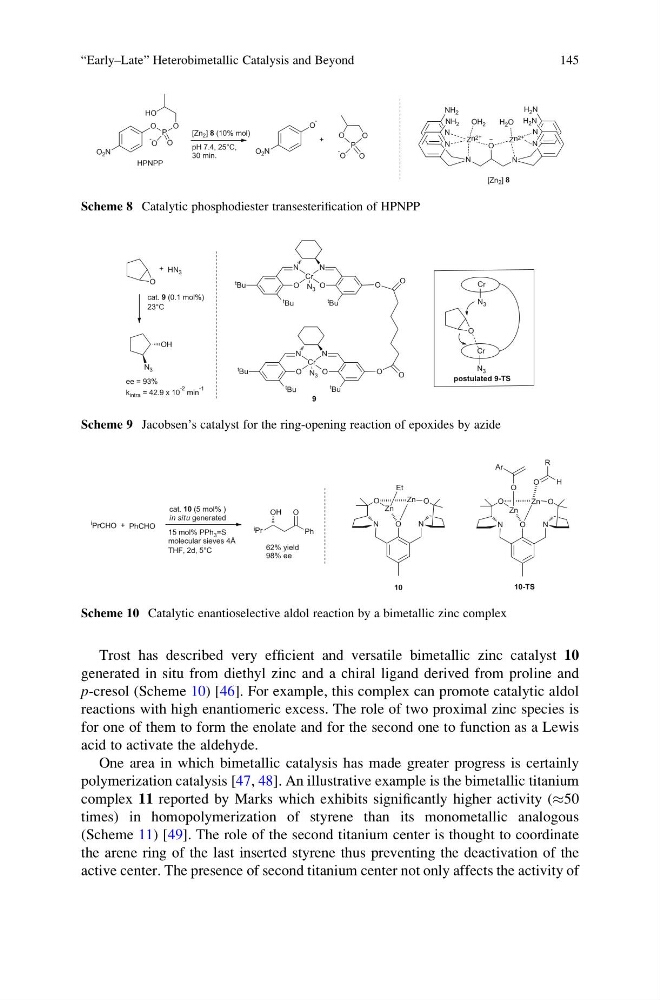
Trost has described very efficient and versatile bimetallic zinc catalyst 10
generated in situ from diethyl zinc and a chiral ligand derived from proline and
p-cresol (Scheme 10) [46]. For example, this complex can promote catalytic aldol
reactions with high enantiomeric excess. The role of two proximal zinc species is
for one of them to form the enolate and for the second one to function as a Lewis
acid to activate the aldehyde.
One area in which bimetallic catalysis has made greater progress is certainly
polymerization catalysis [47, 48]. An illustrative example is the bimetallic titanium
complex 11 reported by Marks which exhibits significantly higher activity (%50
times) in homopolymerization of styrene than its monometallic analogous
(Scheme 11) [49]. The role of the second titanium center is thought to coordinate
the arene ring of the last inserted styrene thus preventing the deactivation of the
active center. The presence of second titanium center not only affects the activity of
N
N
N
H 2 N
H 2 N
N
N
N
NH 2
NH 2
O
Zn 2+
OH 2
Zn 2+
H 2 O
O
O 2 N
P
O
HO
O
-
O
HPNPP
O
-
O 2 N
P
O
O
O
-
O
+
[Zn 2 ] 8 (10% mol)
[Zn 2 ] 8
pH 7.4, 25°C,
30 min.
Scheme 8 Catalytic phosphodiester transesterification of HPNPP
N
N
O
O
t Bu
O
t Bu
t Bu
Cr
N 3
O
O
O
N
N
O
O
t Bu
t Bu
t Bu
Cr
N 3
Cr
N 3
postulated 9-TS
9
Cr
N 3
O
N 3
OH
cat. 9 (0.1 mol%)
23°C
O
+ HN 3
ee = 93%
k intra = 42.9 x 10
-2 min
-1
Scheme 9 Jacobsen’s catalyst for the ring-opening reaction of epoxides by azide
N
O
N
O
O
Zn
Zn
Et
i PrCHO + PhCHO
cat. 10 (5 mol% )
in situ generated
15 mol% PPh 3 =S
molecular sieves 4Å
THF, 2d, 5°C
i Pr
Ph
O
OH
62% yield
98% ee
10
N
O
N
O
O
Zn
Zn
O
Ar
O
R
H
10-TS
Scheme 10 Catalytic enantioselective aldol reaction by a bimetallic zinc complex
“Early–Late” Heterobimetallic Catalysis and Beyond
145
generated in situ from diethyl zinc and a chiral ligand derived from proline and
p-cresol (Scheme 10) [46]. For example, this complex can promote catalytic aldol
reactions with high enantiomeric excess. The role of two proximal zinc species is
for one of them to form the enolate and for the second one to function as a Lewis
acid to activate the aldehyde.
One area in which bimetallic catalysis has made greater progress is certainly
polymerization catalysis [47, 48]. An illustrative example is the bimetallic titanium
complex 11 reported by Marks which exhibits significantly higher activity (%50
times) in homopolymerization of styrene than its monometallic analogous
(Scheme 11) [49]. The role of the second titanium center is thought to coordinate
the arene ring of the last inserted styrene thus preventing the deactivation of the
active center. The presence of second titanium center not only affects the activity of
N
N
N
H 2 N
H 2 N
N
N
N
NH 2
NH 2
O
Zn 2+
OH 2
Zn 2+
H 2 O
O
O 2 N
P
O
HO
O
-
O
HPNPP
O
-
O 2 N
P
O
O
O
-
O
+
[Zn 2 ] 8 (10% mol)
[Zn 2 ] 8
pH 7.4, 25°C,
30 min.
Scheme 8 Catalytic phosphodiester transesterification of HPNPP
N
N
O
O
t Bu
O
t Bu
t Bu
Cr
N 3
O
O
O
N
N
O
O
t Bu
t Bu
t Bu
Cr
N 3
Cr
N 3
postulated 9-TS
9
Cr
N 3
O
N 3
OH
cat. 9 (0.1 mol%)
23°C
O
+ HN 3
ee = 93%
k intra = 42.9 x 10
-2 min
-1
Scheme 9 Jacobsen’s catalyst for the ring-opening reaction of epoxides by azide
N
O
N
O
O
Zn
Zn
Et
i PrCHO + PhCHO
cat. 10 (5 mol% )
in situ generated
15 mol% PPh 3 =S
molecular sieves 4Å
THF, 2d, 5°C
i Pr
Ph
O
OH
62% yield
98% ee
10
N
O
N
O
O
Zn
Zn
O
Ar
O
R
H
10-TS
Scheme 10 Catalytic enantioselective aldol reaction by a bimetallic zinc complex
“Early–Late” Heterobimetallic Catalysis and Beyond
145