

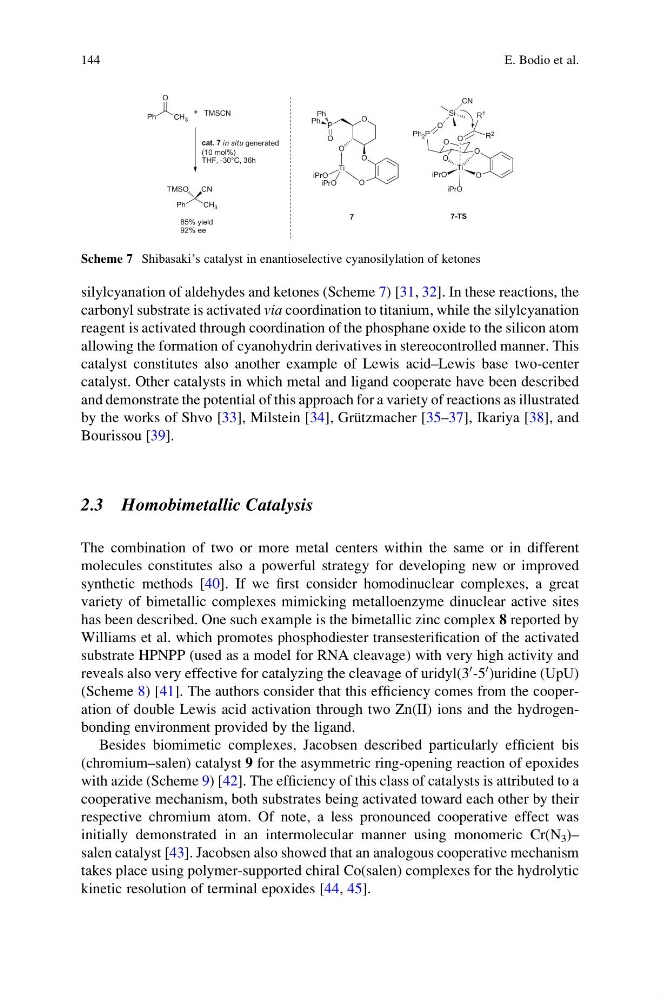
silylcyanation of aldehydes and ketones (Scheme 7) [31, 32]. In these reactions, the
carbonyl substrate is activated via coordination to titanium, while the silylcyanation
reagent is activated through coordination of the phosphane oxide to the silicon atom
allowing the formation of cyanohydrin derivatives in stereocontrolled manner. This
catalyst constitutes also another example of Lewis acid–Lewis base two-center
catalyst. Other catalysts in which metal and ligand cooperate have been described
and demonstrate the potential of this approach for a variety of reactions as illustrated
by the works of Shvo [33], Milstein [34], Gru ¨tzmacher [35–37], Ikariya [38], and
Bourissou [39].
2.3 Homobimetallic Catalysis
The combination of two or more metal centers within the same or in different
molecules constitutes also a powerful strategy for developing new or improved
synthetic methods [40]. If we first consider homodinuclear complexes, a great
variety of bimetallic complexes mimicking metalloenzyme dinuclear active sites
has been described. One such example is the bimetallic zinc complex 8 reported by
Williams et al. which promotes phosphodiester transesterification of the activated
substrate HPNPP (used as a model for RNA cleavage) with very high activity and
reveals also very effective for catalyzing the cleavage of uridyl(3
0 -5
0 )uridine (UpU)
(Scheme 8) [41]. The authors consider that this efficiency comes from the cooperation of double Lewis acid activation through two Zn(II) ions and the hydrogenbonding environment provided by the ligand.
Besides biomimetic complexes, Jacobsen described particularly efficient bis
(chromium–salen) catalyst 9 for the asymmetric ring-opening reaction of epoxides
with azide (Scheme 9) [42]. The efficiency of this class of catalysts is attributed to a
cooperative mechanism, both substrates being activated toward each other by their
respective chromium atom. Of note, a less pronounced cooperative effect was
initially demonstrated in an intermolecular manner using monomeric Cr(N 3 )–
salen catalyst [43]. Jacobsen also showed that an analogous cooperative mechanism
takes place using polymer-supported chiral Co(salen) complexes for the hydrolytic
kinetic resolution of terminal epoxides [44, 45].
O
O
P
O
O
Ph
Ph
O
Ti
iPrO
iPrO
Ti
iPrO
O
O
iPrO
O
Ph 2 P
O
O
O
R 2
Si
CN
7
7-TS
R 1
Ph
O
CH 3
+ TMSCN
cat. 7 in situ generated
(10 mol%)
THF, -30°C, 36h
Ph
CH 3
CN
TMSO
85% yield
92% ee
Scheme 7 Shibasaki’s catalyst in enantioselective cyanosilylation of ketones
144
E. Bodio et al.
carbonyl substrate is activated via coordination to titanium, while the silylcyanation
reagent is activated through coordination of the phosphane oxide to the silicon atom
allowing the formation of cyanohydrin derivatives in stereocontrolled manner. This
catalyst constitutes also another example of Lewis acid–Lewis base two-center
catalyst. Other catalysts in which metal and ligand cooperate have been described
and demonstrate the potential of this approach for a variety of reactions as illustrated
by the works of Shvo [33], Milstein [34], Gru ¨tzmacher [35–37], Ikariya [38], and
Bourissou [39].
2.3 Homobimetallic Catalysis
The combination of two or more metal centers within the same or in different
molecules constitutes also a powerful strategy for developing new or improved
synthetic methods [40]. If we first consider homodinuclear complexes, a great
variety of bimetallic complexes mimicking metalloenzyme dinuclear active sites
has been described. One such example is the bimetallic zinc complex 8 reported by
Williams et al. which promotes phosphodiester transesterification of the activated
substrate HPNPP (used as a model for RNA cleavage) with very high activity and
reveals also very effective for catalyzing the cleavage of uridyl(3
0 -5
0 )uridine (UpU)
(Scheme 8) [41]. The authors consider that this efficiency comes from the cooperation of double Lewis acid activation through two Zn(II) ions and the hydrogenbonding environment provided by the ligand.
Besides biomimetic complexes, Jacobsen described particularly efficient bis
(chromium–salen) catalyst 9 for the asymmetric ring-opening reaction of epoxides
with azide (Scheme 9) [42]. The efficiency of this class of catalysts is attributed to a
cooperative mechanism, both substrates being activated toward each other by their
respective chromium atom. Of note, a less pronounced cooperative effect was
initially demonstrated in an intermolecular manner using monomeric Cr(N 3 )–
salen catalyst [43]. Jacobsen also showed that an analogous cooperative mechanism
takes place using polymer-supported chiral Co(salen) complexes for the hydrolytic
kinetic resolution of terminal epoxides [44, 45].
O
O
P
O
O
Ph
Ph
O
Ti
iPrO
iPrO
Ti
iPrO
O
O
iPrO
O
Ph 2 P
O
O
O
R 2
Si
CN
7
7-TS
R 1
Ph
O
CH 3
+ TMSCN
cat. 7 in situ generated
(10 mol%)
THF, -30°C, 36h
Ph
CH 3
CN
TMSO
85% yield
92% ee
Scheme 7 Shibasaki’s catalyst in enantioselective cyanosilylation of ketones
144
E. Bodio et al.