

2.2 Metal–Ligand Bifunctional Catalysis
Focusing on transition metal catalysis and on results which have paved the ways of
the above recent developments, key milestones in this area date when Ito [23] and
later Shibasaki [24] and Noyori [25] have introduced the concept of metal–ligand
bifunctional catalysis and shown that the ligand may interact directly with the
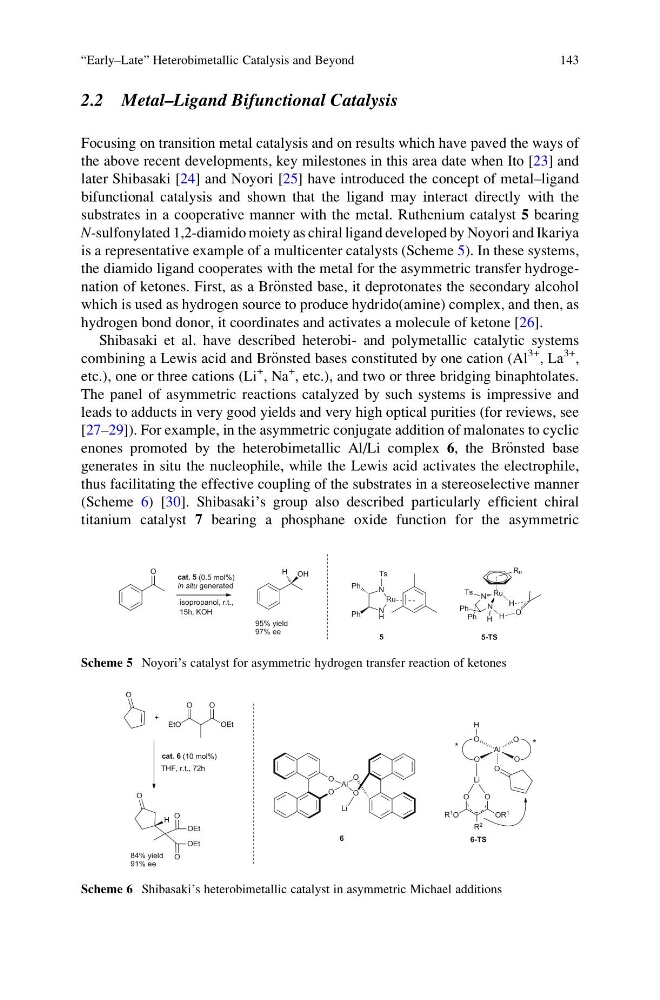
substrates in a cooperative manner with the metal. Ruthenium catalyst 5 bearing
N-sulfonylated 1,2-diamido moiety as chiral ligand developed by Noyori and Ikariya
is a representative example of a multicenter catalysts (Scheme 5). In these systems,
the diamido ligand cooperates with the metal for the asymmetric transfer hydrogenation of ketones. First, as a Br€ onsted base, it deprotonates the secondary alcohol
which is used as hydrogen source to produce hydrido(amine) complex, and then, as
hydrogen bond donor, it coordinates and activates a molecule of ketone [26].
Shibasaki et al. have described heterobi- and polymetallic catalytic systems
combining a Lewis acid and Br€ onsted bases constituted by one cation (Al
3+ , La
3+ ,
etc.), one or three cations (Li
+ , Na
+
, etc.), and two or three bridging binaphtolates.
The panel of asymmetric reactions catalyzed by such systems is impressive and
leads to adducts in very good yields and very high optical purities (for reviews, see
[27–29]). For example, in the asymmetric conjugate addition of malonates to cyclic
enones promoted by the heterobimetallic Al/Li complex 6, the Br€ onsted base
generates in situ the nucleophile, while the Lewis acid activates the electrophile,
thus facilitating the effective coupling of the substrates in a stereoselective manner
(Scheme 6) [30]. Shibasaki’s group also described particularly efficient chiral
titanium catalyst 7 bearing a phosphane oxide function for the asymmetric
N
H
Ru
N
Ph
Ph
Ts
Ru
N
N
H
H
O
Ts
Ph
Ph H
Rn
5
5-TS
O
cat. 5 (0.5 mol%)
in situ generated
isopropanol, r.t.,
15h, KOH
H OH
95% yield
97% ee
Scheme 5 Noyori’s catalyst for asymmetric hydrogen transfer reaction of ketones
Al
O
O
O
O
H
O
Li
O
O
R 1 O
R 2
OR 1
*
*
O
O
O
O
Al
Li
6
6-TS
O
+
EtO
OEt
O
O
cat. 6 (10 mol%)
THF, r.t., 72h
O
OEt
O
O
H
OEt
84% yield
91% ee
Scheme 6 Shibasaki’s heterobimetallic catalyst in asymmetric Michael additions
“Early–Late” Heterobimetallic Catalysis and Beyond
143
Focusing on transition metal catalysis and on results which have paved the ways of
the above recent developments, key milestones in this area date when Ito [23] and
later Shibasaki [24] and Noyori [25] have introduced the concept of metal–ligand
bifunctional catalysis and shown that the ligand may interact directly with the
substrates in a cooperative manner with the metal. Ruthenium catalyst 5 bearing
N-sulfonylated 1,2-diamido moiety as chiral ligand developed by Noyori and Ikariya
is a representative example of a multicenter catalysts (Scheme 5). In these systems,
the diamido ligand cooperates with the metal for the asymmetric transfer hydrogenation of ketones. First, as a Br€ onsted base, it deprotonates the secondary alcohol
which is used as hydrogen source to produce hydrido(amine) complex, and then, as
hydrogen bond donor, it coordinates and activates a molecule of ketone [26].
Shibasaki et al. have described heterobi- and polymetallic catalytic systems
combining a Lewis acid and Br€ onsted bases constituted by one cation (Al
3+ , La
3+ ,
etc.), one or three cations (Li
+ , Na
+
, etc.), and two or three bridging binaphtolates.
The panel of asymmetric reactions catalyzed by such systems is impressive and
leads to adducts in very good yields and very high optical purities (for reviews, see
[27–29]). For example, in the asymmetric conjugate addition of malonates to cyclic
enones promoted by the heterobimetallic Al/Li complex 6, the Br€ onsted base
generates in situ the nucleophile, while the Lewis acid activates the electrophile,
thus facilitating the effective coupling of the substrates in a stereoselective manner
(Scheme 6) [30]. Shibasaki’s group also described particularly efficient chiral
titanium catalyst 7 bearing a phosphane oxide function for the asymmetric
N
H
Ru
N
Ph
Ph
Ts
Ru
N
N
H
H
O
Ts
Ph
Ph H
Rn
5
5-TS
O
cat. 5 (0.5 mol%)
in situ generated
isopropanol, r.t.,
15h, KOH
H OH
95% yield
97% ee
Scheme 5 Noyori’s catalyst for asymmetric hydrogen transfer reaction of ketones
Al
O
O
O
O
H
O
Li
O
O
R 1 O
R 2
OR 1
*
*
O
O
O
O
Al
Li
6
6-TS
O
+
EtO
OEt
O
O
cat. 6 (10 mol%)
THF, r.t., 72h
O
OEt
O
O
H
OEt
84% yield
91% ee
Scheme 6 Shibasaki’s heterobimetallic catalyst in asymmetric Michael additions
“Early–Late” Heterobimetallic Catalysis and Beyond
143