

analogous catalytic systems challenging. In 2006, a step was taken with the synthesis
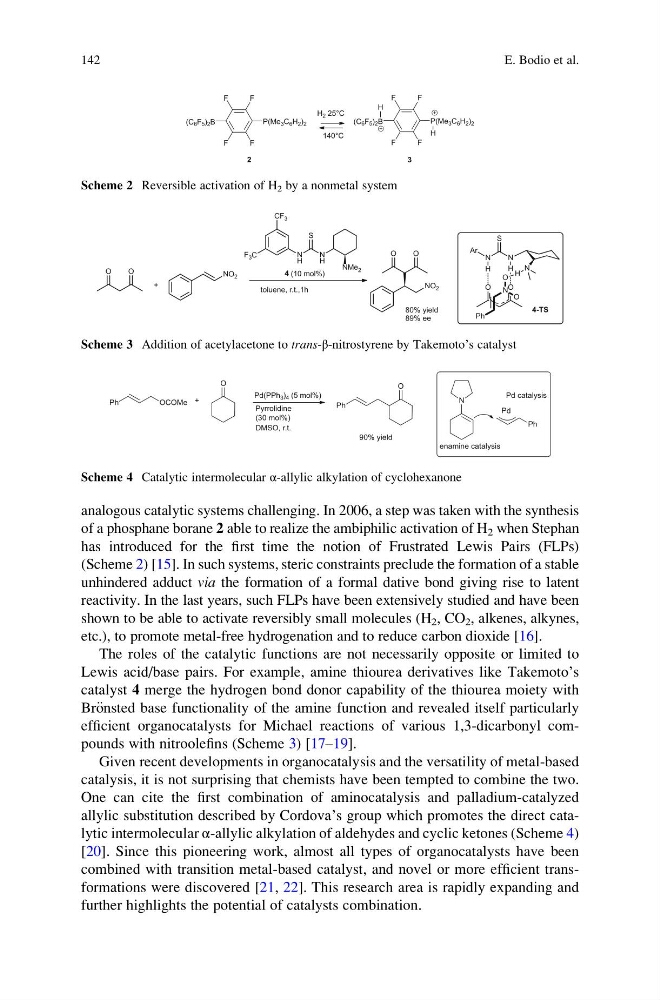
of a phosphane borane 2 able to realize the ambiphilic activation of H 2 when Stephan
has introduced for the first time the notion of Frustrated Lewis Pairs (FLPs)
(Scheme 2) [15]. In such systems, steric constraints preclude the formation of a stable
unhindered adduct via the formation of a formal dative bond giving rise to latent
reactivity. In the last years, such FLPs have been extensively studied and have been
shown to be able to activate reversibly small molecules (H 2 , CO 2 , alkenes, alkynes,
etc.), to promote metal-free hydrogenation and to reduce carbon dioxide [16].
The roles of the catalytic functions are not necessarily opposite or limited to
Lewis acid/base pairs. For example, amine thiourea derivatives like Takemoto’s
catalyst 4 merge the hydrogen bond donor capability of the thiourea moiety with
Br€ onsted base functionality of the amine function and revealed itself particularly
efficient organocatalysts for Michael reactions of various 1,3-dicarbonyl compounds with nitroolefins (Scheme 3) [17–19].
Given recent developments in organocatalysis and the versatility of metal-based
catalysis, it is not surprising that chemists have been tempted to combine the two.
One can cite the first combination of aminocatalysis and palladium-catalyzed
allylic substitution described by Cordova’s group which promotes the direct catalytic intermolecular α-allylic alkylation of aldehydes and cyclic ketones (Scheme 4)
[20]. Since this pioneering work, almost all types of organocatalysts have been
combined with transition metal-based catalyst, and novel or more efficient transformations were discovered [21, 22]. This research area is rapidly expanding and
further highlights the potential of catalysts combination.
(C6F5)2B
P(Me 3 C 6 H 2 ) 2
F
F
F
F
H
H
140°C
H 2 25°C
(C6F5)2B
P(Me 3 C 6 H 2 ) 2
F
F
F
F
2
3
Scheme 2 Reversible activation of H 2 by a nonmetal system
O
O
N
H
N
H
CF 3
F 3 C
NMe 2
S
4 (10 mol%)
4-TS
NO 2
+
O
O
toluene, r.t.,1h
NO 2
O
O
80% yield
89% ee
Ar
N
N
S
N
H
H
H
Ph
N
O
O
Scheme 3 Addition of acetylacetone to trans-β-nitrostyrene by Takemoto’s catalyst
Ph
OCOMe +
O
Pd(PPh 3 ) 4 (5 mol%)
Pyrrolidine
(30 mol%)
DMSO, r.t.
Ph
O
N
Ph
Pd
enamine catalysis
Pd catalysis
90% yield
Scheme 4 Catalytic intermolecular α-allylic alkylation of cyclohexanone
142
E. Bodio et al.
of a phosphane borane 2 able to realize the ambiphilic activation of H 2 when Stephan
has introduced for the first time the notion of Frustrated Lewis Pairs (FLPs)
(Scheme 2) [15]. In such systems, steric constraints preclude the formation of a stable
unhindered adduct via the formation of a formal dative bond giving rise to latent
reactivity. In the last years, such FLPs have been extensively studied and have been
shown to be able to activate reversibly small molecules (H 2 , CO 2 , alkenes, alkynes,
etc.), to promote metal-free hydrogenation and to reduce carbon dioxide [16].
The roles of the catalytic functions are not necessarily opposite or limited to
Lewis acid/base pairs. For example, amine thiourea derivatives like Takemoto’s
catalyst 4 merge the hydrogen bond donor capability of the thiourea moiety with
Br€ onsted base functionality of the amine function and revealed itself particularly
efficient organocatalysts for Michael reactions of various 1,3-dicarbonyl compounds with nitroolefins (Scheme 3) [17–19].
Given recent developments in organocatalysis and the versatility of metal-based
catalysis, it is not surprising that chemists have been tempted to combine the two.
One can cite the first combination of aminocatalysis and palladium-catalyzed
allylic substitution described by Cordova’s group which promotes the direct catalytic intermolecular α-allylic alkylation of aldehydes and cyclic ketones (Scheme 4)
[20]. Since this pioneering work, almost all types of organocatalysts have been
combined with transition metal-based catalyst, and novel or more efficient transformations were discovered [21, 22]. This research area is rapidly expanding and
further highlights the potential of catalysts combination.
(C6F5)2B
P(Me 3 C 6 H 2 ) 2
F
F
F
F
H
H
140°C
H 2 25°C
(C6F5)2B
P(Me 3 C 6 H 2 ) 2
F
F
F
F
2
3
Scheme 2 Reversible activation of H 2 by a nonmetal system
O
O
N
H
N
H
CF 3
F 3 C
NMe 2
S
4 (10 mol%)
4-TS
NO 2
+
O
O
toluene, r.t.,1h
NO 2
O
O
80% yield
89% ee
Ar
N
N
S
N
H
H
H
Ph
N
O
O
Scheme 3 Addition of acetylacetone to trans-β-nitrostyrene by Takemoto’s catalyst
Ph
OCOMe +
O
Pd(PPh 3 ) 4 (5 mol%)
Pyrrolidine
(30 mol%)
DMSO, r.t.
Ph
O
N
Ph
Pd
enamine catalysis
Pd catalysis
90% yield
Scheme 4 Catalytic intermolecular α-allylic alkylation of cyclohexanone
142
E. Bodio et al.