

dedicated to an overview of another promising use of “early–late heterometallic
complexes”: medicine and more precisely design of new anticancer agents.
2 Cooperative Catalysis Besides “Early–Late”
Heterobimetallic Catalysis
Since the last decades, chemists have described a huge variety of multi-catalytic
systems and cooperative effects [6]. First of all, it has been shown that cooperative
effects can appear by combining two catalytic functions within the same molecule
(bifunctional catalysis) [7] or in two separate molecules (cooperative dual catalysis)
[8, 9]. Both can participate to the same catalytic cycle by activating together the same
substrate (double-activation catalysis) or its own substrate. The two catalytic centers
can also activate simultaneously different substrates in two directly coupled catalytic
reactions for giving a product (synergistic catalysis) [10]. Tandem reactions have
been also described [11, 12]. In that case, the two catalytic centers operate consecutively in two independent catalytic cycles, the second catalytic cycle using the
product of the first one as an intermediate and converts it as final product. The second
catalytic function may also not interact with the substrates but contributes to the
stability of the active metal center and acts as redox partner (restorative catalysis) [8].
2.1 Bifunctional Organocatalysis, Frustrated Lewis Pairs
(FLP), and Organo–Metal Cooperative Catalysis
If we first consider purely organic systems, one can mention the asymmetric
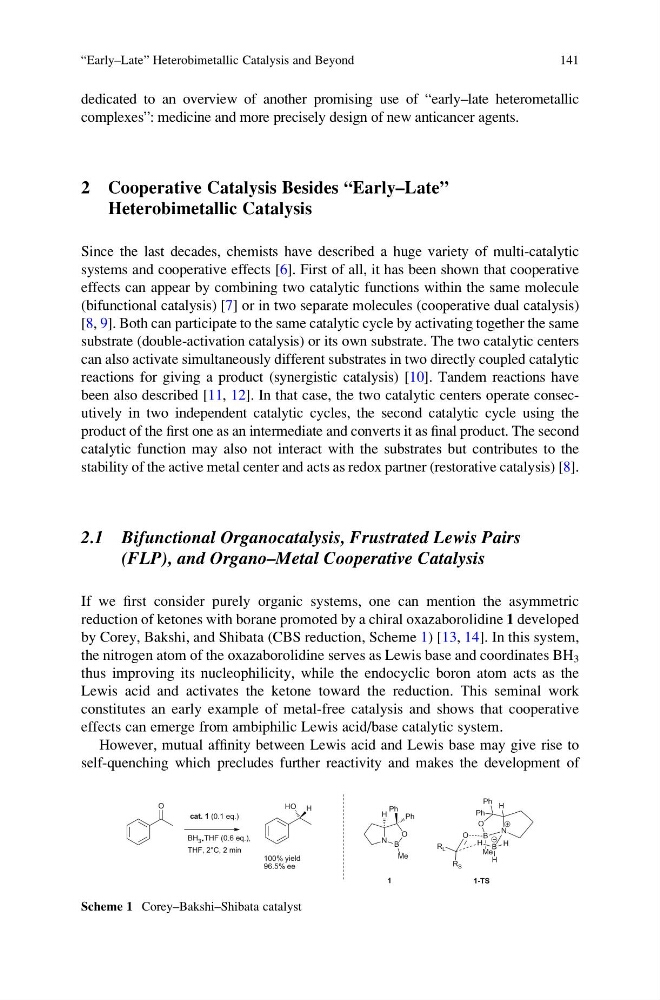
reduction of ketones with borane promoted by a chiral oxazaborolidine 1 developed
by Corey, Bakshi, and Shibata (CBS reduction, Scheme 1) [13, 14]. In this system,
the nitrogen atom of the oxazaborolidine serves as Lewis base and coordinates BH 3
thus improving its nucleophilicity, while the endocyclic boron atom acts as the
Lewis acid and activates the ketone toward the reduction. This seminal work
constitutes an early example of metal-free catalysis and shows that cooperative
effects can emerge from ambiphilic Lewis acid/base catalytic system.
However, mutual affinity between Lewis acid and Lewis base may give rise to
self-quenching which precludes further reactivity and makes the development of
N B
O
Ph
Ph
H
Me
O
H B
N
B
R L
R S
O
Ph H
Ph
H
H
Me
1
1-TS
O
cat. 1 (0.1 eq.)
BH 3 .THF (0.6 eq.),
THF, 2°C, 2 min
.
HO H
100% yield
96.5% ee
Scheme 1 Corey–Bakshi–Shibata catalyst
“Early–Late” Heterobimetallic Catalysis and Beyond
141
complexes”: medicine and more precisely design of new anticancer agents.
2 Cooperative Catalysis Besides “Early–Late”
Heterobimetallic Catalysis
Since the last decades, chemists have described a huge variety of multi-catalytic
systems and cooperative effects [6]. First of all, it has been shown that cooperative
effects can appear by combining two catalytic functions within the same molecule
(bifunctional catalysis) [7] or in two separate molecules (cooperative dual catalysis)
[8, 9]. Both can participate to the same catalytic cycle by activating together the same
substrate (double-activation catalysis) or its own substrate. The two catalytic centers
can also activate simultaneously different substrates in two directly coupled catalytic
reactions for giving a product (synergistic catalysis) [10]. Tandem reactions have
been also described [11, 12]. In that case, the two catalytic centers operate consecutively in two independent catalytic cycles, the second catalytic cycle using the
product of the first one as an intermediate and converts it as final product. The second
catalytic function may also not interact with the substrates but contributes to the
stability of the active metal center and acts as redox partner (restorative catalysis) [8].
2.1 Bifunctional Organocatalysis, Frustrated Lewis Pairs
(FLP), and Organo–Metal Cooperative Catalysis
If we first consider purely organic systems, one can mention the asymmetric
reduction of ketones with borane promoted by a chiral oxazaborolidine 1 developed
by Corey, Bakshi, and Shibata (CBS reduction, Scheme 1) [13, 14]. In this system,
the nitrogen atom of the oxazaborolidine serves as Lewis base and coordinates BH 3
thus improving its nucleophilicity, while the endocyclic boron atom acts as the
Lewis acid and activates the ketone toward the reduction. This seminal work
constitutes an early example of metal-free catalysis and shows that cooperative
effects can emerge from ambiphilic Lewis acid/base catalytic system.
However, mutual affinity between Lewis acid and Lewis base may give rise to
self-quenching which precludes further reactivity and makes the development of
N B
O
Ph
Ph
H
Me
O
H B
N
B
R L
R S
O
Ph H
Ph
H
H
Me
1
1-TS
O
cat. 1 (0.1 eq.)
BH 3 .THF (0.6 eq.),
THF, 2°C, 2 min
.
HO H
100% yield
96.5% ee
Scheme 1 Corey–Bakshi–Shibata catalyst
“Early–Late” Heterobimetallic Catalysis and Beyond
141