

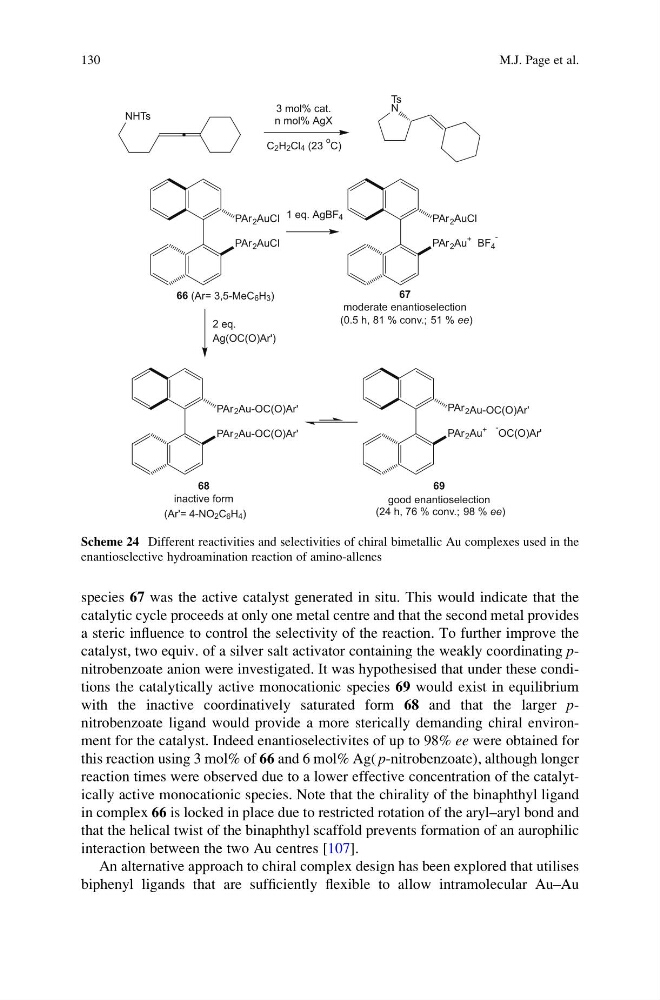
species 67 was the active catalyst generated in situ. This would indicate that the
catalytic cycle proceeds at only one metal centre and that the second metal provides
a steric influence to control the selectivity of the reaction. To further improve the
catalyst, two equiv. of a silver salt activator containing the weakly coordinating pnitrobenzoate anion were investigated. It was hypothesised that under these conditions the catalytically active monocationic species 69 would exist in equilibrium
with the inactive coordinatively saturated form 68 and that the larger pnitrobenzoate ligand would provide a more sterically demanding chiral environment for the catalyst. Indeed enantioselectivites of up to 98% ee were obtained for
this reaction using 3 mol% of 66 and 6 mol% Ag( p-nitrobenzoate), although longer
reaction times were observed due to a lower effective concentration of the catalytically active monocationic species. Note that the chirality of the binaphthyl ligand
in complex 66 is locked in place due to restricted rotation of the aryl–aryl bond and
that the helical twist of the binaphthyl scaffold prevents formation of an aurophilic
interaction between the two Au centres [107].
An alternative approach to chiral complex design has been explored that utilises
biphenyl ligands that are sufficiently flexible to allow intramolecular Au–Au
PAr 2 AuCl
PAr 2 AuCl
NHTs
Ts
N
C2H2Cl4 (23
o C)
3 mol% cat.
n mol% AgX
PAr 2 AuCl
PAr 2 Au
+ BF 4
-
1 eq. AgBF 4
67
moderate enantioselection
(0.5 h, 81 % conv.; 51 % ee)
PAr2Au-OC(O)Ar'
PAr2Au-OC(O)Ar'
PAr 2Au-OC(O)Ar'
PAr 2 Au
+ - OC(O)Ar'
2 eq.
Ag(OC(O)Ar')
68
inactive form
69
good enantioselection
(24 h, 76 % conv.; 98 % ee)
66 (Ar= 3,5-MeC6H3)
(Ar'= 4-NO2C 6 H4)
Scheme 24 Different reactivities and selectivities of chiral bimetallic Au complexes used in the
enantioselective hydroamination reaction of amino-allenes
130
M.J. Page et al.
catalytic cycle proceeds at only one metal centre and that the second metal provides
a steric influence to control the selectivity of the reaction. To further improve the
catalyst, two equiv. of a silver salt activator containing the weakly coordinating pnitrobenzoate anion were investigated. It was hypothesised that under these conditions the catalytically active monocationic species 69 would exist in equilibrium
with the inactive coordinatively saturated form 68 and that the larger pnitrobenzoate ligand would provide a more sterically demanding chiral environment for the catalyst. Indeed enantioselectivites of up to 98% ee were obtained for
this reaction using 3 mol% of 66 and 6 mol% Ag( p-nitrobenzoate), although longer
reaction times were observed due to a lower effective concentration of the catalytically active monocationic species. Note that the chirality of the binaphthyl ligand
in complex 66 is locked in place due to restricted rotation of the aryl–aryl bond and
that the helical twist of the binaphthyl scaffold prevents formation of an aurophilic
interaction between the two Au centres [107].
An alternative approach to chiral complex design has been explored that utilises
biphenyl ligands that are sufficiently flexible to allow intramolecular Au–Au
PAr 2 AuCl
PAr 2 AuCl
NHTs
Ts
N
C2H2Cl4 (23
o C)
3 mol% cat.
n mol% AgX
PAr 2 AuCl
PAr 2 Au
+ BF 4
-
1 eq. AgBF 4
67
moderate enantioselection
(0.5 h, 81 % conv.; 51 % ee)
PAr2Au-OC(O)Ar'
PAr2Au-OC(O)Ar'
PAr 2Au-OC(O)Ar'
PAr 2 Au
+ - OC(O)Ar'
2 eq.
Ag(OC(O)Ar')
68
inactive form
69
good enantioselection
(24 h, 76 % conv.; 98 % ee)
66 (Ar= 3,5-MeC6H3)
(Ar'= 4-NO2C 6 H4)
Scheme 24 Different reactivities and selectivities of chiral bimetallic Au complexes used in the
enantioselective hydroamination reaction of amino-allenes
130
M.J. Page et al.