

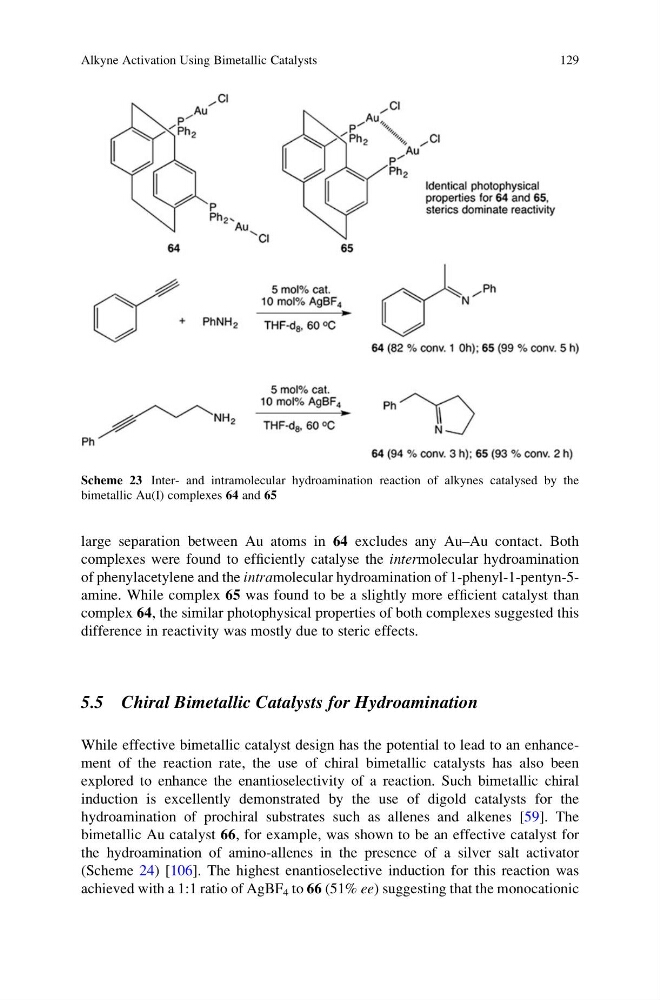
large separation between Au atoms in 64 excludes any Au–Au contact. Both
complexes were found to efficiently catalyse the intermolecular hydroamination
of phenylacetylene and the intramolecular hydroamination of 1-phenyl-1-pentyn-5amine. While complex 65 was found to be a slightly more efficient catalyst than
complex 64, the similar photophysical properties of both complexes suggested this
difference in reactivity was mostly due to steric effects.
5.5 Chiral Bimetallic Catalysts for Hydroamination
While effective bimetallic catalyst design has the potential to lead to an enhancement of the reaction rate, the use of chiral bimetallic catalysts has also been
explored to enhance the enantioselectivity of a reaction. Such bimetallic chiral
induction is excellently demonstrated by the use of digold catalysts for the
hydroamination of prochiral substrates such as allenes and alkenes [59]. The
bimetallic Au catalyst 66, for example, was shown to be an effective catalyst for
the hydroamination of amino-allenes in the presence of a silver salt activator
(Scheme 24) [106]. The highest enantioselective induction for this reaction was
achieved with a 1:1 ratio of AgBF 4 to 66 (51% ee) suggesting that the monocationic
Scheme 23 Inter- and intramolecular hydroamination reaction of alkynes catalysed by the
bimetallic Au(I) complexes 64 and 65
Alkyne Activation Using Bimetallic Catalysts
129
complexes were found to efficiently catalyse the intermolecular hydroamination
of phenylacetylene and the intramolecular hydroamination of 1-phenyl-1-pentyn-5amine. While complex 65 was found to be a slightly more efficient catalyst than
complex 64, the similar photophysical properties of both complexes suggested this
difference in reactivity was mostly due to steric effects.
5.5 Chiral Bimetallic Catalysts for Hydroamination
While effective bimetallic catalyst design has the potential to lead to an enhancement of the reaction rate, the use of chiral bimetallic catalysts has also been
explored to enhance the enantioselectivity of a reaction. Such bimetallic chiral
induction is excellently demonstrated by the use of digold catalysts for the
hydroamination of prochiral substrates such as allenes and alkenes [59]. The
bimetallic Au catalyst 66, for example, was shown to be an effective catalyst for
the hydroamination of amino-allenes in the presence of a silver salt activator
(Scheme 24) [106]. The highest enantioselective induction for this reaction was
achieved with a 1:1 ratio of AgBF 4 to 66 (51% ee) suggesting that the monocationic
Scheme 23 Inter- and intramolecular hydroamination reaction of alkynes catalysed by the
bimetallic Au(I) complexes 64 and 65
Alkyne Activation Using Bimetallic Catalysts
129