

to the catalytically inactive vinylidene complex 59. Crucially the reaction was not
catalysed by the bimetallic complex 60, which is structurally very similar to 57 but
contains the cyclopentadienyl ligands oriented in a trans arrangement across the
Ru–Ru axis [102]. This highlights the importance of the bridging bis(dimethylsilyl)
cyclopentadiene ligand in enforcing a catalytically active structure for complex 56.
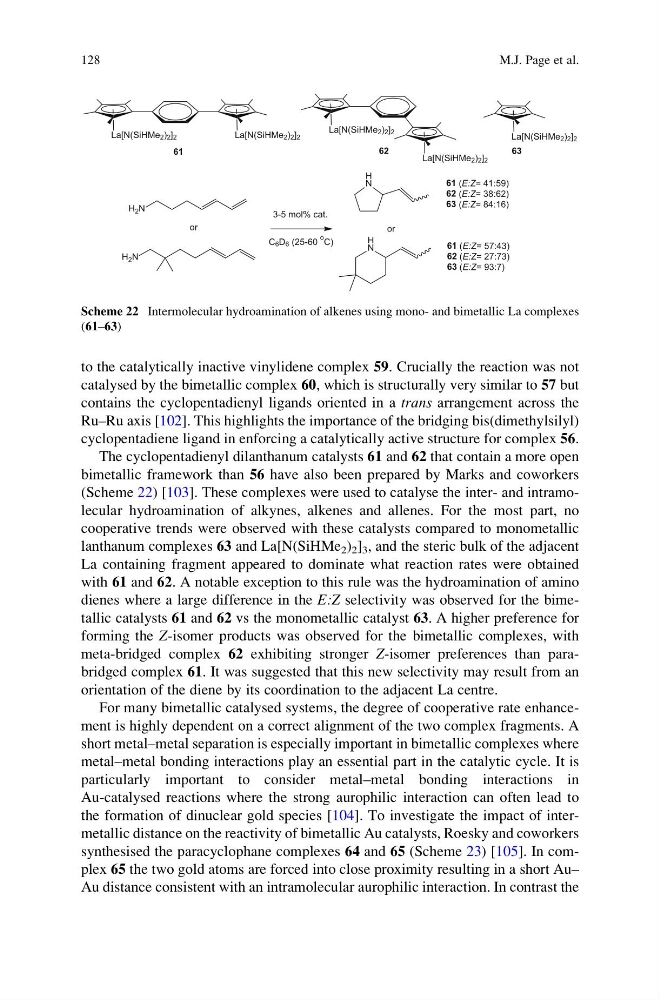
The cyclopentadienyl dilanthanum catalysts 61 and 62 that contain a more open
bimetallic framework than 56 have also been prepared by Marks and coworkers
(Scheme 22) [103]. These complexes were used to catalyse the inter- and intramolecular hydroamination of alkynes, alkenes and allenes. For the most part, no
cooperative trends were observed with these catalysts compared to monometallic
lanthanum complexes 63 and La[N(SiHMe 2 ) 2 ] 3 , and the steric bulk of the adjacent
La containing fragment appeared to dominate what reaction rates were obtained
with 61 and 62. A notable exception to this rule was the hydroamination of amino
dienes where a large difference in the E:Z selectivity was observed for the bimetallic catalysts 61 and 62 vs the monometallic catalyst 63. A higher preference for
forming the Z-isomer products was observed for the bimetallic complexes, with
meta-bridged complex 62 exhibiting stronger Z-isomer preferences than parabridged complex 61. It was suggested that this new selectivity may result from an
orientation of the diene by its coordination to the adjacent La centre.
For many bimetallic catalysed systems, the degree of cooperative rate enhancement is highly dependent on a correct alignment of the two complex fragments. A
short metal–metal separation is especially important in bimetallic complexes where
metal–metal bonding interactions play an essential part in the catalytic cycle. It is
particularly important to consider metal–metal bonding interactions in
Au-catalysed reactions where the strong aurophilic interaction can often lead to
the formation of dinuclear gold species [104]. To investigate the impact of intermetallic distance on the reactivity of bimetallic Au catalysts, Roesky and coworkers
synthesised the paracyclophane complexes 64 and 65 (Scheme 23) [105]. In complex 65 the two gold atoms are forced into close proximity resulting in a short Au–
Au distance consistent with an intramolecular aurophilic interaction. In contrast the
La[N(SiHMe 2 ) 2 ] 2
3-5 mol% cat.
C6D6 (25-60
o
C)
H 2 N
H 2 N
H
N
H
N
or
or
La[N(SiHMe 2 ) 2 ] 2
La[N(SiHMe 2 ) 2 ] 2
La[N(SiHMe2)2]2
La[N(SiHMe 2 ) 2 ] 2
61
62
63
61 (E:Z= 41:59)
62 (E:Z= 38:62)
63 (E:Z= 84:16)
61 (E:Z= 57:43)
62 (E:Z= 27:73)
63 (E:Z= 93:7)
Scheme 22 Intermolecular hydroamination of alkenes using mono- and bimetallic La complexes
(61–63)
128
M.J. Page et al.
catalysed by the bimetallic complex 60, which is structurally very similar to 57 but
contains the cyclopentadienyl ligands oriented in a trans arrangement across the
Ru–Ru axis [102]. This highlights the importance of the bridging bis(dimethylsilyl)
cyclopentadiene ligand in enforcing a catalytically active structure for complex 56.
The cyclopentadienyl dilanthanum catalysts 61 and 62 that contain a more open
bimetallic framework than 56 have also been prepared by Marks and coworkers
(Scheme 22) [103]. These complexes were used to catalyse the inter- and intramolecular hydroamination of alkynes, alkenes and allenes. For the most part, no
cooperative trends were observed with these catalysts compared to monometallic
lanthanum complexes 63 and La[N(SiHMe 2 ) 2 ] 3 , and the steric bulk of the adjacent
La containing fragment appeared to dominate what reaction rates were obtained
with 61 and 62. A notable exception to this rule was the hydroamination of amino
dienes where a large difference in the E:Z selectivity was observed for the bimetallic catalysts 61 and 62 vs the monometallic catalyst 63. A higher preference for
forming the Z-isomer products was observed for the bimetallic complexes, with
meta-bridged complex 62 exhibiting stronger Z-isomer preferences than parabridged complex 61. It was suggested that this new selectivity may result from an
orientation of the diene by its coordination to the adjacent La centre.
For many bimetallic catalysed systems, the degree of cooperative rate enhancement is highly dependent on a correct alignment of the two complex fragments. A
short metal–metal separation is especially important in bimetallic complexes where
metal–metal bonding interactions play an essential part in the catalytic cycle. It is
particularly important to consider metal–metal bonding interactions in
Au-catalysed reactions where the strong aurophilic interaction can often lead to
the formation of dinuclear gold species [104]. To investigate the impact of intermetallic distance on the reactivity of bimetallic Au catalysts, Roesky and coworkers
synthesised the paracyclophane complexes 64 and 65 (Scheme 23) [105]. In complex 65 the two gold atoms are forced into close proximity resulting in a short Au–
Au distance consistent with an intramolecular aurophilic interaction. In contrast the
La[N(SiHMe 2 ) 2 ] 2
3-5 mol% cat.
C6D6 (25-60
o
C)
H 2 N
H 2 N
H
N
H
N
or
or
La[N(SiHMe 2 ) 2 ] 2
La[N(SiHMe 2 ) 2 ] 2
La[N(SiHMe2)2]2
La[N(SiHMe 2 ) 2 ] 2
61
62
63
61 (E:Z= 41:59)
62 (E:Z= 38:62)
63 (E:Z= 84:16)
61 (E:Z= 57:43)
62 (E:Z= 27:73)
63 (E:Z= 93:7)
Scheme 22 Intermolecular hydroamination of alkenes using mono- and bimetallic La complexes
(61–63)
128
M.J. Page et al.