

bonding within their bimetallic complexes. Biphenyl ligands are not inherently
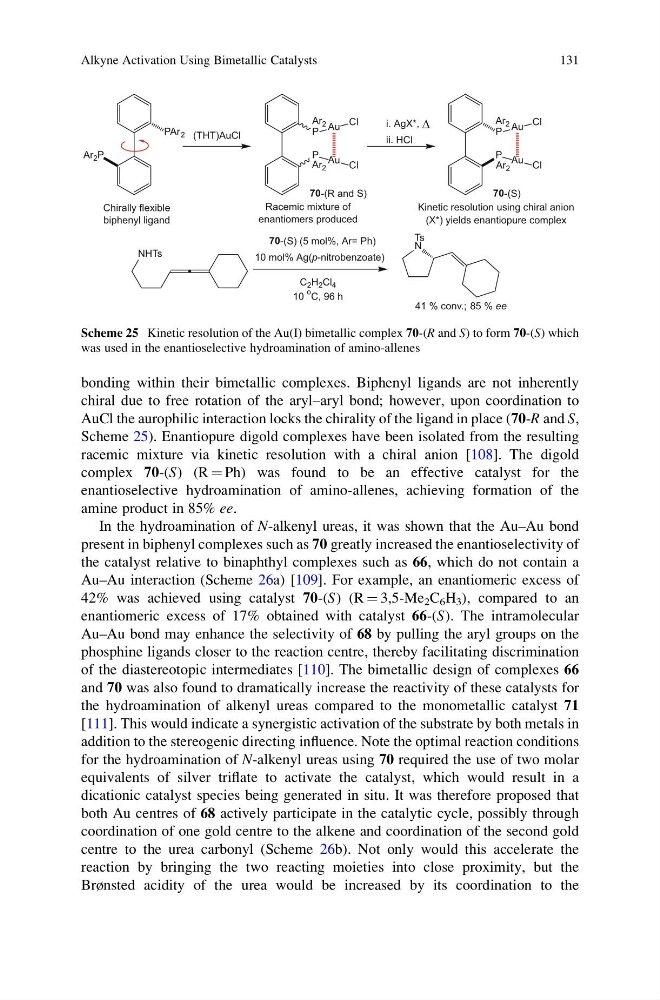
chiral due to free rotation of the aryl–aryl bond; however, upon coordination to
AuCl the aurophilic interaction locks the chirality of the ligand in place (70-R and S,
Scheme 25). Enantiopure digold complexes have been isolated from the resulting
racemic mixture via kinetic resolution with a chiral anion [108]. The digold
complex 70-(S) (R¼ Ph) was found to be an effective catalyst for the
enantioselective hydroamination of amino-allenes, achieving formation of the
amine product in 85% ee.
In the hydroamination of N-alkenyl ureas, it was shown that the Au–Au bond
present in biphenyl complexes such as 70 greatly increased the enantioselectivity of
the catalyst relative to binaphthyl complexes such as 66, which do not contain a
Au–Au interaction (Scheme 26a) [109]. For example, an enantiomeric excess of
42% was achieved using catalyst 70-(S) (R ¼ 3,5-Me 2 C 6 H 3 ), compared to an
enantiomeric excess of 17% obtained with catalyst 66-(S). The intramolecular
Au–Au bond may enhance the selectivity of 68 by pulling the aryl groups on the
phosphine ligands closer to the reaction centre, thereby facilitating discrimination
of the diastereotopic intermediates [110]. The bimetallic design of complexes 66
and 70 was also found to dramatically increase the reactivity of these catalysts for
the hydroamination of alkenyl ureas compared to the monometallic catalyst 71
[111]. This would indicate a synergistic activation of the substrate by both metals in
addition to the stereogenic directing influence. Note the optimal reaction conditions
for the hydroamination of N-alkenyl ureas using 70 required the use of two molar
equivalents of silver triflate to activate the catalyst, which would result in a
dicationic catalyst species being generated in situ. It was therefore proposed that
both Au centres of 68 actively participate in the catalytic cycle, possibly through
coordination of one gold centre to the alkene and coordination of the second gold
centre to the urea carbonyl (Scheme 26b). Not only would this accelerate the
reaction by bringing the two reacting moieties into close proximity, but the
Brønsted acidity of the urea would be increased by its coordination to the
P
P
Ar 2
Ar 2
70-(S)
NHTs
Ts
N
10 mol% Ag(p-nitrobenzoate)
C 2 H 2 Cl 4
10
o C, 96 h
41 % conv.; 85 % ee
70-(S) (5 mol%, Ar= Ph)
Au
Au
Cl
Cl
PAr 2
Ar 2 P
P
P
Ar 2
Ar 2
70-(R and S)
Au
Au
Cl
Cl
Racemic mixture of
enantiomers produced
(THT)AuCl
i. AgX*, D
ii. HCl
Kinetic resolution using chiral anion
(X*) yields enantiopure complex
Chirally flexible
biphenyl ligand
Scheme 25 Kinetic resolution of the Au(I) bimetallic complex 70-(R and S) to form 70-(S) which
was used in the enantioselective hydroamination of amino-allenes
Alkyne Activation Using Bimetallic Catalysts
131
chiral due to free rotation of the aryl–aryl bond; however, upon coordination to
AuCl the aurophilic interaction locks the chirality of the ligand in place (70-R and S,
Scheme 25). Enantiopure digold complexes have been isolated from the resulting
racemic mixture via kinetic resolution with a chiral anion [108]. The digold
complex 70-(S) (R¼ Ph) was found to be an effective catalyst for the
enantioselective hydroamination of amino-allenes, achieving formation of the
amine product in 85% ee.
In the hydroamination of N-alkenyl ureas, it was shown that the Au–Au bond
present in biphenyl complexes such as 70 greatly increased the enantioselectivity of
the catalyst relative to binaphthyl complexes such as 66, which do not contain a
Au–Au interaction (Scheme 26a) [109]. For example, an enantiomeric excess of
42% was achieved using catalyst 70-(S) (R ¼ 3,5-Me 2 C 6 H 3 ), compared to an
enantiomeric excess of 17% obtained with catalyst 66-(S). The intramolecular
Au–Au bond may enhance the selectivity of 68 by pulling the aryl groups on the
phosphine ligands closer to the reaction centre, thereby facilitating discrimination
of the diastereotopic intermediates [110]. The bimetallic design of complexes 66
and 70 was also found to dramatically increase the reactivity of these catalysts for
the hydroamination of alkenyl ureas compared to the monometallic catalyst 71
[111]. This would indicate a synergistic activation of the substrate by both metals in
addition to the stereogenic directing influence. Note the optimal reaction conditions
for the hydroamination of N-alkenyl ureas using 70 required the use of two molar
equivalents of silver triflate to activate the catalyst, which would result in a
dicationic catalyst species being generated in situ. It was therefore proposed that
both Au centres of 68 actively participate in the catalytic cycle, possibly through
coordination of one gold centre to the alkene and coordination of the second gold
centre to the urea carbonyl (Scheme 26b). Not only would this accelerate the
reaction by bringing the two reacting moieties into close proximity, but the
Brønsted acidity of the urea would be increased by its coordination to the
P
P
Ar 2
Ar 2
70-(S)
NHTs
Ts
N
10 mol% Ag(p-nitrobenzoate)
C 2 H 2 Cl 4
10
o C, 96 h
41 % conv.; 85 % ee
70-(S) (5 mol%, Ar= Ph)
Au
Au
Cl
Cl
PAr 2
Ar 2 P
P
P
Ar 2
Ar 2
70-(R and S)
Au
Au
Cl
Cl
Racemic mixture of
enantiomers produced
(THT)AuCl
i. AgX*, D
ii. HCl
Kinetic resolution using chiral anion
(X*) yields enantiopure complex
Chirally flexible
biphenyl ligand
Scheme 25 Kinetic resolution of the Au(I) bimetallic complex 70-(R and S) to form 70-(S) which
was used in the enantioselective hydroamination of amino-allenes
Alkyne Activation Using Bimetallic Catalysts
131