

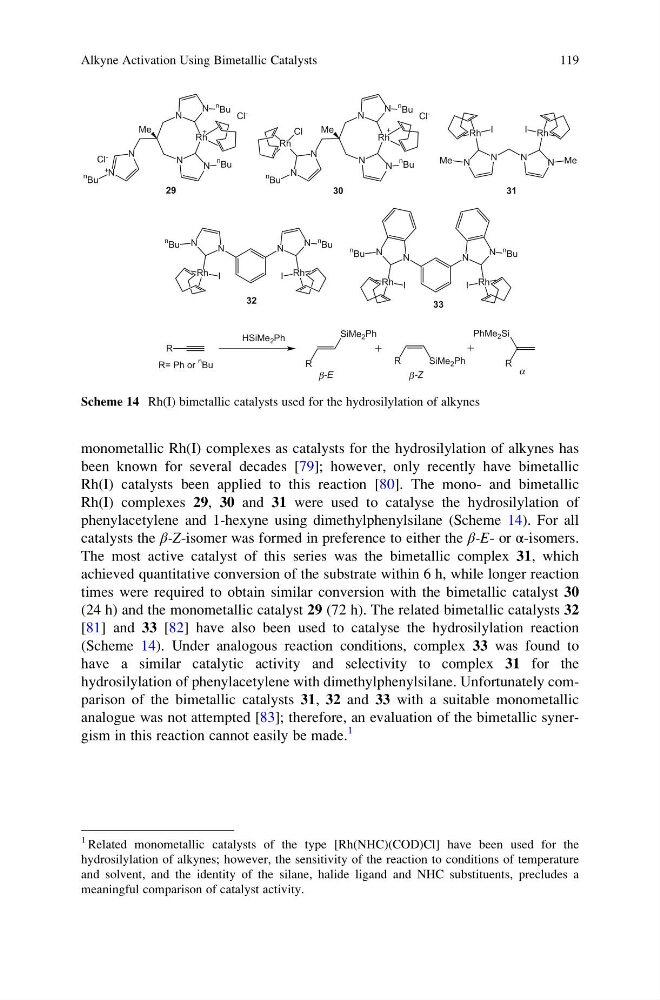
monometallic Rh(I) complexes as catalysts for the hydrosilylation of alkynes has
been known for several decades [79]; however, only recently have bimetallic
Rh(I) catalysts been applied to this reaction [80]. The mono- and bimetallic
Rh(I) complexes 29, 30 and 31 were used to catalyse the hydrosilylation of
phenylacetylene and 1-hexyne using dimethylphenylsilane (Scheme 14). For all
catalysts the β-Z-isomer was formed in preference to either the β-E- or α-isomers.
The most active catalyst of this series was the bimetallic complex 31, which
achieved quantitative conversion of the substrate within 6 h, while longer reaction
times were required to obtain similar conversion with the bimetallic catalyst 30
(24 h) and the monometallic catalyst 29 (72 h). The related bimetallic catalysts 32
[81] and 33 [82] have also been used to catalyse the hydrosilylation reaction
(Scheme 14). Under analogous reaction conditions, complex 33 was found to
have a similar catalytic activity and selectivity to complex 31 for the
hydrosilylation of phenylacetylene with dimethylphenylsilane. Unfortunately comparison of the bimetallic catalysts 31, 32 and 33 with a suitable monometallic
analogue was not attempted [83]; therefore, an evaluation of the bimetallic synergism in this reaction cannot easily be made.
1
Rh
N
N
N
N
N
N
n
Bu
n
Bu
n Bu
Me
Cl -
Cl -
Rh
N
N
N
N
N
N
n
Bu
n
Bu
n
Bu
Me
Cl -
Cl
Rh
N
N
Me
I
Rh
N
N Me
I Rh
29
30
31
R
R
SiMe 2 Ph
R
SiMe 2 Ph
R
PhMe 2 Si
HSiMe 2 Ph
R= Ph or
n Bu
b
b
-E
-Z
a
N
N
N
N
n Bu
n
Bu
I Rh
I
Rh
N
N
N
N
n
Bu
n Bu
I Rh
I
Rh
32
33
Scheme 14 Rh(I) bimetallic catalysts used for the hydrosilylation of alkynes
1 Related monometallic catalysts of the type [Rh(NHC)(COD)Cl] have been used for the
hydrosilylation of alkynes; however, the sensitivity of the reaction to conditions of temperature
and solvent, and the identity of the silane, halide ligand and NHC substituents, precludes a
meaningful comparison of catalyst activity.
Alkyne Activation Using Bimetallic Catalysts
119
been known for several decades [79]; however, only recently have bimetallic
Rh(I) catalysts been applied to this reaction [80]. The mono- and bimetallic
Rh(I) complexes 29, 30 and 31 were used to catalyse the hydrosilylation of
phenylacetylene and 1-hexyne using dimethylphenylsilane (Scheme 14). For all
catalysts the β-Z-isomer was formed in preference to either the β-E- or α-isomers.
The most active catalyst of this series was the bimetallic complex 31, which
achieved quantitative conversion of the substrate within 6 h, while longer reaction
times were required to obtain similar conversion with the bimetallic catalyst 30
(24 h) and the monometallic catalyst 29 (72 h). The related bimetallic catalysts 32
[81] and 33 [82] have also been used to catalyse the hydrosilylation reaction
(Scheme 14). Under analogous reaction conditions, complex 33 was found to
have a similar catalytic activity and selectivity to complex 31 for the
hydrosilylation of phenylacetylene with dimethylphenylsilane. Unfortunately comparison of the bimetallic catalysts 31, 32 and 33 with a suitable monometallic
analogue was not attempted [83]; therefore, an evaluation of the bimetallic synergism in this reaction cannot easily be made.
1
Rh
N
N
N
N
N
N
n
Bu
n
Bu
n Bu
Me
Cl -
Cl -
Rh
N
N
N
N
N
N
n
Bu
n
Bu
n
Bu
Me
Cl -
Cl
Rh
N
N
Me
I
Rh
N
N Me
I Rh
29
30
31
R
R
SiMe 2 Ph
R
SiMe 2 Ph
R
PhMe 2 Si
HSiMe 2 Ph
R= Ph or
n Bu
b
b
-E
-Z
a
N
N
N
N
n Bu
n
Bu
I Rh
I
Rh
N
N
N
N
n
Bu
n Bu
I Rh
I
Rh
32
33
Scheme 14 Rh(I) bimetallic catalysts used for the hydrosilylation of alkynes
1 Related monometallic catalysts of the type [Rh(NHC)(COD)Cl] have been used for the
hydrosilylation of alkynes; however, the sensitivity of the reaction to conditions of temperature
and solvent, and the identity of the silane, halide ligand and NHC substituents, precludes a
meaningful comparison of catalyst activity.
Alkyne Activation Using Bimetallic Catalysts
119