

blocks in organic synthesis [68]. One of the more effective catalysts for the
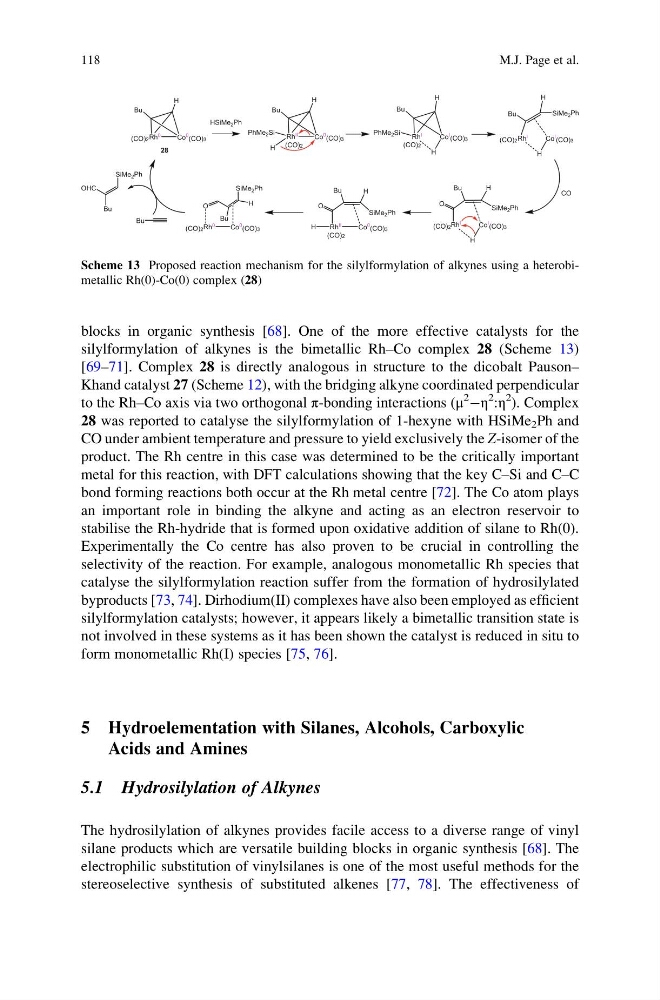
silylformylation of alkynes is the bimetallic Rh–Co complex 28 (Scheme 13)
[69–71]. Complex 28 is directly analogous in structure to the dicobalt Pauson–
Khand catalyst 27 (Scheme 12), with the bridging alkyne coordinated perpendicular
to the Rh–Co axis via two orthogonal π-bonding interactions (μ
2
Àη
2 :η
2
). Complex
28 was reported to catalyse the silylformylation of 1-hexyne with HSiMe 2 Ph and
CO under ambient temperature and pressure to yield exclusively the Z-isomer of the
product. The Rh centre in this case was determined to be the critically important
metal for this reaction, with DFT calculations showing that the key C–Si and C–C
bond forming reactions both occur at the Rh metal centre [72]. The Co atom plays
an important role in binding the alkyne and acting as an electron reservoir to
stabilise the Rh-hydride that is formed upon oxidative addition of silane to Rh(0).
Experimentally the Co centre has also proven to be crucial in controlling the
selectivity of the reaction. For example, analogous monometallic Rh species that
catalyse the silylformylation reaction suffer from the formation of hydrosilylated
byproducts [73, 74]. Dirhodium(II) complexes have also been employed as efficient
silylformylation catalysts; however, it appears likely a bimetallic transition state is
not involved in these systems as it has been shown the catalyst is reduced in situ to
form monometallic Rh(I) species [75, 76].
5 Hydroelementation with Silanes, Alcohols, Carboxylic
Acids and Amines
5.1 Hydrosilylation of Alkynes
The hydrosilylation of alkynes provides facile access to a diverse range of vinyl
silane products which are versatile building blocks in organic synthesis [68]. The
electrophilic substitution of vinylsilanes is one of the most useful methods for the
stereoselective synthesis of substituted alkenes [77, 78]. The effectiveness of
Rh 0
Co 0
(CO)3
Bu
H
Rh II
Co 0
(CO)3
Bu
H
PhMe 2 Si
(CO)2
(CO)2
28
H
HSiMe 2 Ph
Rh I
Co I (CO)3
Bu
H
PhMe 2 Si
(CO)2
H
Rh I
Co I (CO)3
Bu
H
(CO)2
H
SiMe 2 Ph
Rh I
Co I (CO)3
Bu
H
(CO)2
H
SiMe 2 Ph
O
Rh II
Co 0 (CO)3
Bu
H
(CO)2
SiMe 2 Ph
O
H
Co 0
(CO)3
Rh 0
SiMe 2 Ph
H
Bu
O
(CO)2
CO
Bu
SiMe 2 Ph
OHC
Bu
Scheme 13 Proposed reaction mechanism for the silylformylation of alkynes using a heterobimetallic Rh(0)-Co(0) complex (28)
118
M.J. Page et al.
silylformylation of alkynes is the bimetallic Rh–Co complex 28 (Scheme 13)
[69–71]. Complex 28 is directly analogous in structure to the dicobalt Pauson–
Khand catalyst 27 (Scheme 12), with the bridging alkyne coordinated perpendicular
to the Rh–Co axis via two orthogonal π-bonding interactions (μ
2
Àη
2 :η
2
). Complex
28 was reported to catalyse the silylformylation of 1-hexyne with HSiMe 2 Ph and
CO under ambient temperature and pressure to yield exclusively the Z-isomer of the
product. The Rh centre in this case was determined to be the critically important
metal for this reaction, with DFT calculations showing that the key C–Si and C–C
bond forming reactions both occur at the Rh metal centre [72]. The Co atom plays
an important role in binding the alkyne and acting as an electron reservoir to
stabilise the Rh-hydride that is formed upon oxidative addition of silane to Rh(0).
Experimentally the Co centre has also proven to be crucial in controlling the
selectivity of the reaction. For example, analogous monometallic Rh species that
catalyse the silylformylation reaction suffer from the formation of hydrosilylated
byproducts [73, 74]. Dirhodium(II) complexes have also been employed as efficient
silylformylation catalysts; however, it appears likely a bimetallic transition state is
not involved in these systems as it has been shown the catalyst is reduced in situ to
form monometallic Rh(I) species [75, 76].
5 Hydroelementation with Silanes, Alcohols, Carboxylic
Acids and Amines
5.1 Hydrosilylation of Alkynes
The hydrosilylation of alkynes provides facile access to a diverse range of vinyl
silane products which are versatile building blocks in organic synthesis [68]. The
electrophilic substitution of vinylsilanes is one of the most useful methods for the
stereoselective synthesis of substituted alkenes [77, 78]. The effectiveness of
Rh 0
Co 0
(CO)3
Bu
H
Rh II
Co 0
(CO)3
Bu
H
PhMe 2 Si
(CO)2
(CO)2
28
H
HSiMe 2 Ph
Rh I
Co I (CO)3
Bu
H
PhMe 2 Si
(CO)2
H
Rh I
Co I (CO)3
Bu
H
(CO)2
H
SiMe 2 Ph
Rh I
Co I (CO)3
Bu
H
(CO)2
H
SiMe 2 Ph
O
Rh II
Co 0 (CO)3
Bu
H
(CO)2
SiMe 2 Ph
O
H
Co 0
(CO)3
Rh 0
SiMe 2 Ph
H
Bu
O
(CO)2
CO
Bu
SiMe 2 Ph
OHC
Bu
Scheme 13 Proposed reaction mechanism for the silylformylation of alkynes using a heterobimetallic Rh(0)-Co(0) complex (28)
118
M.J. Page et al.