

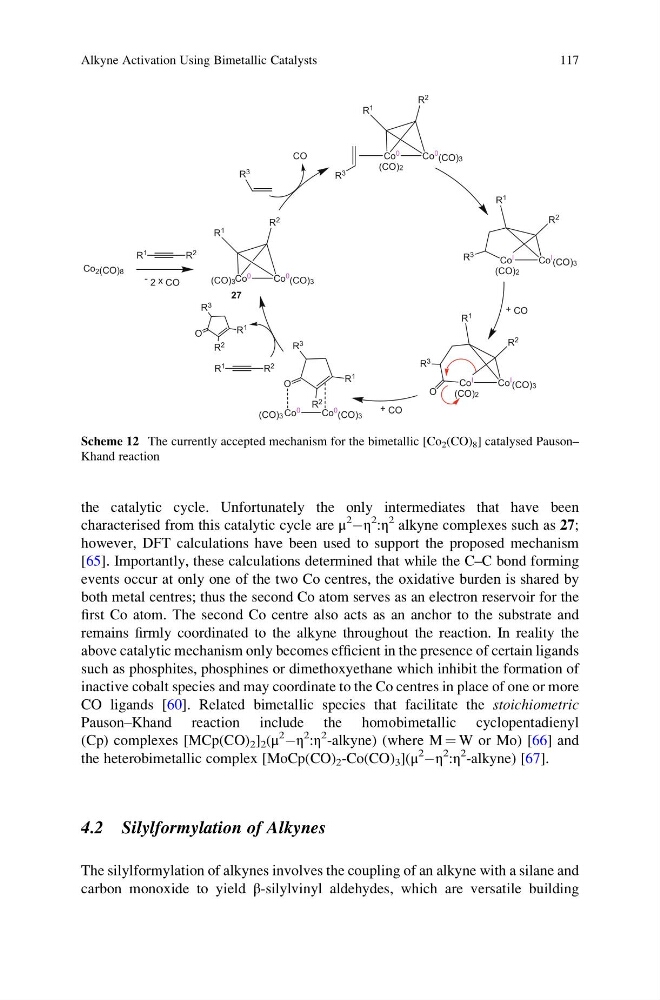
the catalytic cycle. Unfortunately the only intermediates that have been
characterised from this catalytic cycle are μ
2
Àη
2 :η
2 alkyne complexes such as 27;
however, DFT calculations have been used to support the proposed mechanism
[65]. Importantly, these calculations determined that while the C–C bond forming
events occur at only one of the two Co centres, the oxidative burden is shared by
both metal centres; thus the second Co atom serves as an electron reservoir for the
first Co atom. The second Co centre also acts as an anchor to the substrate and
remains firmly coordinated to the alkyne throughout the reaction. In reality the
above catalytic mechanism only becomes efficient in the presence of certain ligands
such as phosphites, phosphines or dimethoxyethane which inhibit the formation of
inactive cobalt species and may coordinate to the Co centres in place of one or more
CO ligands [60]. Related bimetallic species that facilitate the stoichiometric
Pauson–Khand reaction include the homobimetallic cyclopentadienyl
(Cp) complexes [MCp(CO) 2 ] 2 (μ
2
Àη
2 :η
2 -alkyne) (where M ¼ W or Mo) [66] and
the heterobimetallic complex [MoCp(CO) 2 -Co(CO) 3 ](μ
2
Àη
2 :η
2 -alkyne) [67].
4.2 Silylformylation of Alkynes
The silylformylation of alkynes involves the coupling of an alkyne with a silane and
carbon monoxide to yield β-silylvinyl aldehydes, which are versatile building
Co 0
Co 0
(CO)3
R 1
R 2
Co 0
Co 0 (CO)3
R 1
R 2
(CO)2
R 3
Co
I
Co
I (CO)3
R 1
R 2
(CO)2
R 3
Co
I
Co
I (CO)3
R 1
R 2
(CO)2
R 3
O
Co 0
(CO)3
Co 0
R 1
R 2
O
R 3
(CO)3
(CO)3
Co 2(CO)8
CO
+ CO
- 2 x CO
R 1
R 2
R 3
+ CO
R 1
R 2
27
R 1
R 2
O
R 3
Scheme 12 The currently accepted mechanism for the bimetallic [Co 2 (CO) 8 ] catalysed Pauson–
Khand reaction
Alkyne Activation Using Bimetallic Catalysts
117
characterised from this catalytic cycle are μ
2
Àη
2 :η
2 alkyne complexes such as 27;
however, DFT calculations have been used to support the proposed mechanism
[65]. Importantly, these calculations determined that while the C–C bond forming
events occur at only one of the two Co centres, the oxidative burden is shared by
both metal centres; thus the second Co atom serves as an electron reservoir for the
first Co atom. The second Co centre also acts as an anchor to the substrate and
remains firmly coordinated to the alkyne throughout the reaction. In reality the
above catalytic mechanism only becomes efficient in the presence of certain ligands
such as phosphites, phosphines or dimethoxyethane which inhibit the formation of
inactive cobalt species and may coordinate to the Co centres in place of one or more
CO ligands [60]. Related bimetallic species that facilitate the stoichiometric
Pauson–Khand reaction include the homobimetallic cyclopentadienyl
(Cp) complexes [MCp(CO) 2 ] 2 (μ
2
Àη
2 :η
2 -alkyne) (where M ¼ W or Mo) [66] and
the heterobimetallic complex [MoCp(CO) 2 -Co(CO) 3 ](μ
2
Àη
2 :η
2 -alkyne) [67].
4.2 Silylformylation of Alkynes
The silylformylation of alkynes involves the coupling of an alkyne with a silane and
carbon monoxide to yield β-silylvinyl aldehydes, which are versatile building
Co 0
Co 0
(CO)3
R 1
R 2
Co 0
Co 0 (CO)3
R 1
R 2
(CO)2
R 3
Co
I
Co
I (CO)3
R 1
R 2
(CO)2
R 3
Co
I
Co
I (CO)3
R 1
R 2
(CO)2
R 3
O
Co 0
(CO)3
Co 0
R 1
R 2
O
R 3
(CO)3
(CO)3
Co 2(CO)8
CO
+ CO
- 2 x CO
R 1
R 2
R 3
+ CO
R 1
R 2
27
R 1
R 2
O
R 3
Scheme 12 The currently accepted mechanism for the bimetallic [Co 2 (CO) 8 ] catalysed Pauson–
Khand reaction
Alkyne Activation Using Bimetallic Catalysts
117