

4 The Pauson–Khand Reaction and Silylformylation
4.1 The Pauson–Khand Reaction
The Pauson–Khand reaction is the coupling of an alkyne, alkene and CO to yield a
cyclopentenone in an overall [2 + 2 + 1] cycloaddition reaction (Scheme 12) and has
proven to be a valuable tool in the total synthesis of various natural products
[60, 61]. The reaction was first catalysed by the bimetallic dicobalt complex
[Co 2 (CO) 8 ] [62–64], although a number of variations with monometallic cobalt
complexes and with different metals have also been reported [61]. The currently
accepted mechanism of the [Co 2 (CO) 8 ]-catalysed Pauson–Khand reaction involves
initial coordination of the alkyne perpendicular to the Co–Co axis through two
orthogonal π-bonding interactions to give complex 27. This is followed by coordination of the alkene and then insertion of the alkene into a Co–C bond. Migratory
insertion of a CO ligand and reductive elimination of the product liberates the
[Co 2 (CO) 6 ] fragment, which is trapped by a second equivalent of alkyne to renew
Au(PR3)
24
(PR 3 )Au
(IPr)Au
Au(IPr)
SbF 6
SbF 6
Ph
Ph
Me
+
Ph
Me
Ph
CD 2 Cl 2 , 25
o C
CD 2 Cl 2 , 25
o C
(IPr = 1,3-bis(2,6-diisopropylphenyl)imidazol-2-ylidene)
b)
a)
c)
25
O
Au(PPh3)
Au(PPh3)
(Ph3P)Au
BF 4
n
Me
Me
Me
n
CHCl 3 , 60
o C
26
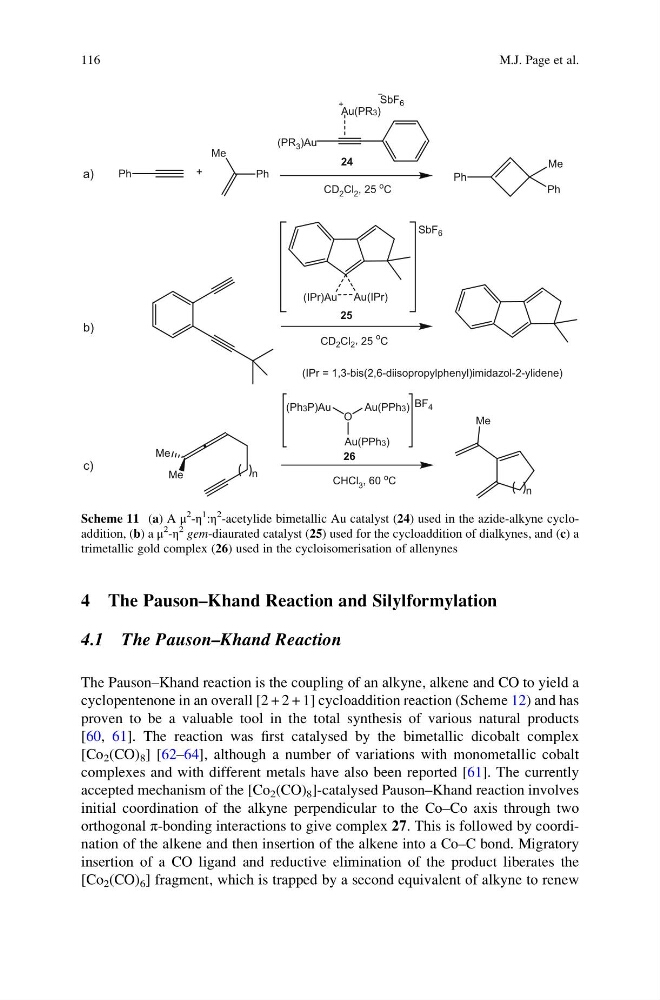
Scheme 11 (a) A μ
2
-η
1
:η
2
-acetylide bimetallic Au catalyst (24) used in the azide-alkyne cycloaddition, (b) a μ
2
-η
2 gem-diaurated catalyst (25) used for the cycloaddition of dialkynes, and (c) a
trimetallic gold complex (26) used in the cycloisomerisation of allenynes
116
M.J. Page et al.
4.1 The Pauson–Khand Reaction
The Pauson–Khand reaction is the coupling of an alkyne, alkene and CO to yield a
cyclopentenone in an overall [2 + 2 + 1] cycloaddition reaction (Scheme 12) and has
proven to be a valuable tool in the total synthesis of various natural products
[60, 61]. The reaction was first catalysed by the bimetallic dicobalt complex
[Co 2 (CO) 8 ] [62–64], although a number of variations with monometallic cobalt
complexes and with different metals have also been reported [61]. The currently
accepted mechanism of the [Co 2 (CO) 8 ]-catalysed Pauson–Khand reaction involves
initial coordination of the alkyne perpendicular to the Co–Co axis through two
orthogonal π-bonding interactions to give complex 27. This is followed by coordination of the alkene and then insertion of the alkene into a Co–C bond. Migratory
insertion of a CO ligand and reductive elimination of the product liberates the
[Co 2 (CO) 6 ] fragment, which is trapped by a second equivalent of alkyne to renew
Au(PR3)
24
(PR 3 )Au
(IPr)Au
Au(IPr)
SbF 6
SbF 6
Ph
Ph
Me
+
Ph
Me
Ph
CD 2 Cl 2 , 25
o C
CD 2 Cl 2 , 25
o C
(IPr = 1,3-bis(2,6-diisopropylphenyl)imidazol-2-ylidene)
b)
a)
c)
25
O
Au(PPh3)
Au(PPh3)
(Ph3P)Au
BF 4
n
Me
Me
Me
n
CHCl 3 , 60
o C
26
Scheme 11 (a) A μ
2
-η
1
:η
2
-acetylide bimetallic Au catalyst (24) used in the azide-alkyne cycloaddition, (b) a μ
2
-η
2 gem-diaurated catalyst (25) used for the cycloaddition of dialkynes, and (c) a
trimetallic gold complex (26) used in the cycloisomerisation of allenynes
116
M.J. Page et al.