

5.2 Hydroalkoxylation of Alkynes
The mono- and dihydroalkoxylation of alkynes provides access to enol ether and
acetal functional groups, respectively. This reaction is particularly versatile when
applied in an intramolecular fashion to yield oxygen containing heterocycles such
as furans, pyrans and spiroketals which are essential components of many biologically active compounds. Monometallic Au(I) catalysts are known to be excellent
catalysts for the hydroalkoxylation of alkynes [84, 85]. Due to the strong aurophilic
interaction that is possible between two gold atoms, bimetallic intermediates have
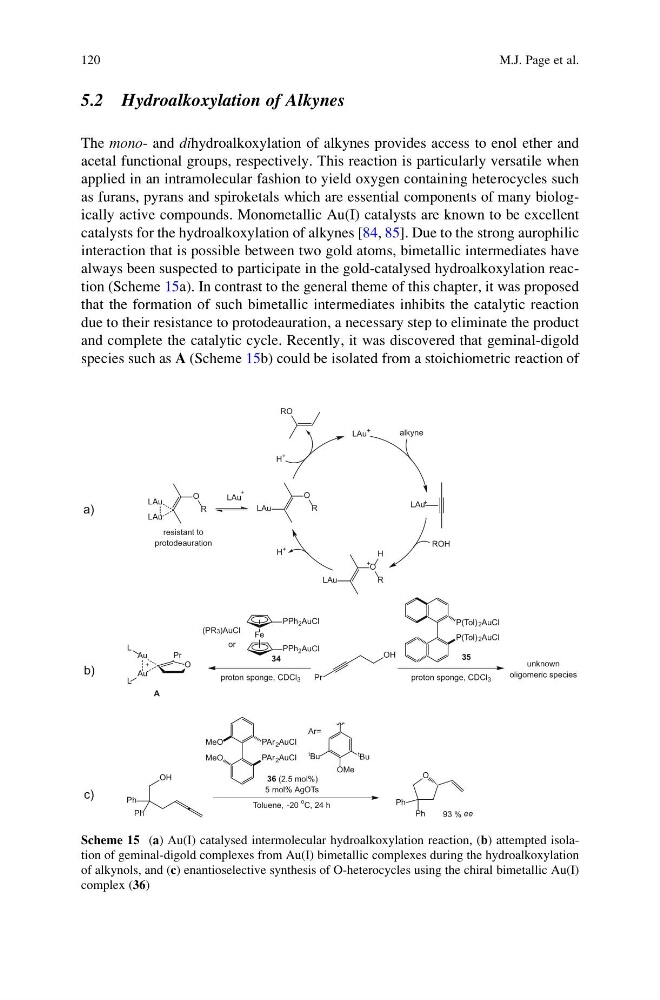
always been suspected to participate in the gold-catalysed hydroalkoxylation reaction (Scheme 15a). In contrast to the general theme of this chapter, it was proposed
that the formation of such bimetallic intermediates inhibits the catalytic reaction
due to their resistance to protodeauration, a necessary step to eliminate the product
and complete the catalytic cycle. Recently, it was discovered that geminal-digold
species such as A (Scheme 15b) could be isolated from a stoichiometric reaction of
LAu
LAu
O
R
O
R
LAu
LAu
LAu
O
R
H
LAu
alkyne
H
+
H
+
RO
ROH
LAu
resistant to
protodeauration
O
Pr
Au
Au
L
L
Pr
OH
proton sponge, CDCl3
PPh 2 AuCl
Fe
PPh 2 AuCl
P(Tol) 2AuCl
P(Tol) 2AuCl
(PR3)AuCl
or
proton sponge, CDCl3
unknown
oligomeric species
A
34
35
MeO
MeO
PAr 2 AuCl
PAr 2 AuCl
t
Bu
t
Bu
OMe
Ar=
OH
Ph
Ph
O
Ph
Ph
5 mol% AgOTs
Toluene, -20
o
C, 24 h
93 % ee
36 (2.5 mol%)
a)
b)
c)
Scheme 15 (a) Au(I) catalysed intermolecular hydroalkoxylation reaction, (b) attempted isolation of geminal-digold complexes from Au(I) bimetallic complexes during the hydroalkoxylation
of alkynols, and (c) enantioselective synthesis of O-heterocycles using the chiral bimetallic Au(I)
complex (36)
120
M.J. Page et al.
The mono- and dihydroalkoxylation of alkynes provides access to enol ether and
acetal functional groups, respectively. This reaction is particularly versatile when
applied in an intramolecular fashion to yield oxygen containing heterocycles such
as furans, pyrans and spiroketals which are essential components of many biologically active compounds. Monometallic Au(I) catalysts are known to be excellent
catalysts for the hydroalkoxylation of alkynes [84, 85]. Due to the strong aurophilic
interaction that is possible between two gold atoms, bimetallic intermediates have
always been suspected to participate in the gold-catalysed hydroalkoxylation reaction (Scheme 15a). In contrast to the general theme of this chapter, it was proposed
that the formation of such bimetallic intermediates inhibits the catalytic reaction
due to their resistance to protodeauration, a necessary step to eliminate the product
and complete the catalytic cycle. Recently, it was discovered that geminal-digold
species such as A (Scheme 15b) could be isolated from a stoichiometric reaction of
LAu
LAu
O
R
O
R
LAu
LAu
LAu
O
R
H
LAu
alkyne
H
+
H
+
RO
ROH
LAu
resistant to
protodeauration
O
Pr
Au
Au
L
L
Pr
OH
proton sponge, CDCl3
PPh 2 AuCl
Fe
PPh 2 AuCl
P(Tol) 2AuCl
P(Tol) 2AuCl
(PR3)AuCl
or
proton sponge, CDCl3
unknown
oligomeric species
A
34
35
MeO
MeO
PAr 2 AuCl
PAr 2 AuCl
t
Bu
t
Bu
OMe
Ar=
OH
Ph
Ph
O
Ph
Ph
5 mol% AgOTs
Toluene, -20
o
C, 24 h
93 % ee
36 (2.5 mol%)
a)
b)
c)
Scheme 15 (a) Au(I) catalysed intermolecular hydroalkoxylation reaction, (b) attempted isolation of geminal-digold complexes from Au(I) bimetallic complexes during the hydroalkoxylation
of alkynols, and (c) enantioselective synthesis of O-heterocycles using the chiral bimetallic Au(I)
complex (36)
120
M.J. Page et al.