

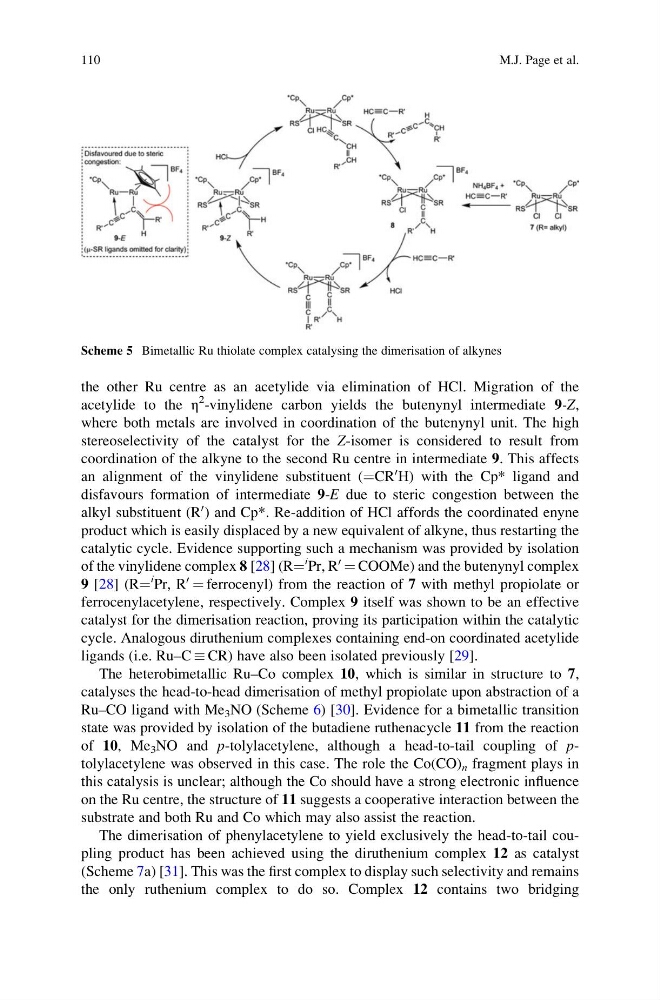
the other Ru centre as an acetylide via elimination of HCl. Migration of the
acetylide to the η
2 -vinylidene carbon yields the butenynyl intermediate 9-Z,
where both metals are involved in coordination of the butenynyl unit. The high
stereoselectivity of the catalyst for the Z-isomer is considered to result from
coordination of the alkyne to the second Ru centre in intermediate 9. This affects
an alignment of the vinylidene substituent (¼CR
0 H) with the Cp* ligand and
disfavours formation of intermediate 9-E due to steric congestion between the
alkyl substituent (R
0 ) and Cp*. Re-addition of HCl affords the coordinated enyne
product which is easily displaced by a new equivalent of alkyne, thus restarting the
catalytic cycle. Evidence supporting such a mechanism was provided by isolation
of the vinylidene complex 8 [28] (R¼
i
Pr, R
0
¼ COOMe) and the butenynyl complex
9 [28] (R¼
i
Pr, R
0
¼ ferrocenyl) from the reaction of 7 with methyl propiolate or
ferrocenylacetylene, respectively. Complex 9 itself was shown to be an effective
catalyst for the dimerisation reaction, proving its participation within the catalytic
cycle. Analogous diruthenium complexes containing end-on coordinated acetylide
ligands (i.e. Ru–C CR) have also been isolated previously [29].
The heterobimetallic Ru–Co complex 10, which is similar in structure to 7,
catalyses the head-to-head dimerisation of methyl propiolate upon abstraction of a
Ru–CO ligand with Me 3 NO (Scheme 6) [30]. Evidence for a bimetallic transition
state was provided by isolation of the butadiene ruthenacycle 11 from the reaction
of 10, Me 3 NO and p-tolylacetylene, although a head-to-tail coupling of ptolylacetylene was observed in this case. The role the Co(CO) n fragment plays in
this catalysis is unclear; although the Co should have a strong electronic influence
on the Ru centre, the structure of 11 suggests a cooperative interaction between the
substrate and both Ru and Co which may also assist the reaction.
The dimerisation of phenylacetylene to yield exclusively the head-to-tail coupling product has been achieved using the diruthenium complex 12 as catalyst
(Scheme 7a) [31]. This was the first complex to display such selectivity and remains
the only ruthenium complex to do so. Complex 12 contains two bridging
Scheme 5 Bimetallic Ru thiolate complex catalysing the dimerisation of alkynes
110
M.J. Page et al.
acetylide to the η
2 -vinylidene carbon yields the butenynyl intermediate 9-Z,
where both metals are involved in coordination of the butenynyl unit. The high
stereoselectivity of the catalyst for the Z-isomer is considered to result from
coordination of the alkyne to the second Ru centre in intermediate 9. This affects
an alignment of the vinylidene substituent (¼CR
0 H) with the Cp* ligand and
disfavours formation of intermediate 9-E due to steric congestion between the
alkyl substituent (R
0 ) and Cp*. Re-addition of HCl affords the coordinated enyne
product which is easily displaced by a new equivalent of alkyne, thus restarting the
catalytic cycle. Evidence supporting such a mechanism was provided by isolation
of the vinylidene complex 8 [28] (R¼
i
Pr, R
0
¼ COOMe) and the butenynyl complex
9 [28] (R¼
i
Pr, R
0
¼ ferrocenyl) from the reaction of 7 with methyl propiolate or
ferrocenylacetylene, respectively. Complex 9 itself was shown to be an effective
catalyst for the dimerisation reaction, proving its participation within the catalytic
cycle. Analogous diruthenium complexes containing end-on coordinated acetylide
ligands (i.e. Ru–C CR) have also been isolated previously [29].
The heterobimetallic Ru–Co complex 10, which is similar in structure to 7,
catalyses the head-to-head dimerisation of methyl propiolate upon abstraction of a
Ru–CO ligand with Me 3 NO (Scheme 6) [30]. Evidence for a bimetallic transition
state was provided by isolation of the butadiene ruthenacycle 11 from the reaction
of 10, Me 3 NO and p-tolylacetylene, although a head-to-tail coupling of ptolylacetylene was observed in this case. The role the Co(CO) n fragment plays in
this catalysis is unclear; although the Co should have a strong electronic influence
on the Ru centre, the structure of 11 suggests a cooperative interaction between the
substrate and both Ru and Co which may also assist the reaction.
The dimerisation of phenylacetylene to yield exclusively the head-to-tail coupling product has been achieved using the diruthenium complex 12 as catalyst
(Scheme 7a) [31]. This was the first complex to display such selectivity and remains
the only ruthenium complex to do so. Complex 12 contains two bridging
Scheme 5 Bimetallic Ru thiolate complex catalysing the dimerisation of alkynes
110
M.J. Page et al.