

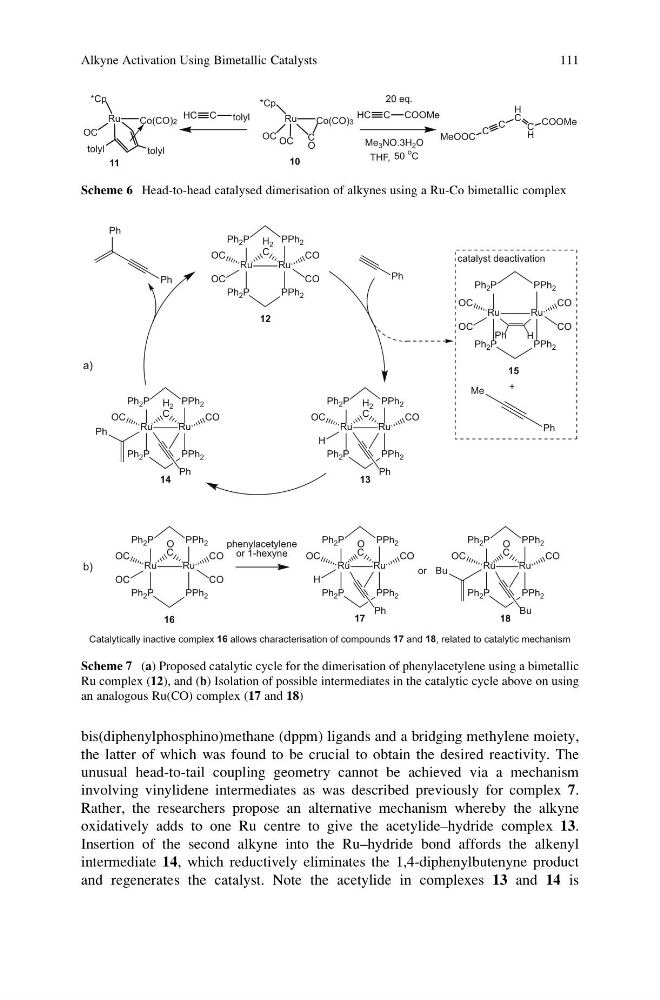
bis(diphenylphosphino)methane (dppm) ligands and a bridging methylene moiety,
the latter of which was found to be crucial to obtain the desired reactivity. The
unusual head-to-tail coupling geometry cannot be achieved via a mechanism
involving vinylidene intermediates as was described previously for complex 7.
Rather, the researchers propose an alternative mechanism whereby the alkyne
oxidatively adds to one Ru centre to give the acetylide–hydride complex 13.
Insertion of the second alkyne into the Ru–hydride bond affords the alkenyl
intermediate 14, which reductively eliminates the 1,4-diphenylbutenyne product
and regenerates the catalyst. Note the acetylide in complexes 13 and 14 is
Ru
*Cp
OC C
O
Co(CO)3
OC
10
HC C COOMe
H
C
C
H
C
C
MeOOC
COOMe
Me 3 NO.3H 2 O
THF, 50
o C
HC C
tolyl
Ru
OC
*Cp
Co(CO)2
11
tolyl
tolyl
20 eq.
Scheme 6 Head-to-head catalysed dimerisation of alkynes using a Ru-Co bimetallic complex
Ru
Ph 2 P
PPh 2
Ph 2 P
PPh 2
Ru
H 2
C
H
OC
CO
13
Ru
Ph 2 P
PPh 2
Ph 2 P
PPh 2
Ru
H 2
C
OC
CO
OC
CO
12
Ph
Ru
Ph 2 P
PPh 2
Ph 2 P
PPh 2
Ru
H 2
C
OC
CO
14
Ph
Ph
Ph
Ph
Ru
Ph 2 P
PPh 2
Ph 2 P
PPh 2
Ru
OC
CO
OC
CO
15
Ph
H
Ph
Me
+
catalyst deactivation
Ru
Ph 2 P
PPh 2
Ph 2 P
PPh 2
Ru
O
C
OC
CO
OC
CO
16
Ru
Ph 2 P
PPh 2
Ph 2 P
PPh 2
Ru
O
C
H
OC
CO
17
Ph
Ru
Ph 2 P
PPh 2
Ph 2 P
PPh 2
Ru
O
C
OC
CO
18
Bu
Bu
phenylacetylene
or 1-hexyne
or
Ph
a)
b)
Catalytically inactive complex 16 allows characterisation of compounds 17 and 18, related to catalytic mechanism
Scheme 7 (a) Proposed catalytic cycle for the dimerisation of phenylacetylene using a bimetallic
Ru complex (12), and (b) Isolation of possible intermediates in the catalytic cycle above on using
an analogous Ru(CO) complex (17 and 18)
Alkyne Activation Using Bimetallic Catalysts
111
the latter of which was found to be crucial to obtain the desired reactivity. The
unusual head-to-tail coupling geometry cannot be achieved via a mechanism
involving vinylidene intermediates as was described previously for complex 7.
Rather, the researchers propose an alternative mechanism whereby the alkyne
oxidatively adds to one Ru centre to give the acetylide–hydride complex 13.
Insertion of the second alkyne into the Ru–hydride bond affords the alkenyl
intermediate 14, which reductively eliminates the 1,4-diphenylbutenyne product
and regenerates the catalyst. Note the acetylide in complexes 13 and 14 is
Ru
*Cp
OC C
O
Co(CO)3
OC
10
HC C COOMe
H
C
C
H
C
C
MeOOC
COOMe
Me 3 NO.3H 2 O
THF, 50
o C
HC C
tolyl
Ru
OC
*Cp
Co(CO)2
11
tolyl
tolyl
20 eq.
Scheme 6 Head-to-head catalysed dimerisation of alkynes using a Ru-Co bimetallic complex
Ru
Ph 2 P
PPh 2
Ph 2 P
PPh 2
Ru
H 2
C
H
OC
CO
13
Ru
Ph 2 P
PPh 2
Ph 2 P
PPh 2
Ru
H 2
C
OC
CO
OC
CO
12
Ph
Ru
Ph 2 P
PPh 2
Ph 2 P
PPh 2
Ru
H 2
C
OC
CO
14
Ph
Ph
Ph
Ph
Ru
Ph 2 P
PPh 2
Ph 2 P
PPh 2
Ru
OC
CO
OC
CO
15
Ph
H
Ph
Me
+
catalyst deactivation
Ru
Ph 2 P
PPh 2
Ph 2 P
PPh 2
Ru
O
C
OC
CO
OC
CO
16
Ru
Ph 2 P
PPh 2
Ph 2 P
PPh 2
Ru
O
C
H
OC
CO
17
Ph
Ru
Ph 2 P
PPh 2
Ph 2 P
PPh 2
Ru
O
C
OC
CO
18
Bu
Bu
phenylacetylene
or 1-hexyne
or
Ph
a)
b)
Catalytically inactive complex 16 allows characterisation of compounds 17 and 18, related to catalytic mechanism
Scheme 7 (a) Proposed catalytic cycle for the dimerisation of phenylacetylene using a bimetallic
Ru complex (12), and (b) Isolation of possible intermediates in the catalytic cycle above on using
an analogous Ru(CO) complex (17 and 18)
Alkyne Activation Using Bimetallic Catalysts
111