

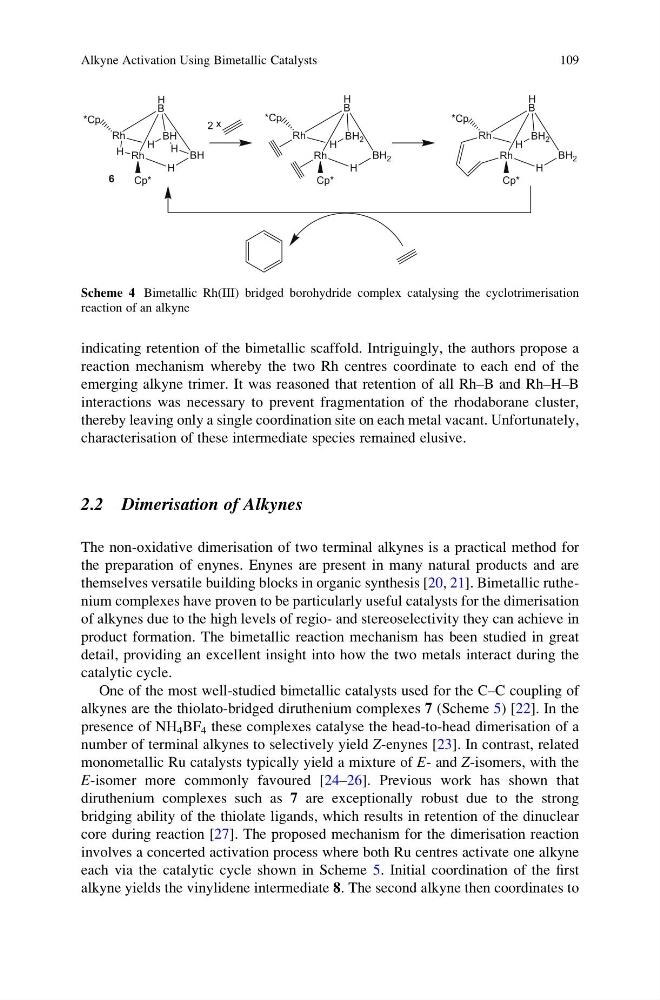
indicating retention of the bimetallic scaffold. Intriguingly, the authors propose a
reaction mechanism whereby the two Rh centres coordinate to each end of the
emerging alkyne trimer. It was reasoned that retention of all Rh–B and Rh–H–B
interactions was necessary to prevent fragmentation of the rhodaborane cluster,
thereby leaving only a single coordination site on each metal vacant. Unfortunately,
characterisation of these intermediate species remained elusive.
2.2 Dimerisation of Alkynes
The non-oxidative dimerisation of two terminal alkynes is a practical method for
the preparation of enynes. Enynes are present in many natural products and are
themselves versatile building blocks in organic synthesis [20, 21]. Bimetallic ruthenium complexes have proven to be particularly useful catalysts for the dimerisation
of alkynes due to the high levels of regio- and stereoselectivity they can achieve in
product formation. The bimetallic reaction mechanism has been studied in great
detail, providing an excellent insight into how the two metals interact during the
catalytic cycle.
One of the most well-studied bimetallic catalysts used for the C–C coupling of
alkynes are the thiolato-bridged diruthenium complexes 7 (Scheme 5) [22]. In the
presence of NH 4 BF 4 these complexes catalyse the head-to-head dimerisation of a
number of terminal alkynes to selectively yield Z-enynes [23]. In contrast, related
monometallic Ru catalysts typically yield a mixture of E- and Z-isomers, with the
E-isomer more commonly favoured [24–26]. Previous work has shown that
diruthenium complexes such as 7 are exceptionally robust due to the strong
bridging ability of the thiolate ligands, which results in retention of the dinuclear
core during reaction [27]. The proposed mechanism for the dimerisation reaction
involves a concerted activation process where both Ru centres activate one alkyne
each via the catalytic cycle shown in Scheme 5. Initial coordination of the first
alkyne yields the vinylidene intermediate 8. The second alkyne then coordinates to
H
BH
BH
Rh
Rh
H
B
Cp*
*Cp
H
H
H
H
BH 2
BH 2
Rh
Rh
H
B
Cp*
*Cp
H
H
BH 2
BH 2
Rh
Rh
H
B
Cp*
*Cp
H
6
2 x
Scheme 4 Bimetallic Rh(III) bridged borohydride complex catalysing the cyclotrimerisation
reaction of an alkyne
Alkyne Activation Using Bimetallic Catalysts
109
reaction mechanism whereby the two Rh centres coordinate to each end of the
emerging alkyne trimer. It was reasoned that retention of all Rh–B and Rh–H–B
interactions was necessary to prevent fragmentation of the rhodaborane cluster,
thereby leaving only a single coordination site on each metal vacant. Unfortunately,
characterisation of these intermediate species remained elusive.
2.2 Dimerisation of Alkynes
The non-oxidative dimerisation of two terminal alkynes is a practical method for
the preparation of enynes. Enynes are present in many natural products and are
themselves versatile building blocks in organic synthesis [20, 21]. Bimetallic ruthenium complexes have proven to be particularly useful catalysts for the dimerisation
of alkynes due to the high levels of regio- and stereoselectivity they can achieve in
product formation. The bimetallic reaction mechanism has been studied in great
detail, providing an excellent insight into how the two metals interact during the
catalytic cycle.
One of the most well-studied bimetallic catalysts used for the C–C coupling of
alkynes are the thiolato-bridged diruthenium complexes 7 (Scheme 5) [22]. In the
presence of NH 4 BF 4 these complexes catalyse the head-to-head dimerisation of a
number of terminal alkynes to selectively yield Z-enynes [23]. In contrast, related
monometallic Ru catalysts typically yield a mixture of E- and Z-isomers, with the
E-isomer more commonly favoured [24–26]. Previous work has shown that
diruthenium complexes such as 7 are exceptionally robust due to the strong
bridging ability of the thiolate ligands, which results in retention of the dinuclear
core during reaction [27]. The proposed mechanism for the dimerisation reaction
involves a concerted activation process where both Ru centres activate one alkyne
each via the catalytic cycle shown in Scheme 5. Initial coordination of the first
alkyne yields the vinylidene intermediate 8. The second alkyne then coordinates to
H
BH
BH
Rh
Rh
H
B
Cp*
*Cp
H
H
H
H
BH 2
BH 2
Rh
Rh
H
B
Cp*
*Cp
H
H
BH 2
BH 2
Rh
Rh
H
B
Cp*
*Cp
H
6
2 x
Scheme 4 Bimetallic Rh(III) bridged borohydride complex catalysing the cyclotrimerisation
reaction of an alkyne
Alkyne Activation Using Bimetallic Catalysts
109