

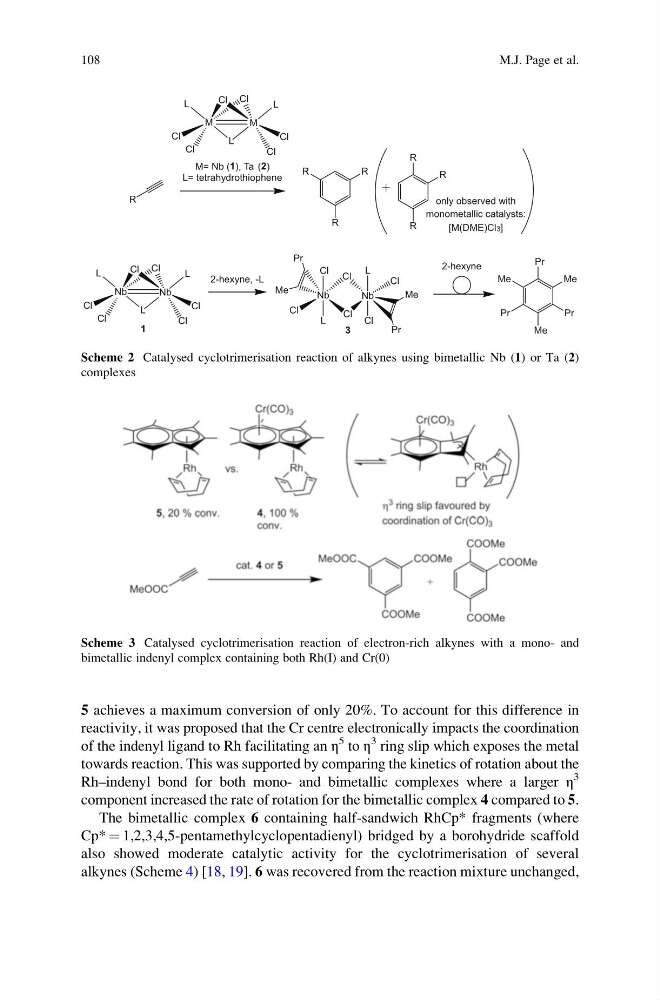
5 achieves a maximum conversion of only 20%. To account for this difference in
reactivity, it was proposed that the Cr centre electronically impacts the coordination
of the indenyl ligand to Rh facilitating an η
5 to η
3 ring slip which exposes the metal
towards reaction. This was supported by comparing the kinetics of rotation about the
Rh–indenyl bond for both mono- and bimetallic complexes where a larger η
3
component increased the rate of rotation for the bimetallic complex 4 compared to 5.
The bimetallic complex 6 containing half-sandwich RhCp* fragments (where
Cp* ¼ 1,2,3,4,5-pentamethylcyclopentadienyl) bridged by a borohydride scaffold
also showed moderate catalytic activity for the cyclotrimerisation of several
alkynes (Scheme 4) [18, 19]. 6 was recovered from the reaction mixture unchanged,
M
Cl
Cl
Cl
L
L
M
Cl
Cl
Cl
L
Nb
Cl
Cl
L
Nb
Cl
Cl
L
Cl
Cl
Me
Pr
Pr
Me
R
R
R
R
R
R
R
M= Nb (1), Ta (2)
L= tetrahydrothiophene
Nb
Cl
Cl
Cl
L
L
Nb
Cl
Cl
Cl
L
2-hexyne, -L
2-hexyne
Me
Me
Me
Pr
Pr
Pr
1
3
+
only observed with
monometallic catalysts:
[M(DME)Cl3]
Scheme 2 Catalysed cyclotrimerisation reaction of alkynes using bimetallic Nb (1) or Ta (2)
complexes
Scheme 3 Catalysed cyclotrimerisation reaction of electron-rich alkynes with a mono- and
bimetallic indenyl complex containing both Rh(I) and Cr(0)
108
M.J. Page et al.
reactivity, it was proposed that the Cr centre electronically impacts the coordination
of the indenyl ligand to Rh facilitating an η
5 to η
3 ring slip which exposes the metal
towards reaction. This was supported by comparing the kinetics of rotation about the
Rh–indenyl bond for both mono- and bimetallic complexes where a larger η
3
component increased the rate of rotation for the bimetallic complex 4 compared to 5.
The bimetallic complex 6 containing half-sandwich RhCp* fragments (where
Cp* ¼ 1,2,3,4,5-pentamethylcyclopentadienyl) bridged by a borohydride scaffold
also showed moderate catalytic activity for the cyclotrimerisation of several
alkynes (Scheme 4) [18, 19]. 6 was recovered from the reaction mixture unchanged,
M
Cl
Cl
Cl
L
L
M
Cl
Cl
Cl
L
Nb
Cl
Cl
L
Nb
Cl
Cl
L
Cl
Cl
Me
Pr
Pr
Me
R
R
R
R
R
R
R
M= Nb (1), Ta (2)
L= tetrahydrothiophene
Nb
Cl
Cl
Cl
L
L
Nb
Cl
Cl
Cl
L
2-hexyne, -L
2-hexyne
Me
Me
Me
Pr
Pr
Pr
1
3
+
only observed with
monometallic catalysts:
[M(DME)Cl3]
Scheme 2 Catalysed cyclotrimerisation reaction of alkynes using bimetallic Nb (1) or Ta (2)
complexes
Scheme 3 Catalysed cyclotrimerisation reaction of electron-rich alkynes with a mono- and
bimetallic indenyl complex containing both Rh(I) and Cr(0)
108
M.J. Page et al.