

2 Cyclotrimerisation, Dimerisation and Nucleophilic
Substitution
2.1 Cyclotrimerisation of Alkynes
The cyclotrimerisation of alkynes is a useful and atom economical route that
enables the formation of substituted benzene derivatives from easily accessible
starting materials. The reaction can be catalysed by a wide variety of metals, and,
mechanistically, the monometallic catalysed process is very well understood [13–
15]. In the first step of the catalytic cycle, a metal complex coordinated by two
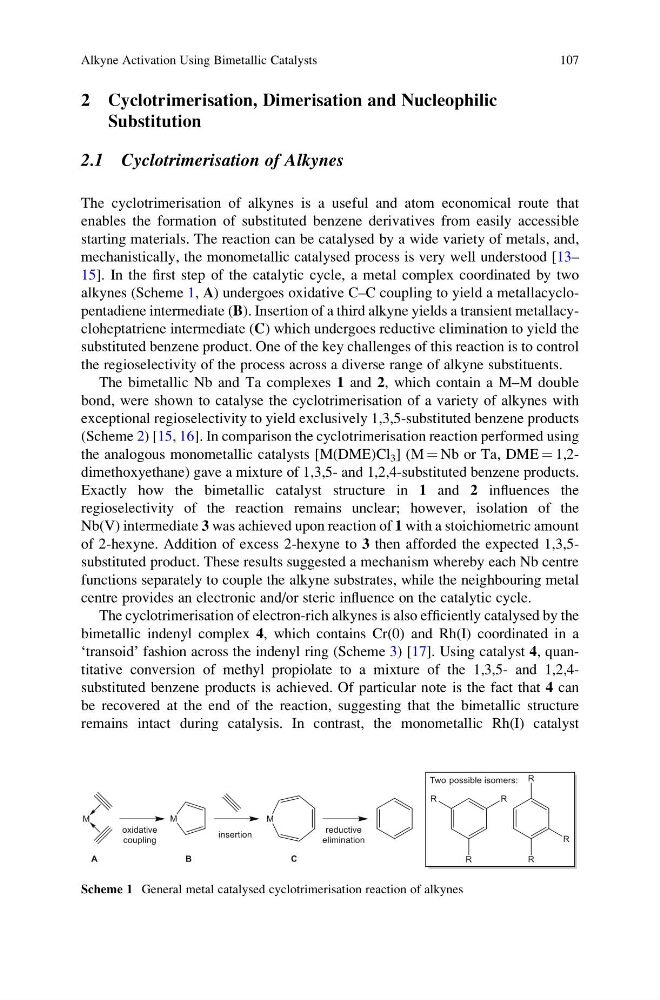
alkynes (Scheme 1, A) undergoes oxidative C–C coupling to yield a metallacyclopentadiene intermediate (B). Insertion of a third alkyne yields a transient metallacycloheptatriene intermediate (C) which undergoes reductive elimination to yield the
substituted benzene product. One of the key challenges of this reaction is to control
the regioselectivity of the process across a diverse range of alkyne substituents.
The bimetallic Nb and Ta complexes 1 and 2, which contain a M–M double
bond, were shown to catalyse the cyclotrimerisation of a variety of alkynes with
exceptional regioselectivity to yield exclusively 1,3,5-substituted benzene products
(Scheme 2) [15, 16]. In comparison the cyclotrimerisation reaction performed using
the analogous monometallic catalysts [M(DME)Cl 3 ] (M ¼ Nb or Ta, DME ¼ 1,2dimethoxyethane) gave a mixture of 1,3,5- and 1,2,4-substituted benzene products.
Exactly how the bimetallic catalyst structure in 1 and 2 influences the
regioselectivity of the reaction remains unclear; however, isolation of the
Nb(V) intermediate 3 was achieved upon reaction of 1 with a stoichiometric amount
of 2-hexyne. Addition of excess 2-hexyne to 3 then afforded the expected 1,3,5substituted product. These results suggested a mechanism whereby each Nb centre
functions separately to couple the alkyne substrates, while the neighbouring metal
centre provides an electronic and/or steric influence on the catalytic cycle.
The cyclotrimerisation of electron-rich alkynes is also efficiently catalysed by the
bimetallic indenyl complex 4, which contains Cr(0) and Rh(I) coordinated in a
‘transoid’ fashion across the indenyl ring (Scheme 3) [17]. Using catalyst 4, quantitative conversion of methyl propiolate to a mixture of the 1,3,5- and 1,2,4substituted benzene products is achieved. Of particular note is the fact that 4 can
be recovered at the end of the reaction, suggesting that the bimetallic structure
remains intact during catalysis. In contrast, the monometallic Rh(I) catalyst
Scheme 1 General metal catalysed cyclotrimerisation reaction of alkynes
Alkyne Activation Using Bimetallic Catalysts
107
Substitution
2.1 Cyclotrimerisation of Alkynes
The cyclotrimerisation of alkynes is a useful and atom economical route that
enables the formation of substituted benzene derivatives from easily accessible
starting materials. The reaction can be catalysed by a wide variety of metals, and,
mechanistically, the monometallic catalysed process is very well understood [13–
15]. In the first step of the catalytic cycle, a metal complex coordinated by two
alkynes (Scheme 1, A) undergoes oxidative C–C coupling to yield a metallacyclopentadiene intermediate (B). Insertion of a third alkyne yields a transient metallacycloheptatriene intermediate (C) which undergoes reductive elimination to yield the
substituted benzene product. One of the key challenges of this reaction is to control
the regioselectivity of the process across a diverse range of alkyne substituents.
The bimetallic Nb and Ta complexes 1 and 2, which contain a M–M double
bond, were shown to catalyse the cyclotrimerisation of a variety of alkynes with
exceptional regioselectivity to yield exclusively 1,3,5-substituted benzene products
(Scheme 2) [15, 16]. In comparison the cyclotrimerisation reaction performed using
the analogous monometallic catalysts [M(DME)Cl 3 ] (M ¼ Nb or Ta, DME ¼ 1,2dimethoxyethane) gave a mixture of 1,3,5- and 1,2,4-substituted benzene products.
Exactly how the bimetallic catalyst structure in 1 and 2 influences the
regioselectivity of the reaction remains unclear; however, isolation of the
Nb(V) intermediate 3 was achieved upon reaction of 1 with a stoichiometric amount
of 2-hexyne. Addition of excess 2-hexyne to 3 then afforded the expected 1,3,5substituted product. These results suggested a mechanism whereby each Nb centre
functions separately to couple the alkyne substrates, while the neighbouring metal
centre provides an electronic and/or steric influence on the catalytic cycle.
The cyclotrimerisation of electron-rich alkynes is also efficiently catalysed by the
bimetallic indenyl complex 4, which contains Cr(0) and Rh(I) coordinated in a
‘transoid’ fashion across the indenyl ring (Scheme 3) [17]. Using catalyst 4, quantitative conversion of methyl propiolate to a mixture of the 1,3,5- and 1,2,4substituted benzene products is achieved. Of particular note is the fact that 4 can
be recovered at the end of the reaction, suggesting that the bimetallic structure
remains intact during catalysis. In contrast, the monometallic Rh(I) catalyst
Scheme 1 General metal catalysed cyclotrimerisation reaction of alkynes
Alkyne Activation Using Bimetallic Catalysts
107