

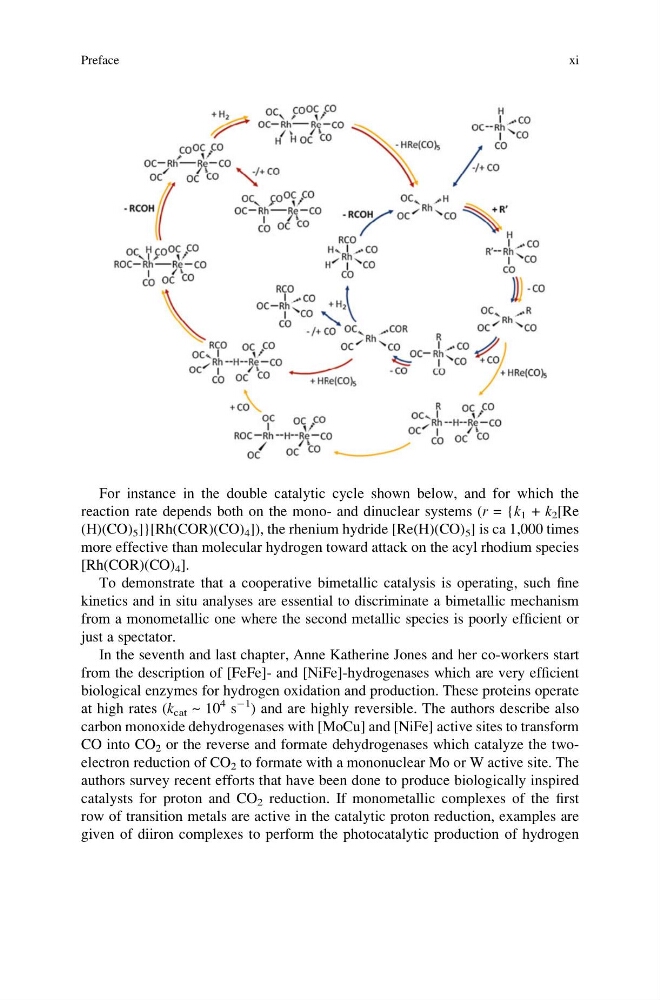
For instance in the double catalytic cycle shown below, and for which the
reaction rate depends both on the mono- and dinuclear systems (r = {k 1 + k 2 [Re
(H)(CO) 5 ]}[Rh(COR)(CO) 4 ]), the rhenium hydride [Re(H)(CO) 5 ] is ca 1,000 times
more effective than molecular hydrogen toward attack on the acyl rhodium species
[Rh(COR)(CO) 4 ].
To demonstrate that a cooperative bimetallic catalysis is operating, such fine
kinetics and in situ analyses are essential to discriminate a bimetallic mechanism
from a monometallic one where the second metallic species is poorly efficient or
just a spectator.
In the seventh and last chapter, Anne Katherine Jones and her co-workers start
from the description of [FeFe]- and [NiFe]-hydrogenases which are very efficient
biological enzymes for hydrogen oxidation and production. These proteins operate
at high rates (k cat ~ 10
4 s
À1 ) and are highly reversible. The authors describe also
carbon monoxide dehydrogenases with [MoCu] and [NiFe] active sites to transform
CO into CO 2 or the reverse and formate dehydrogenases which catalyze the twoelectron reduction of CO 2 to formate with a mononuclear Mo or W active site. The
authors survey recent efforts that have been done to produce biologically inspired
catalysts for proton and CO 2 reduction. If monometallic complexes of the first
row of transition metals are active in the catalytic proton reduction, examples are
given of diiron complexes to perform the photocatalytic production of hydrogen
Preface
xi
reaction rate depends both on the mono- and dinuclear systems (r = {k 1 + k 2 [Re
(H)(CO) 5 ]}[Rh(COR)(CO) 4 ]), the rhenium hydride [Re(H)(CO) 5 ] is ca 1,000 times
more effective than molecular hydrogen toward attack on the acyl rhodium species
[Rh(COR)(CO) 4 ].
To demonstrate that a cooperative bimetallic catalysis is operating, such fine
kinetics and in situ analyses are essential to discriminate a bimetallic mechanism
from a monometallic one where the second metallic species is poorly efficient or
just a spectator.
In the seventh and last chapter, Anne Katherine Jones and her co-workers start
from the description of [FeFe]- and [NiFe]-hydrogenases which are very efficient
biological enzymes for hydrogen oxidation and production. These proteins operate
at high rates (k cat ~ 10
4 s
À1 ) and are highly reversible. The authors describe also
carbon monoxide dehydrogenases with [MoCu] and [NiFe] active sites to transform
CO into CO 2 or the reverse and formate dehydrogenases which catalyze the twoelectron reduction of CO 2 to formate with a mononuclear Mo or W active site. The
authors survey recent efforts that have been done to produce biologically inspired
catalysts for proton and CO 2 reduction. If monometallic complexes of the first
row of transition metals are active in the catalytic proton reduction, examples are
given of diiron complexes to perform the photocatalytic production of hydrogen
Preface
xi