

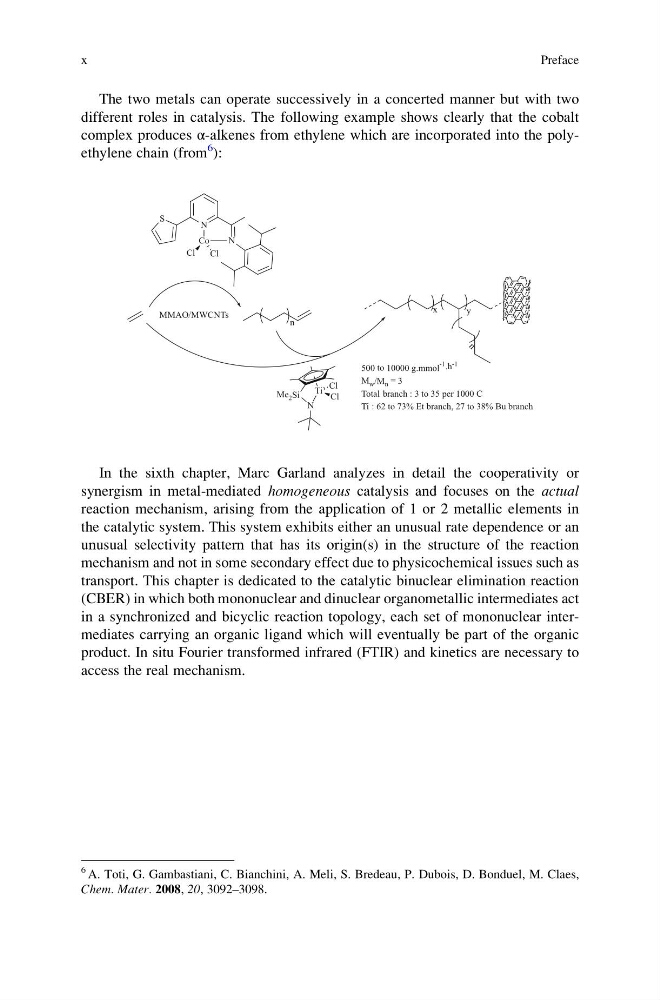
The two metals can operate successively in a concerted manner but with two
different roles in catalysis. The following example shows clearly that the cobalt
complex produces α-alkenes from ethylene which are incorporated into the polyethylene chain (from
6 ):
N
N
S
Co
Cl
Cl
Ti
Cl
Cl
Me 2 Si
N
n
x
y
MMAO/MWCNTs
n
500 to 10000 g.mmol
-1 .h -1
M w /M n = 3
Total branch : 3 to 35 per 1000 C
Ti : 62 to 73% Et branch, 27 to 38% Bu branch
In the sixth chapter, Marc Garland analyzes in detail the cooperativity or
synergism in metal-mediated homogeneous catalysis and focuses on the actual
reaction mechanism, arising from the application of 1 or 2 metallic elements in
the catalytic system. This system exhibits either an unusual rate dependence or an
unusual selectivity pattern that has its origin(s) in the structure of the reaction
mechanism and not in some secondary effect due to physicochemical issues such as
transport. This chapter is dedicated to the catalytic binuclear elimination reaction
(CBER) in which both mononuclear and dinuclear organometallic intermediates act
in a synchronized and bicyclic reaction topology, each set of mononuclear intermediates carrying an organic ligand which will eventually be part of the organic
product. In situ Fourier transformed infrared (FTIR) and kinetics are necessary to
access the real mechanism.
6 A. Toti, G. Gambastiani, C. Bianchini, A. Meli, S. Bredeau, P. Dubois, D. Bonduel, M. Claes,
Chem. Mater. 2008, 20, 3092–3098.
x
Preface
different roles in catalysis. The following example shows clearly that the cobalt
complex produces α-alkenes from ethylene which are incorporated into the polyethylene chain (from
6 ):
N
N
S
Co
Cl
Cl
Ti
Cl
Cl
Me 2 Si
N
n
x
y
MMAO/MWCNTs
n
500 to 10000 g.mmol
-1 .h -1
M w /M n = 3
Total branch : 3 to 35 per 1000 C
Ti : 62 to 73% Et branch, 27 to 38% Bu branch
In the sixth chapter, Marc Garland analyzes in detail the cooperativity or
synergism in metal-mediated homogeneous catalysis and focuses on the actual
reaction mechanism, arising from the application of 1 or 2 metallic elements in
the catalytic system. This system exhibits either an unusual rate dependence or an
unusual selectivity pattern that has its origin(s) in the structure of the reaction
mechanism and not in some secondary effect due to physicochemical issues such as
transport. This chapter is dedicated to the catalytic binuclear elimination reaction
(CBER) in which both mononuclear and dinuclear organometallic intermediates act
in a synchronized and bicyclic reaction topology, each set of mononuclear intermediates carrying an organic ligand which will eventually be part of the organic
product. In situ Fourier transformed infrared (FTIR) and kinetics are necessary to
access the real mechanism.
6 A. Toti, G. Gambastiani, C. Bianchini, A. Meli, S. Bredeau, P. Dubois, D. Bonduel, M. Claes,
Chem. Mater. 2008, 20, 3092–3098.
x
Preface