

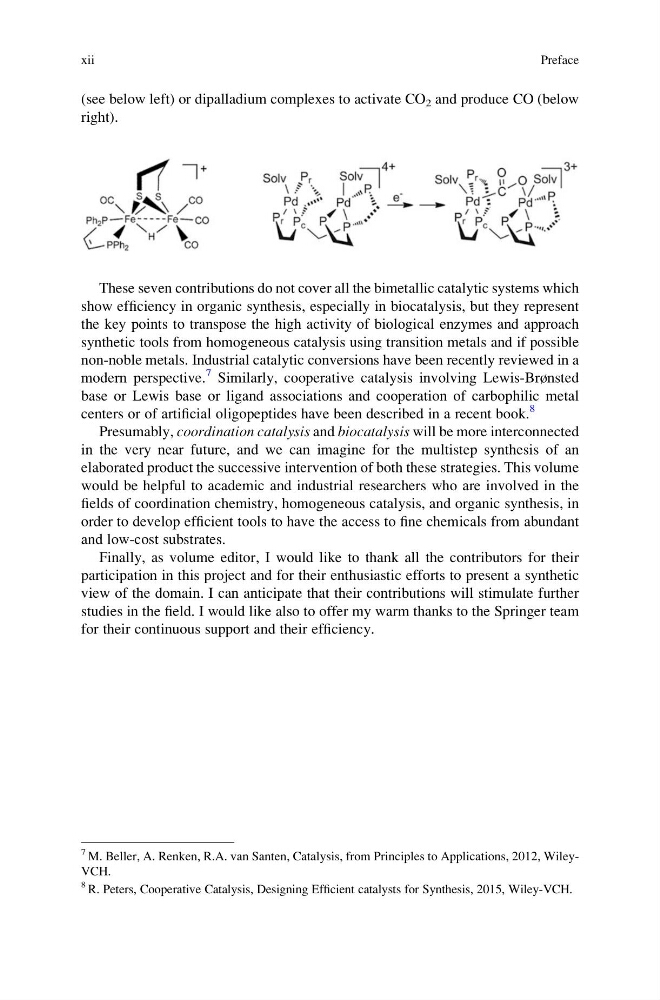
(see below left) or dipalladium complexes to activate CO 2 and produce CO (below
right).
These seven contributions do not cover all the bimetallic catalytic systems which
show efficiency in organic synthesis, especially in biocatalysis, but they represent
the key points to transpose the high activity of biological enzymes and approach
synthetic tools from homogeneous catalysis using transition metals and if possible
non-noble metals. Industrial catalytic conversions have been recently reviewed in a
modern perspective.
7 Similarly, cooperative catalysis involving Lewis-Brønsted
base or Lewis base or ligand associations and cooperation of carbophilic metal
centers or of artificial oligopeptides have been described in a recent book.
8
Presumably, coordination catalysis and biocatalysis will be more interconnected
in the very near future, and we can imagine for the multistep synthesis of an
elaborated product the successive intervention of both these strategies. This volume
would be helpful to academic and industrial researchers who are involved in the
fields of coordination chemistry, homogeneous catalysis, and organic synthesis, in
order to develop efficient tools to have the access to fine chemicals from abundant
and low-cost substrates.
Finally, as volume editor, I would like to thank all the contributors for their
participation in this project and for their enthusiastic efforts to present a synthetic
view of the domain. I can anticipate that their contributions will stimulate further
studies in the field. I would like also to offer my warm thanks to the Springer team
for their continuous support and their efficiency.
7 M. Beller, A. Renken, R.A. van Santen, Catalysis, from Principles to Applications, 2012, WileyVCH.
8 R. Peters, Cooperative Catalysis, Designing Efficient catalysts for Synthesis, 2015, Wiley-VCH.
xii
Preface
right).
These seven contributions do not cover all the bimetallic catalytic systems which
show efficiency in organic synthesis, especially in biocatalysis, but they represent
the key points to transpose the high activity of biological enzymes and approach
synthetic tools from homogeneous catalysis using transition metals and if possible
non-noble metals. Industrial catalytic conversions have been recently reviewed in a
modern perspective.
7 Similarly, cooperative catalysis involving Lewis-Brønsted
base or Lewis base or ligand associations and cooperation of carbophilic metal
centers or of artificial oligopeptides have been described in a recent book.
8
Presumably, coordination catalysis and biocatalysis will be more interconnected
in the very near future, and we can imagine for the multistep synthesis of an
elaborated product the successive intervention of both these strategies. This volume
would be helpful to academic and industrial researchers who are involved in the
fields of coordination chemistry, homogeneous catalysis, and organic synthesis, in
order to develop efficient tools to have the access to fine chemicals from abundant
and low-cost substrates.
Finally, as volume editor, I would like to thank all the contributors for their
participation in this project and for their enthusiastic efforts to present a synthetic
view of the domain. I can anticipate that their contributions will stimulate further
studies in the field. I would like also to offer my warm thanks to the Springer team
for their continuous support and their efficiency.
7 M. Beller, A. Renken, R.A. van Santen, Catalysis, from Principles to Applications, 2012, WileyVCH.
8 R. Peters, Cooperative Catalysis, Designing Efficient catalysts for Synthesis, 2015, Wiley-VCH.
xii
Preface