

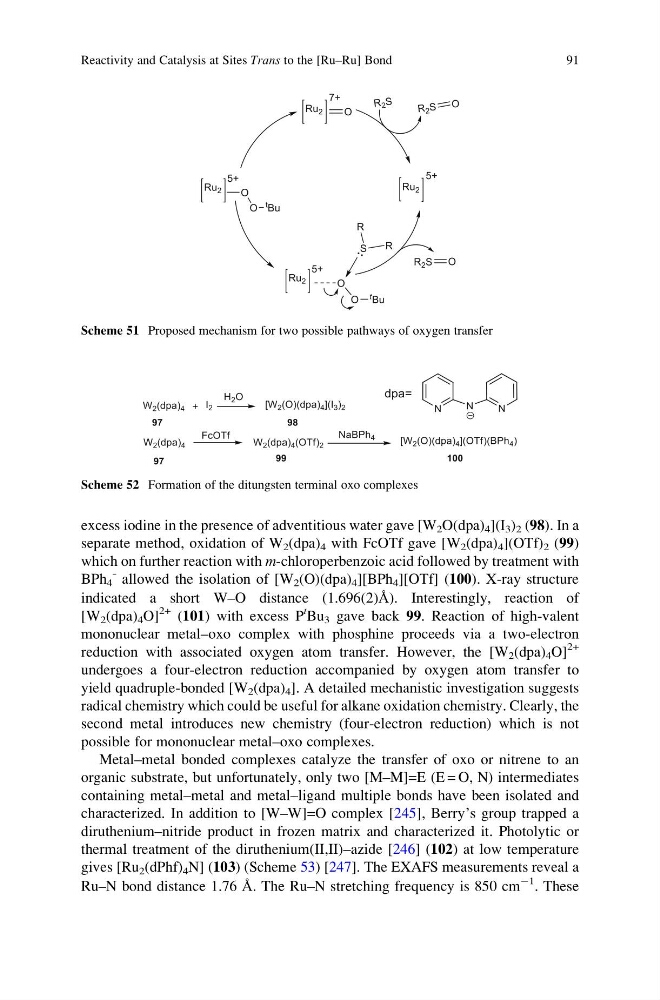
excess iodine in the presence of adventitious water gave [W 2 O(dpa) 4 ](I 3 ) 2 (98). In a
separate method, oxidation of W 2 (dpa) 4 with FcOTf gave [W 2 (dpa) 4 ](OTf) 2 (99)
which on further reaction with m-chloroperbenzoic acid followed by treatment with
BPh 4
¯ allowed the isolation of [W 2 (O)(dpa) 4 ][BPh 4 ][OTf] (100). X-ray structure
indicated a short W–O distance (1.696(2)Å). Interestingly, reaction of
[W 2 (dpa) 4 O]
2+ (101) with excess P
t
Bu 3 gave back 99. Reaction of high-valent
mononuclear metal–oxo complex with phosphine proceeds via a two-electron
reduction with associated oxygen atom transfer. However, the [W 2 (dpa) 4 O]
2+
undergoes a four-electron reduction accompanied by oxygen atom transfer to
yield quadruple-bonded [W 2 (dpa) 4 ]. A detailed mechanistic investigation suggests
radical chemistry which could be useful for alkane oxidation chemistry. Clearly, the
second metal introduces new chemistry (four-electron reduction) which is not
possible for mononuclear metal–oxo complexes.
Metal–metal bonded complexes catalyze the transfer of oxo or nitrene to an
organic substrate, but unfortunately, only two [M–M]=E (E = O, N) intermediates
containing metal–metal and metal–ligand multiple bonds have been isolated and
characterized. In addition to [W–W]=O complex [245], Berry’s group trapped a
diruthenium–nitride product in frozen matrix and characterized it. Photolytic or
thermal treatment of the diruthenium(II,II)–azide [246] (102) at low temperature
gives [Ru 2 (dPhf) 4 N] (103) (Scheme 53) [247]. The EXAFS measurements reveal a
Ru–N bond distance 1.76 Å. The Ru–N stretching frequency is 850 cm
À1 . These
Scheme 52 Formation of the ditungsten terminal oxo complexes
Scheme 51 Proposed mechanism for two possible pathways of oxygen transfer
Reactivity and Catalysis at Sites Trans to the [Ru–Ru] Bond
91
separate method, oxidation of W 2 (dpa) 4 with FcOTf gave [W 2 (dpa) 4 ](OTf) 2 (99)
which on further reaction with m-chloroperbenzoic acid followed by treatment with
BPh 4
¯ allowed the isolation of [W 2 (O)(dpa) 4 ][BPh 4 ][OTf] (100). X-ray structure
indicated a short W–O distance (1.696(2)Å). Interestingly, reaction of
[W 2 (dpa) 4 O]
2+ (101) with excess P
t
Bu 3 gave back 99. Reaction of high-valent
mononuclear metal–oxo complex with phosphine proceeds via a two-electron
reduction with associated oxygen atom transfer. However, the [W 2 (dpa) 4 O]
2+
undergoes a four-electron reduction accompanied by oxygen atom transfer to
yield quadruple-bonded [W 2 (dpa) 4 ]. A detailed mechanistic investigation suggests
radical chemistry which could be useful for alkane oxidation chemistry. Clearly, the
second metal introduces new chemistry (four-electron reduction) which is not
possible for mononuclear metal–oxo complexes.
Metal–metal bonded complexes catalyze the transfer of oxo or nitrene to an
organic substrate, but unfortunately, only two [M–M]=E (E = O, N) intermediates
containing metal–metal and metal–ligand multiple bonds have been isolated and
characterized. In addition to [W–W]=O complex [245], Berry’s group trapped a
diruthenium–nitride product in frozen matrix and characterized it. Photolytic or
thermal treatment of the diruthenium(II,II)–azide [246] (102) at low temperature
gives [Ru 2 (dPhf) 4 N] (103) (Scheme 53) [247]. The EXAFS measurements reveal a
Ru–N bond distance 1.76 Å. The Ru–N stretching frequency is 850 cm
À1 . These
Scheme 52 Formation of the ditungsten terminal oxo complexes
Scheme 51 Proposed mechanism for two possible pathways of oxygen transfer
Reactivity and Catalysis at Sites Trans to the [Ru–Ru] Bond
91