

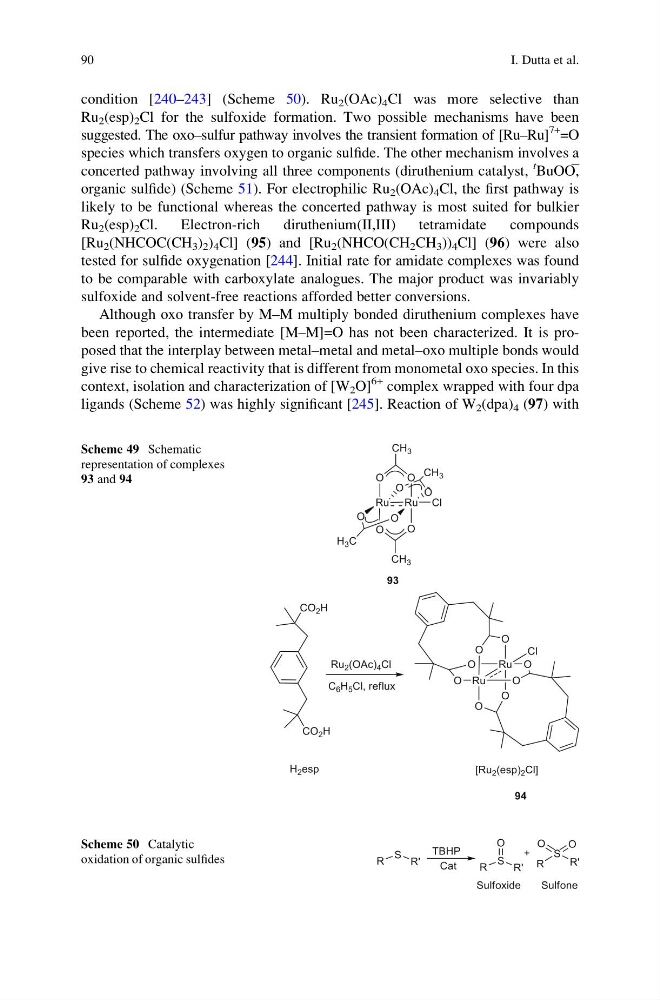
condition [240–243] (Scheme 50). Ru 2 (OAc) 4 Cl was more selective than
Ru 2 (esp) 2 Cl for the sulfoxide formation. Two possible mechanisms have been
suggested. The oxo–sulfur pathway involves the transient formation of [Ru–Ru]
7+
=O
species which transfers oxygen to organic sulfide. The other mechanism involves a
concerted pathway involving all three components (diruthenium catalyst,
t
BuOO̅ ,
organic sulfide) (Scheme 51). For electrophilic Ru 2 (OAc) 4 Cl, the first pathway is
likely to be functional whereas the concerted pathway is most suited for bulkier
Ru 2 (esp) 2 Cl.
Electron-rich
diruthenium(II,III)
tetramidate
compounds
[Ru 2 (NHCOC(CH 3 ) 2 ) 4 Cl] (95) and [Ru 2 (NHCO(CH 2 CH 3 )) 4 Cl] (96) were also
tested for sulfide oxygenation [244]. Initial rate for amidate complexes was found
to be comparable with carboxylate analogues. The major product was invariably
sulfoxide and solvent-free reactions afforded better conversions.
Although oxo transfer by M–M multiply bonded diruthenium complexes have
been reported, the intermediate [M–M]=O has not been characterized. It is proposed that the interplay between metal–metal and metal–oxo multiple bonds would
give rise to chemical reactivity that is different from monometal oxo species. In this
context, isolation and characterization of [W 2 O]
6+ complex wrapped with four dpa
ligands (Scheme 52) was highly significant [245]. Reaction of W 2 (dpa) 4 (97) with
Scheme 50 Catalytic
oxidation of organic sulfides
Scheme 49 Schematic
representation of complexes
93 and 94
90
I. Dutta et al.
Ru 2 (esp) 2 Cl for the sulfoxide formation. Two possible mechanisms have been
suggested. The oxo–sulfur pathway involves the transient formation of [Ru–Ru]
7+
=O
species which transfers oxygen to organic sulfide. The other mechanism involves a
concerted pathway involving all three components (diruthenium catalyst,
t
BuOO̅ ,
organic sulfide) (Scheme 51). For electrophilic Ru 2 (OAc) 4 Cl, the first pathway is
likely to be functional whereas the concerted pathway is most suited for bulkier
Ru 2 (esp) 2 Cl.
Electron-rich
diruthenium(II,III)
tetramidate
compounds
[Ru 2 (NHCOC(CH 3 ) 2 ) 4 Cl] (95) and [Ru 2 (NHCO(CH 2 CH 3 )) 4 Cl] (96) were also
tested for sulfide oxygenation [244]. Initial rate for amidate complexes was found
to be comparable with carboxylate analogues. The major product was invariably
sulfoxide and solvent-free reactions afforded better conversions.
Although oxo transfer by M–M multiply bonded diruthenium complexes have
been reported, the intermediate [M–M]=O has not been characterized. It is proposed that the interplay between metal–metal and metal–oxo multiple bonds would
give rise to chemical reactivity that is different from monometal oxo species. In this
context, isolation and characterization of [W 2 O]
6+ complex wrapped with four dpa
ligands (Scheme 52) was highly significant [245]. Reaction of W 2 (dpa) 4 (97) with
Scheme 50 Catalytic
oxidation of organic sulfides
Scheme 49 Schematic
representation of complexes
93 and 94
90
I. Dutta et al.