

[74] and theoretically [75–78]. Here the acenes consist of a number (n r ) of fused
benzene rings; see Fig. 2.
The distinct properties [74] of the
1 L a and
1 L b states for the linear acenes have
already been described in the literature [75–78]. Essentially, the
1 L a (or
1 B 2u when
the x-axis corresponds to the long molecular axis state) is dominated by a single
electron transition HOMO ! LUMO, while the
1 L b (or
1
B 3u ) state results from a
combination of HOMO À 1 ! LUMO and HOMO ! LUMO + 1 transitions. Further, excitations to
1 L a (
1 B 2u ) are short axis polarized with high intensity whereas
the transitions to
1 L b (
1 B 3u ) are long axis polarized with low intensity.
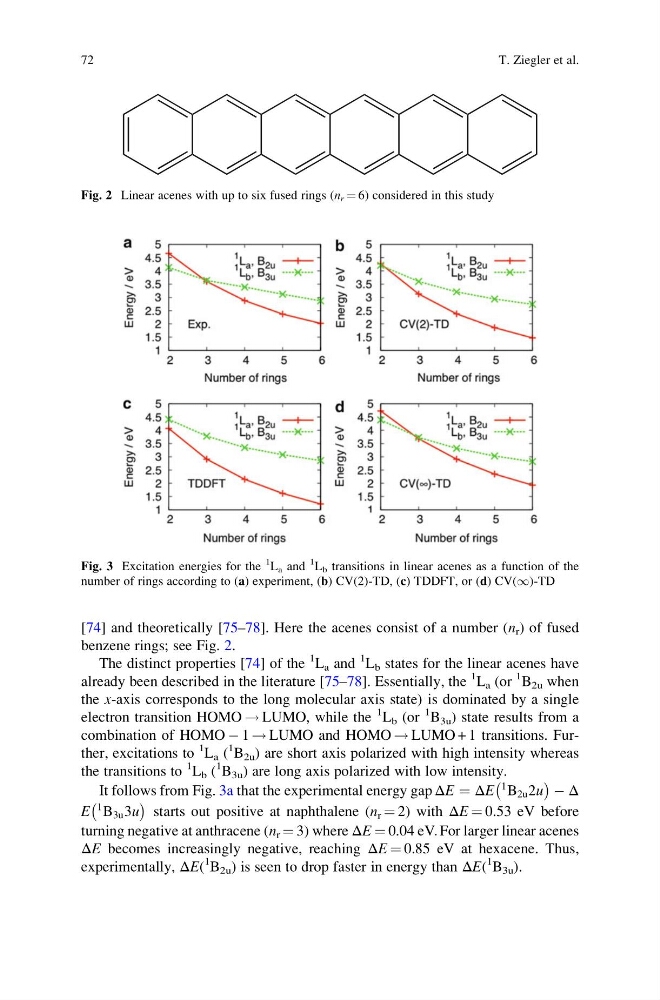
It follows from Fig. 3a that the experimental energy gap ΔE ¼ ΔE
1 B 2u 2u
À
Á À Δ
E
1 B 3u 3u
À
Á
starts out positive at naphthalene (n r ¼ 2) with ΔE ¼ 0.53 eV before
turning negative at anthracene (n r ¼ 3) where ΔE ¼ 0.04 eV: For larger linear acenes
ΔE becomes increasingly negative, reaching ΔE ¼ 0.85 eV at hexacene. Thus,
experimentally, ΔE(
1 B 2u ) is seen to drop faster in energy than ΔE(
1 B 3u ).
Fig. 3 Excitation energies for the
1
L a and
1
L b transitions in linear acenes as a function of the
number of rings according to (a) experiment, (b) CV(2)-TD, (c) TDDFT, or (d) CV(1)-TD
Fig. 2 Linear acenes with up to six fused rings (n r ¼ 6) considered in this study
72
T. Ziegler et al.
benzene rings; see Fig. 2.
The distinct properties [74] of the
1 L a and
1 L b states for the linear acenes have
already been described in the literature [75–78]. Essentially, the
1 L a (or
1 B 2u when
the x-axis corresponds to the long molecular axis state) is dominated by a single
electron transition HOMO ! LUMO, while the
1 L b (or
1
B 3u ) state results from a
combination of HOMO À 1 ! LUMO and HOMO ! LUMO + 1 transitions. Further, excitations to
1 L a (
1 B 2u ) are short axis polarized with high intensity whereas
the transitions to
1 L b (
1 B 3u ) are long axis polarized with low intensity.
It follows from Fig. 3a that the experimental energy gap ΔE ¼ ΔE
1 B 2u 2u
À
Á À Δ
E
1 B 3u 3u
À
Á
starts out positive at naphthalene (n r ¼ 2) with ΔE ¼ 0.53 eV before
turning negative at anthracene (n r ¼ 3) where ΔE ¼ 0.04 eV: For larger linear acenes
ΔE becomes increasingly negative, reaching ΔE ¼ 0.85 eV at hexacene. Thus,
experimentally, ΔE(
1 B 2u ) is seen to drop faster in energy than ΔE(
1 B 3u ).
Fig. 3 Excitation energies for the
1
L a and
1
L b transitions in linear acenes as a function of the
number of rings according to (a) experiment, (b) CV(2)-TD, (c) TDDFT, or (d) CV(1)-TD
Fig. 2 Linear acenes with up to six fused rings (n r ¼ 6) considered in this study
72
T. Ziegler et al.