

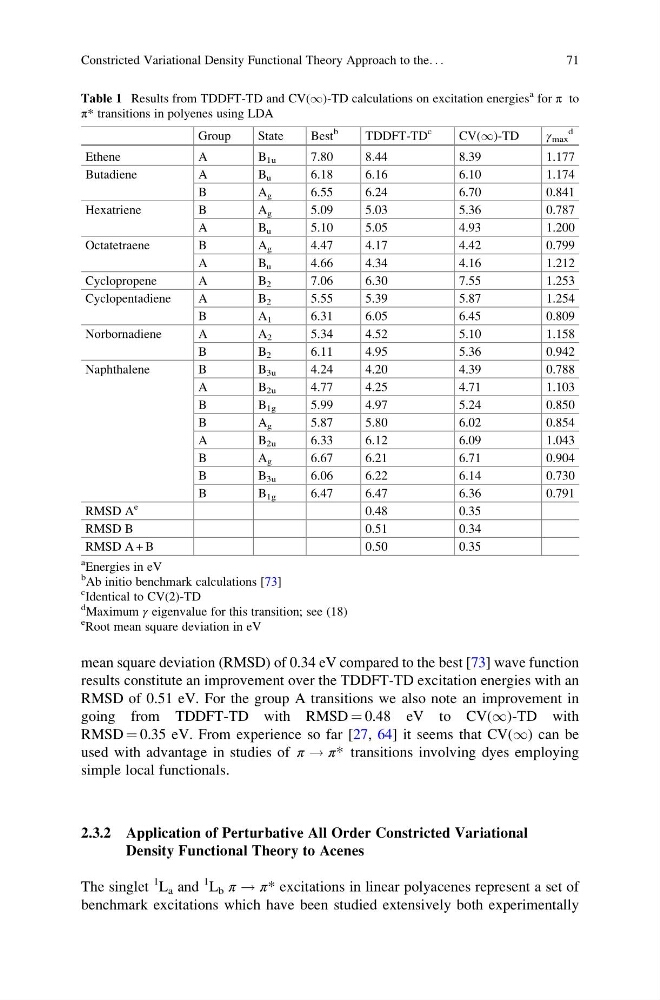
mean square deviation (RMSD) of 0.34 eV compared to the best [73] wave function
results constitute an improvement over the TDDFT-TD excitation energies with an
RMSD of 0.51 eV. For the group A transitions we also note an improvement in
going from TDDFT-TD with RMSD ¼ 0.48 eV to CV(1)-TD with
RMSD ¼ 0.35 eV. From experience so far [27, 64] it seems that CV(1) can be
used with advantage in studies of π ! π* transitions involving dyes employing
simple local functionals.
2.3.2 Application of Perturbative All Order Constricted Variational
Density Functional Theory to Acenes
The singlet
1 L a and
1 L b π ! π* excitations in linear polyacenes represent a set of
benchmark excitations which have been studied extensively both experimentally
Table 1 Results from TDDFT-TD and CV(1)-TD calculations on excitation energies
a for π to
π* transitions in polyenes using LDA
Group
State
Best
b
TDDFT-TD
c
CV(1)-TD
γ max
d
Ethene
A
B 1u
7.80
8.44
8.39
1.177
Butadiene
A
B u
6.18
6.16
6.10
1.174
B
A g
6.55
6.24
6.70
0.841
Hexatriene
B
A g
5.09
5.03
5.36
0.787
A
B u
5.10
5.05
4.93
1.200
Octatetraene
B
A g
4.47
4.17
4.42
0.799
A
B u
4.66
4.34
4.16
1.212
Cyclopropene
A
B 2
7.06
6.30
7.55
1.253
Cyclopentadiene
A
B 2
5.55
5.39
5.87
1.254
B
A 1
6.31
6.05
6.45
0.809
Norbornadiene
A
A 2
5.34
4.52
5.10
1.158
B
B 2
6.11
4.95
5.36
0.942
Naphthalene
B
B 3u
4.24
4.20
4.39
0.788
A
B 2u
4.77
4.25
4.71
1.103
B
B 1g
5.99
4.97
5.24
0.850
B
A g
5.87
5.80
6.02
0.854
A
B 2u
6.33
6.12
6.09
1.043
B
A g
6.67
6.21
6.71
0.904
B
B 3u
6.06
6.22
6.14
0.730
B
B 1g
6.47
6.47
6.36
0.791
RMSD A
e
0.48
0.35
RMSD B
0.51
0.34
RMSD A + B
0.50
0.35
a
Energies in eV
b
Ab initio benchmark calculations [73]
c
Identical to CV(2)-TD
d
Maximum γ eigenvalue for this transition; see (18)
e
Root mean square deviation in eV
Constricted Variational Density Functional Theory Approach to the. . .
71
results constitute an improvement over the TDDFT-TD excitation energies with an
RMSD of 0.51 eV. For the group A transitions we also note an improvement in
going from TDDFT-TD with RMSD ¼ 0.48 eV to CV(1)-TD with
RMSD ¼ 0.35 eV. From experience so far [27, 64] it seems that CV(1) can be
used with advantage in studies of π ! π* transitions involving dyes employing
simple local functionals.
2.3.2 Application of Perturbative All Order Constricted Variational
Density Functional Theory to Acenes
The singlet
1 L a and
1 L b π ! π* excitations in linear polyacenes represent a set of
benchmark excitations which have been studied extensively both experimentally
Table 1 Results from TDDFT-TD and CV(1)-TD calculations on excitation energies
a for π to
π* transitions in polyenes using LDA
Group
State
Best
b
TDDFT-TD
c
CV(1)-TD
γ max
d
Ethene
A
B 1u
7.80
8.44
8.39
1.177
Butadiene
A
B u
6.18
6.16
6.10
1.174
B
A g
6.55
6.24
6.70
0.841
Hexatriene
B
A g
5.09
5.03
5.36
0.787
A
B u
5.10
5.05
4.93
1.200
Octatetraene
B
A g
4.47
4.17
4.42
0.799
A
B u
4.66
4.34
4.16
1.212
Cyclopropene
A
B 2
7.06
6.30
7.55
1.253
Cyclopentadiene
A
B 2
5.55
5.39
5.87
1.254
B
A 1
6.31
6.05
6.45
0.809
Norbornadiene
A
A 2
5.34
4.52
5.10
1.158
B
B 2
6.11
4.95
5.36
0.942
Naphthalene
B
B 3u
4.24
4.20
4.39
0.788
A
B 2u
4.77
4.25
4.71
1.103
B
B 1g
5.99
4.97
5.24
0.850
B
A g
5.87
5.80
6.02
0.854
A
B 2u
6.33
6.12
6.09
1.043
B
A g
6.67
6.21
6.71
0.904
B
B 3u
6.06
6.22
6.14
0.730
B
B 1g
6.47
6.47
6.36
0.791
RMSD A
e
0.48
0.35
RMSD B
0.51
0.34
RMSD A + B
0.50
0.35
a
Energies in eV
b
Ab initio benchmark calculations [73]
c
Identical to CV(2)-TD
d
Maximum γ eigenvalue for this transition; see (18)
e
Root mean square deviation in eV
Constricted Variational Density Functional Theory Approach to the. . .
71