

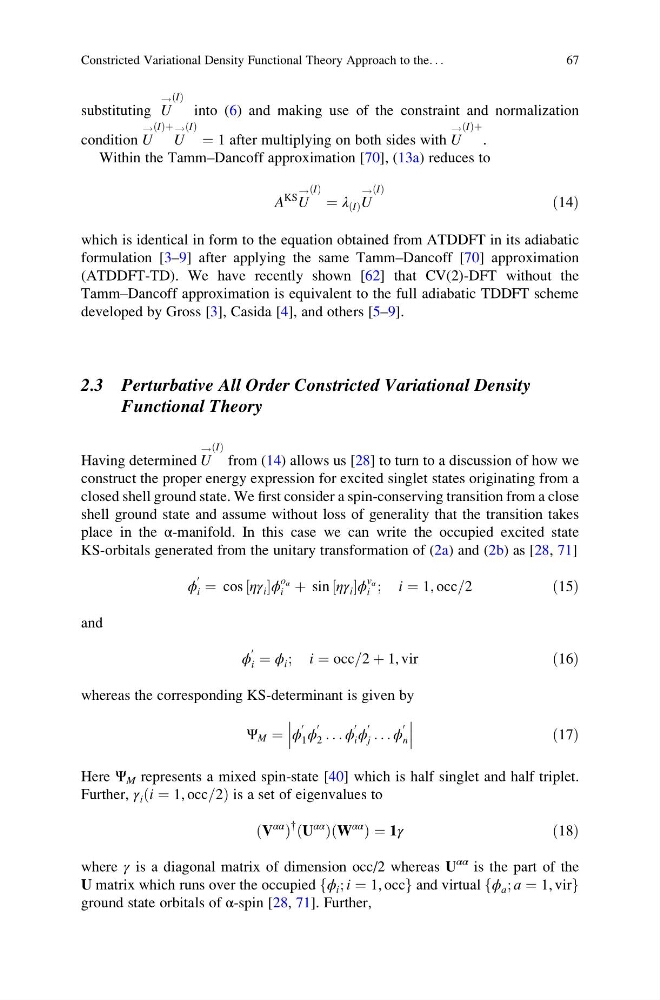
substituting U
! I
ð Þ
into (6) and making use of the constraint and normalization
condition U
! I
ð Þþ
U
! I
ð Þ
¼ 1 after multiplying on both sides with U
! I
ð Þþ
.
Within the Tamm–Dancoff approximation [70], (13a) reduces to
A
KS U
! I
ð Þ
¼ λ I
ð Þ U
! I
ð Þ
ð14Þ
which is identical in form to the equation obtained from ATDDFT in its adiabatic
formulation [3–9] after applying the same Tamm–Dancoff [70] approximation
(ATDDFT-TD). We have recently shown [62] that CV(2)-DFT without the
Tamm–Dancoff approximation is equivalent to the full adiabatic TDDFT scheme
developed by Gross [3], Casida [4], and others [5–9].
2.3 Perturbative All Order Constricted Variational Density
Functional Theory
Having determined U
! I
ð Þ
from (14) allows us [28] to turn to a discussion of how we
construct the proper energy expression for excited singlet states originating from a
closed shell ground state. We first consider a spin-conserving transition from a close
shell ground state and assume without loss of generality that the transition takes
place in the α-manifold. In this case we can write the occupied excited state
KS-orbitals generated from the unitary transformation of (2a) and (2b) as [28, 71]
ϕ
0
i ¼ cos ηγ i
½ ϕ
o α
i þ sin ηγ i
½ ϕ
v α
i ; i ¼ 1, occ=2
ð15Þ
and
ϕ
0
i ¼ ϕ i ; i ¼ occ=2 þ 1, vir
ð16Þ
whereas the corresponding KS-determinant is given by
Ψ M ¼ ϕ
0
1 ϕ
0
2 . . . ϕ
0
i ϕ
0
j . . . ϕ
0
n
ð17Þ
Here Ψ M represents a mixed spin-state [40] which is half singlet and half triplet.
Further, γ i i ¼ 1, occ=2
ð
Þis a set of eigenvalues to
V
αα
ð
Þ
{ U
αα
ð
Þ W
αα
ð
Þ¼1γ
ð18Þ
where γ is a diagonal matrix of dimension occ/2 whereas U
αα is the part of the
U matrix which runs over the occupied ϕ i ; i ¼ 1, occ
f
gand virtual ϕ a ; a ¼ 1, vir
f
g
ground state orbitals of α-spin [28, 71]. Further,
Constricted Variational Density Functional Theory Approach to the. . .
67
! I
ð Þ
into (6) and making use of the constraint and normalization
condition U
! I
ð Þþ
U
! I
ð Þ
¼ 1 after multiplying on both sides with U
! I
ð Þþ
.
Within the Tamm–Dancoff approximation [70], (13a) reduces to
A
KS U
! I
ð Þ
¼ λ I
ð Þ U
! I
ð Þ
ð14Þ
which is identical in form to the equation obtained from ATDDFT in its adiabatic
formulation [3–9] after applying the same Tamm–Dancoff [70] approximation
(ATDDFT-TD). We have recently shown [62] that CV(2)-DFT without the
Tamm–Dancoff approximation is equivalent to the full adiabatic TDDFT scheme
developed by Gross [3], Casida [4], and others [5–9].
2.3 Perturbative All Order Constricted Variational Density
Functional Theory
Having determined U
! I
ð Þ
from (14) allows us [28] to turn to a discussion of how we
construct the proper energy expression for excited singlet states originating from a
closed shell ground state. We first consider a spin-conserving transition from a close
shell ground state and assume without loss of generality that the transition takes
place in the α-manifold. In this case we can write the occupied excited state
KS-orbitals generated from the unitary transformation of (2a) and (2b) as [28, 71]
ϕ
0
i ¼ cos ηγ i
½ ϕ
o α
i þ sin ηγ i
½ ϕ
v α
i ; i ¼ 1, occ=2
ð15Þ
and
ϕ
0
i ¼ ϕ i ; i ¼ occ=2 þ 1, vir
ð16Þ
whereas the corresponding KS-determinant is given by
Ψ M ¼ ϕ
0
1 ϕ
0
2 . . . ϕ
0
i ϕ
0
j . . . ϕ
0
n
ð17Þ
Here Ψ M represents a mixed spin-state [40] which is half singlet and half triplet.
Further, γ i i ¼ 1, occ=2
ð
Þis a set of eigenvalues to
V
αα
ð
Þ
{ U
αα
ð
Þ W
αα
ð
Þ¼1γ
ð18Þ
where γ is a diagonal matrix of dimension occ/2 whereas U
αα is the part of the
U matrix which runs over the occupied ϕ i ; i ¼ 1, occ
f
gand virtual ϕ a ; a ¼ 1, vir
f
g
ground state orbitals of α-spin [28, 71]. Further,
Constricted Variational Density Functional Theory Approach to the. . .
67