

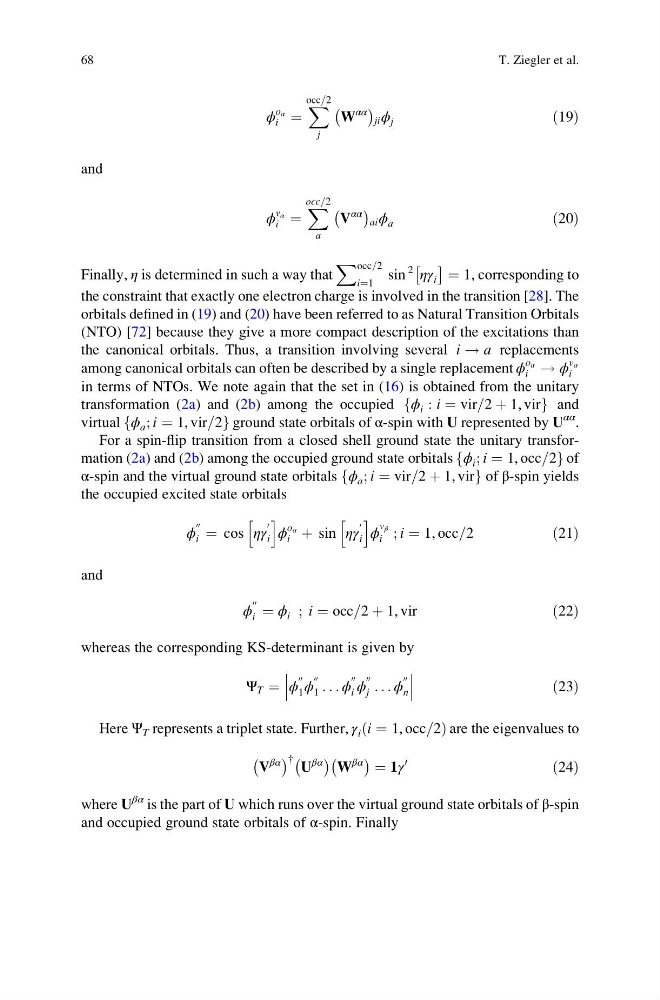
ϕ
o α
i ¼
X
occ=2
j
À
W
αα
Á
ji ϕ j
ð19Þ
and
ϕ
v α
i ¼
X
occ=2
a
À
V
αα
Á
ai ϕ a
ð20Þ
Finally, η is determined in such a way that
X occ=2
i¼1
sin
2
Â
ηγ i
à ¼ 1, corresponding to
the constraint that exactly one electron charge is involved in the transition [28]. The
orbitals defined in (19) and (20) have been referred to as Natural Transition Orbitals
(NTO) [72] because they give a more compact description of the excitations than
the canonical orbitals. Thus, a transition involving several i ! a replacements
among canonical orbitals can often be described by a single replacement ϕ
o α
i ! ϕ
v α
i
in terms of NTOs. We note again that the set in (16) is obtained from the unitary
transformation (2a) and (2b) among the occupied ϕ i : i ¼ vir=2 þ 1, vir
f
gand
virtual ϕ a ; i ¼ 1, vir=2
f
g ground state orbitals of α-spin with U represented by U
αα .
For a spin-flip transition from a closed shell ground state the unitary transformation (2a) and (2b) among the occupied ground state orbitals ϕ i ; i ¼ 1, occ=2
f
g of
α-spin and the virtual ground state orbitals ϕ a ; i ¼ vir=2 þ 1, vir
f
g of β-spin yields
the occupied excited state orbitals
ϕ
00
i ¼ cos ηγ
0
i
h i
ϕ
o α
i þ sin ηγ
0
i
h i
ϕ
v β
i ; i ¼ 1, occ=2
ð21Þ
and
ϕ
00
i ¼ ϕ i ; i ¼ occ=2 þ 1, vir
ð22Þ
whereas the corresponding KS-determinant is given by
Ψ T ¼ ϕ
00
1 ϕ
00
1 . . . ϕ
00
i ϕ
00
j . . . ϕ
00
n
ð23Þ
Here Ψ T represents a triplet state. Further, γ i i ¼ 1, occ=2
ð
Þ are the eigenvalues to
V
βα
À
Á { U
βα
À
Á
W
βα
À
Á ¼ 1γ
0
ð24Þ
where U
βα is the part of U which runs over the virtual ground state orbitals of β-spin
and occupied ground state orbitals of α-spin. Finally
68
T. Ziegler et al.
o α
i ¼
X
occ=2
j
À
W
αα
Á
ji ϕ j
ð19Þ
and
ϕ
v α
i ¼
X
occ=2
a
À
V
αα
Á
ai ϕ a
ð20Þ
Finally, η is determined in such a way that
X occ=2
i¼1
sin
2
Â
ηγ i
à ¼ 1, corresponding to
the constraint that exactly one electron charge is involved in the transition [28]. The
orbitals defined in (19) and (20) have been referred to as Natural Transition Orbitals
(NTO) [72] because they give a more compact description of the excitations than
the canonical orbitals. Thus, a transition involving several i ! a replacements
among canonical orbitals can often be described by a single replacement ϕ
o α
i ! ϕ
v α
i
in terms of NTOs. We note again that the set in (16) is obtained from the unitary
transformation (2a) and (2b) among the occupied ϕ i : i ¼ vir=2 þ 1, vir
f
gand
virtual ϕ a ; i ¼ 1, vir=2
f
g ground state orbitals of α-spin with U represented by U
αα .
For a spin-flip transition from a closed shell ground state the unitary transformation (2a) and (2b) among the occupied ground state orbitals ϕ i ; i ¼ 1, occ=2
f
g of
α-spin and the virtual ground state orbitals ϕ a ; i ¼ vir=2 þ 1, vir
f
g of β-spin yields
the occupied excited state orbitals
ϕ
00
i ¼ cos ηγ
0
i
h i
ϕ
o α
i þ sin ηγ
0
i
h i
ϕ
v β
i ; i ¼ 1, occ=2
ð21Þ
and
ϕ
00
i ¼ ϕ i ; i ¼ occ=2 þ 1, vir
ð22Þ
whereas the corresponding KS-determinant is given by
Ψ T ¼ ϕ
00
1 ϕ
00
1 . . . ϕ
00
i ϕ
00
j . . . ϕ
00
n
ð23Þ
Here Ψ T represents a triplet state. Further, γ i i ¼ 1, occ=2
ð
Þ are the eigenvalues to
V
βα
À
Á { U
βα
À
Á
W
βα
À
Á ¼ 1γ
0
ð24Þ
where U
βα is the part of U which runs over the virtual ground state orbitals of β-spin
and occupied ground state orbitals of α-spin. Finally
68
T. Ziegler et al.