

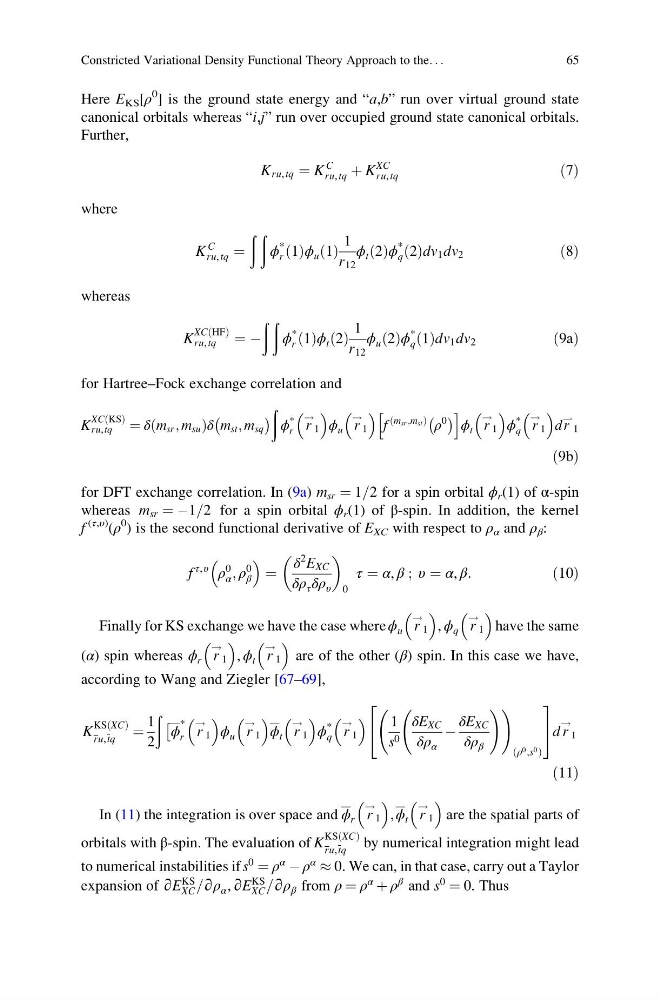
Here E KS [ρ
0 ] is the ground state energy and “a,b” run over virtual ground state
canonical orbitals whereas “i,j” run over occupied ground state canonical orbitals.
Further,
K ru, tq ¼ K
C
ru, tq þ K
XC
ru, tq
ð7Þ
where
K
C
ru, tq ¼
ð ð
ϕ
*
r 1
ð Þϕ u 1
ð Þ
1
r 12
ϕ t 2
ð Þϕ
*
q 2
ð Þdv 1 dv 2
ð8Þ
whereas
K
XC HF
ð Þ
ru, tq
¼ À
ð ð
ϕ
*
r 1
ð Þϕ t 2
ð Þ
1
r 12
ϕ u 2
ð Þϕ
*
q 1
ð Þdv 1 dv 2
ð9aÞ
for Hartree–Fock exchange correlation and
K
XC KS
ð Þ
ru, tq
¼ δ m sr ; m su
ð
Þ δ m st ; m sq
À
Á
ð
ϕ
*
r r
!
1
ϕ u r
!
1
f
m sr ;m st
ð
Þ
ρ
0
À Á
h
i
ϕ t r
!
1
ϕ
*
q r
!
1
d r
*
1
ð9bÞ
for DFT exchange correlation. In (9a) m sr ¼ 1=2 for a spin orbital ϕ r (1) of α-spin
whereas m sr ¼ À1=2 for a spin orbital ϕ r (1) of β-spin. In addition, the kernel
f
(τ,υ) (ρ
0 ) is the second functional derivative of E XC with respect to ρ α and ρ β :
f
τ, υ
ρ
0
α ; ρ
0
β
¼
δ
2 E XC
δρ τ δρ υ
0
τ ¼ α, β ; υ ¼ α, β:
ð10Þ
Finally for KS exchange we have the case where ϕ u r
!
1
, ϕ q r
!
1
have the same
(α) spin whereas ϕ r r
!
1
, ϕ t r
!
1
are of the other (β) spin. In this case we have,
according to Wang and Ziegler [67–69],
K
KS XC
ð Þ
ru,tq
¼
1
2
ð Â
ϕ
*
r r
!
1
ϕ u r
!
1
ϕ t r
!
1
ϕ
*
q r
!
1
1
s 0
δE XC
δρ α
À
δE XC
δρ β
! !
ρ 0 ;s 0
ð
Þ
2
4
3
5 d r
!
1
ð11Þ
In (11) the integration is over space and ϕ r r
!
1
, ϕ t r
!
1
are the spatial parts of
orbitals with β-spin. The evaluation of K
KS XC
ð Þ
ru,tq
by numerical integration might lead
to numerical instabilities if s
0
¼ ρ
α
À ρ
α
% 0. We can, in that case, carry out a Taylor
expansion of ∂E
KS
XC =∂ρ α , ∂E
KS
XC =∂ρ β from ρ ¼ ρ
α
þ ρ
β and s
0
¼ 0. Thus
Constricted Variational Density Functional Theory Approach to the. . .
65
0 ] is the ground state energy and “a,b” run over virtual ground state
canonical orbitals whereas “i,j” run over occupied ground state canonical orbitals.
Further,
K ru, tq ¼ K
C
ru, tq þ K
XC
ru, tq
ð7Þ
where
K
C
ru, tq ¼
ð ð
ϕ
*
r 1
ð Þϕ u 1
ð Þ
1
r 12
ϕ t 2
ð Þϕ
*
q 2
ð Þdv 1 dv 2
ð8Þ
whereas
K
XC HF
ð Þ
ru, tq
¼ À
ð ð
ϕ
*
r 1
ð Þϕ t 2
ð Þ
1
r 12
ϕ u 2
ð Þϕ
*
q 1
ð Þdv 1 dv 2
ð9aÞ
for Hartree–Fock exchange correlation and
K
XC KS
ð Þ
ru, tq
¼ δ m sr ; m su
ð
Þ δ m st ; m sq
À
Á
ð
ϕ
*
r r
!
1
ϕ u r
!
1
f
m sr ;m st
ð
Þ
ρ
0
À Á
h
i
ϕ t r
!
1
ϕ
*
q r
!
1
d r
*
1
ð9bÞ
for DFT exchange correlation. In (9a) m sr ¼ 1=2 for a spin orbital ϕ r (1) of α-spin
whereas m sr ¼ À1=2 for a spin orbital ϕ r (1) of β-spin. In addition, the kernel
f
(τ,υ) (ρ
0 ) is the second functional derivative of E XC with respect to ρ α and ρ β :
f
τ, υ
ρ
0
α ; ρ
0
β
¼
δ
2 E XC
δρ τ δρ υ
0
τ ¼ α, β ; υ ¼ α, β:
ð10Þ
Finally for KS exchange we have the case where ϕ u r
!
1
, ϕ q r
!
1
have the same
(α) spin whereas ϕ r r
!
1
, ϕ t r
!
1
are of the other (β) spin. In this case we have,
according to Wang and Ziegler [67–69],
K
KS XC
ð Þ
ru,tq
¼
1
2
ð Â
ϕ
*
r r
!
1
ϕ u r
!
1
ϕ t r
!
1
ϕ
*
q r
!
1
1
s 0
δE XC
δρ α
À
δE XC
δρ β
! !
ρ 0 ;s 0
ð
Þ
2
4
3
5 d r
!
1
ð11Þ
In (11) the integration is over space and ϕ r r
!
1
, ϕ t r
!
1
are the spatial parts of
orbitals with β-spin. The evaluation of K
KS XC
ð Þ
ru,tq
by numerical integration might lead
to numerical instabilities if s
0
¼ ρ
α
À ρ
α
% 0. We can, in that case, carry out a Taylor
expansion of ∂E
KS
XC =∂ρ α , ∂E
KS
XC =∂ρ β from ρ ¼ ρ
α
þ ρ
β and s
0
¼ 0. Thus
Constricted Variational Density Functional Theory Approach to the. . .
65